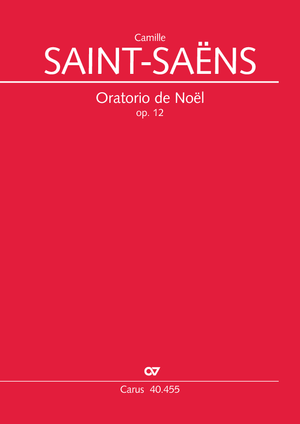
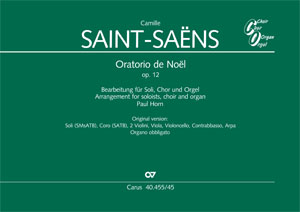
Oratorio de Noël (Christmas Oratorio)
Arragement for soloists, choir and organ (arr. P. Horn)
In 1858 Camille Saint-Saëns composed his Oratorio de Noël for five vocal soloists, mixed choir, strings, organ and harp. The work, sung in Latin, is based on texts from the Old and New Testaments, the Psalms and Gospels, as well as the Catholic Christmas liturgy. A distinctive chamber music-like instrumentation, with lyrical soloistic parts and a modest choral part combine to create a basic pastoral mood which has led this Christmas Oratorio to become one of the most performed works by Saint-Saëns. Carus offers this work both in its original version and in an arrangement in which the choir is accompanied solely by an organ.
Also abailable in the original verstion (Carus 40.455/00).
| Originalversion | Bearbeitung für Orgel |
| Soli SMsATB, Coro SATB, 2 Vl, Va, Vc, Cb, Org, Arpa | Soli SMsATB, Coro SATB, Org |



-
Composer
Camille Saint-Saëns
| 1835-1921Camille Saint-Saëns was a true multi-talent. He was a pianist, conductor, organist, musicologist, music teacher and composer and became famous above all for the Carnival of the Animals and the opera Samson et Dalila.
He composed his Symphony in A major at the age of 15 and was accepted to the University of Paris at the age of 16. Saint-Saëns studied piano, organ and composition at the Paris Conservatoire and became organist of Saint-Séverin in Paris in 1852. In the same year, he also met Franz Liszt, who subsequently exerted an influence on Saint-Saëns' compositional work. A year later, he celebrated his musical debut as a composer. The opera Samson et Dalila, which premiered in Weimar in 1877, brought him lasting success in opera houses to this day. His Christmas oratorio Oratorio de Noël, which is available from Carus-Verlag, is probably the best-known of his sacred works. Personal details
-
Arranger
Paul Horn
| 1922-2016Paul Horn war ein deutscher Kirchenmusiker, Organist, Komponist und Musikwissenschaftler. Er studierte Kirchenmusik und Orgel an der Evangelischen Kirchenmusikschule Esslingen am Neckar bei Hans-Arnold Metzger und Musikwissenschaft, Theologie und Geschichte an der Universität Tübingen. Seine berufliche Laufbahn begann als Kantor an der Evangelischen Michaelskirche in Stuttgart-Degerloch. 1954 wurde er Kantor an der Evangelischen Stadtkirche Ravensburg, eine Position, die er bis zu seiner Pensionierung innehatte. Als Musikwissenschaftler arbeitete Horn bis ins hohe Alter eng mit Carus zusammen. So stammen zahlreiche Carus-Klavierauszüge aus seiner Feder. Personal details
Reviews on our website can only be submitted by customers with a registered user account. A check whether the rated products were actually purchased does not take place.
Frequent questions about this work
 There are no questions and answers available so far or you were unable to find an answer to your specific question about this work? Then click here and send your specific questions to our Customer Services!