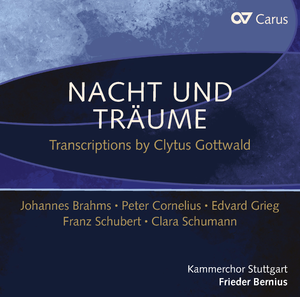
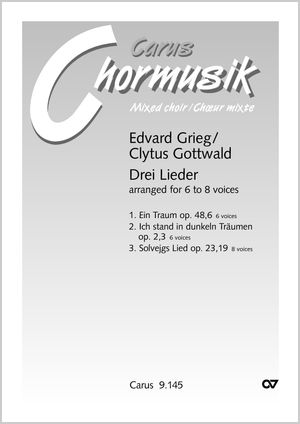
Drei Lieder
Vocal transcriptions by Clytus Gottwald
 View
View
 Listen
(3)
Listen
(3)
- Ein Traum
- Ich stand in dunklen Träumen
- Solvejgs Lied
 Additional material
- Purchase additional material as a download product.
-
 Digital text (without sheet music) incl. printing licence, html file, singing text, originalhtml file, singing text, original (Sample)Unbenanntes Dokument 1. Mir träumte einst ein schöner Traum
Mir träumte einst ein schöner Traum,
mich liebte eine blonde Maid;
es war am grünen Waldesraum,
es war zur warmen Frühlingszeit:Die Knospe sprang, der Waldbach schwoll,
fern aus dem Dorfe scholl Geläut,
wir waren ganzer Wonne voll,
versunken ganz in Seligkeit.Und schöner noch als einst der Traum
begab es sich in Wirklichkeit:
Es war am grünen Waldesraum,
es war zur warmen Frühlingszeit....
-
Digital text (without sheet music) incl. printing licence, html file, singing text, english translationhtml file, singing text, english translation (Sample)Unbenanntes Dokument 1. Once I dreamt a beautiful dream
Once I dreamt a beautiful dream,
a blond maiden did love me;
it was in a green forest glade,
it was in warm springtime.Buds were sprouting, the brook ran strong,
bells were ringing from the distant village,
we were full with joy,
immersed in bliss.And much more beautiful than was the dream
happened in reality:
it was in a green forest glade
it was in warm springtime....
-
Digital text (without sheet music) incl. printing licence, html file, singing text, french translationhtml file, singing text, french translation (Sample)Unbenanntes Dokument 1. Une fois j'ai fait un joli rêve
Une fois j’ai fait un joli rêve :
une jeune fille blonde m'aimait ;
c'était dans une clairière de la forêt verte,
il faisait un doux temps de printemps.Les bourgeons fleurissaient, le ruisseau de la
forêt coulait fort, / au loin les cloches du village
sonnaient, / nous étions tout pleins de joie,
immergés complètement dans le bonheur.Et encore plus beau que le rêve,
cela arrivait dans la réalité:
c’était dans une clairière de la forêt verte,
il faisait un doux temps de printemps....
Contents

-
Composer
Edvard Grieg
| 1843-1907Edvard Grieg wurde am 15. Juni 1843 als viertes von fünf Kindern in Bergen/Norwegen geboren. Er studierte von 1858 bis 1862 am Konservatorium in Leipzig Klavier und Komposition, nachdem er bereits früh von seiner Mutter, einer vorzüglichen Pianistin und Pädagogin, im Klavierspiel unterrichtet worden war. 1862 siedelte er nach Kopenhagen um, wo er 1864 zusammen mit Hans Christian Andersen und anderen Musikern die Konzertgesellschaft zur Pflege neuer skandinavischer Musik gründete. Er integrierte die Volksmusik seiner Heimat mittels derer typischen Elemente wie der Verwendung leerer Quinten, scharf betonter Tanzrhythmen und dem eigentümlichen Schwanken zwischen modalen und Dur-Molltonarten in die klassische Musik. Wichtige Impulse für die Herausbildung des nationalen Stils seiner Musik erhielt Grieg unter anderem von dem früh verstorbenen Komponisten der norwegischen Nationalhymne Rikard Nordraak. Griegs größte Bedeutung liegt in der Klavier- und Kammermusik. Jedoch schrieb er auch wertvolle Chor- und Liedliteratur, bei der es einiges zu entdecken gibt. Personal details
-
Arranger
Clytus Gottwald
| 1925-2023The choral conductor, composer and musicologist Clytus Gottwald (1925 - 2023) made significant contributions to contemporary choral music. As editor for New Music at Südfunk Stuttgart and founder and director of the Schola Cantorum Stuttgart, he was in productive exchange with his contemporaries, Pierre Boulez, Mauricio Kagel, György Ligeti, Luigi Nono, Karlheinz Stockhausen and many others. With his Schola Cantorum, a 16-voice chamber vocal ensemble, Gottwald decisively shaped the a cappella choral culture of the highest technical level that is taken for granted today. Clytus Gottwald's transcriptions of piano songs and instrumental pieces for unaccompanied choir are appreciated by choirs all over the world. Modelled on the style of Ligeti, his works set the highest of musical standards. Clytus Gottwald has received several awards for his services, including the Cultural Prize of Baden-Württemberg in 2009, the European Church Music Prize in 2012, and the Cross of Merit of the Federal Republic of Germany in 2014. His importance for the development of contemporary choral music cannot be overestimated. Personal details
Reviews on our website can only be submitted by customers with a registered user account. A check whether the rated products were actually purchased does not take place.
Frequent questions about this work
 There are no questions and answers available so far or you were unable to find an answer to your specific question about this work? Then click here and send your specific questions to our Customer Services!