Like Goethe in his West-östlicher Diwan, the author of the poem Zauberkreis, which formed the basis of this composition, also made a close study of oriental poetry. Was steht denn auf den hundert Blättern (What is written on the hundred sheets) is taken from the extensive collection Östliche Rosen published in 1822 by poet and philologist Friedrich Rückert. Fanny Hensel (née Mendelssohn) set the words to music in 1843: “dass Schönheit in sich selbst beschrieben hat einen Kreis, und keinen andern auch das Lieben zu finden weiß” (“that beauty has described a circle within itself, and love knows how to find no other”).
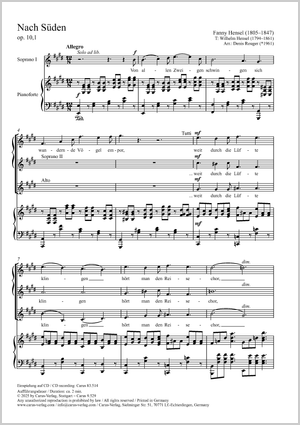
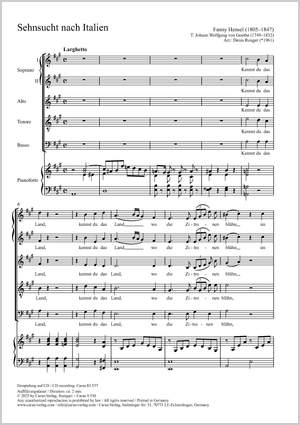
This art song was originally conceived for solo voice and piano rather than chamber choir. In his arrangement, Denis Rouger has carefully adapted it to the needs and expressive capabilities of a larger ensemble while at the same time preserving the character and qualities of the original. Each vocal part enjoys its own melodic line extracted from the harmonic and rhythmic framework. The variety and sophistication of this choral arrangement takes full account of the enormous flexibility in interpretation and expression demanded of soloist and pianist by French mélodies or German Lieder.
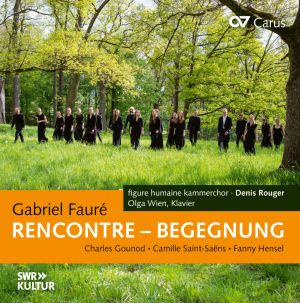
The song was recorded by figure humaine kammerchor on the CD Rencontre – Begegnung (Carus 83.537).
Explore



 Listen
(1)
Listen
(1)
- Zauberkreis
Purchase
Additional product information
-
Composer
Fanny Hensel
| 1805-1847Fanny Hensel (1805-1847), born Mendelssohn, was one of the most talented female composers of the Romantic period and an important representative of 19th century German musical life. As the sister of Felix Mendelssohn-Bartholdy, she grew up in an artistic environment that encouraged her musical development from an early age, but also confronted her with social restrictions due to her gender. In the 1830s and 1840s in particular, Fanny Hensel composed a large number of songs, piano and choral works and - despite the reservations of her father and brother - ultimately decided to gradually publish her music. In her family home in Berlin, a centre for musicians and intellectuals, she performed many of these works, which combine romantic emotionality with tonal sophistication, as part of the so-called Sunday music. On 14 May 1847, she suffered a stroke during rehearsals for one of her popular Sunday concerts and died just a few hours later. Her impressive œuvre, which comprises more than 460 compositions, is today regarded as a significant contribution to Romantic musical culture and is attracting increasing attention in concerts and academic studies.
Personal details
-
Songwriter / Librettist
Friedrich Rückert
| 1788-1866Friedrich Rückert, born 1788 in Schweinfurt, died 1866 near Coburg. Poet and translator. Professor of oriental philology in Erlangen. Personal details
-
Arranger
Denis Rouger
| 1961Denis Rouger gained his initial musical experience as the son of a Parisian family of musicians and during his studies at the Conservatoire National Supérieur de Musique de Paris, where he received first prizes in harmony, fugue and counterpoint.
He was a lecturer and choirmaster at the University of Paris-Sorbonne for 20 years and choirmaster at Notre-Dame de Paris Cathedral for 10 years. He is honorary conductor of the Parisian church La Madeleine. He also collaborates with numerous ensembles in Germany. He has been invited as a guest conductor by radio choirs, the Balthasar-Neumann-Chor, the Baden-Württemberg State Youth Choir and the Stuttgart Philharmonic Orchestra, among others. Concerts have taken him to Italy, the Netherlands, Canada, Russia, the United Arab Emirates and Switzerland (Lucerne Festival).
He gives master classes in Sweden, Bulgaria, France, Germany, as well as in Switzerland.
Denis Rouger has been Professor of Choral Conducting at the Stuttgart State University of Music and Performing Arts since 2011. The chamber choir he founded at the university in the fall of 2011 won first prize at the International Choir Competition in Mosbach (Germany) in 2014.
In addition to his work as a choirmaster, he composes and arranges French and German songs for choir. His arrangements on the CDs Kennst Du das Land ... and ... wo die Zitronen blühn (Carus) were well received by the press and radio. In collaboration with Carus-Verlag, he has edited the choir book Französische Chormusik, which received the German Music Edition Award “Best Edition” in 2019.
In 2016, Denis Rouger founded the figure humaine kammerchor (www.figurehumaine.de), with which he regularly gives concerts at renowned festivals.
Personal details
Reviews on our website can only be submitted by customers with a registered user account. A check whether the rated products were actually purchased does not take place.
No feedback available for this product.
Frequent questions about this work
 There are no questions and answers available so far or you were unable to find an answer to your specific question about this work? Then click here and send your specific questions to our Customer Services!