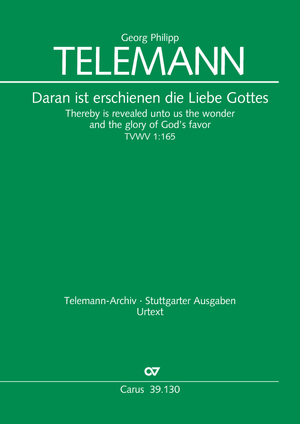
Thereby is revealed unto us the glory of God's favor
Kantate zum 2. Pfingsttag TVWV 1:165


-
Composer
Georg Philipp Telemann
| 1681-1767Telemann's extremely rich compositional output, the fruits of three quarters of a century's work, encompasses almost all genres of music; in his vocal works it ranges from songs with basso continuo accompaniment to chamber and church cantatas, and to opera. In his own assessment, church music played a central role in his output; he alone probably composed over 1,600 church cantatas, as well as cantata-style funeral music settings (such as Du aber, Daniel, gehe hin), psalm settings (for example, Deus judicium tuum) and oratorios. Throughout his works Telemann showed himself to be a progressive composer, open to new trends and keen to experiment whilst exploring new directions; not without reason was he called a forerunner of classicism. However, his compositions constitute only a part of his importance to music history: as a music publisher, the author of publications for teaching, the director of middle-class music societies and initiator of public concerts, he made a considerable contribution to creating the preconditions for the support of the musically-educated middle classes in the ensuing era of music. Personal details
-
Editor
Klaus Hofmann
| 1939
-
Continuo realization
Klaus Hofmann
| 1939
-
Translator
Robert Scandrett
| 1925-2014
Reviews
G
G. Ph. Telemann „Daran ist erschienen die liebe Gottes” TVWW 1:165
Die Solidität dieser Ausgabe bedarf keines weiteren Aus- oder Nachweises: die Namen sprechen für sich. Die Musik Telemanns spricht ebenfalls für sich: sie erwartet den höchst gewandten „beredten” Musiker, der weiß was er zu tun hat. Eine gute Musik nicht nur für das Pfingstfest, das leider mittlerweile auch in „katholischen Kreisen” unter kirchenmusikalischer Auszehrung zu leiden hat.
Quelle: Kirchenmusikalische Mitteilungen März 2001, S. 70
Telemann, Georg Philipp (1681-1767): Daran ist erschienen die Liebe Gottes
Der Chor ist allerdings „nur” beim Eingangs- und Schlusschor beschäftigt. Dazwischen verbergen sich zwei Arien, ein Duett, Rezitativ und Arioso e Rezitativo, die natürlich solistisch zu besetzten sind. Diese Erstausgabe ist mehr als nur eine von vielen barocken „Entdeckungen” vieler sogenannter Kleinmeister. Dies ist ein echter Telemann. Interessant wäre auch die geschmeidige englische Version von Robert Scandrett, die ebenfalls in dieser vorbildlichen Carus-Ausgabe enthalten ist. Mal was anderes.
Thilo Plaesser
Quelle: Musik im Bistum Essen 3/2000, S. 43
Reviews on our website can only be submitted by customers with a registered user account. A check whether the rated products were actually purchased does not take place.
Frequent questions about this work
 There are no questions and answers available so far or you were unable to find an answer to your specific question about this work? Then click here and send your specific questions to our Customer Services!