

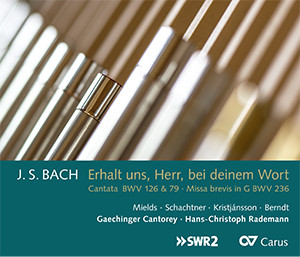
After the really well-known cantata "Ein feste Burg ist unser Gott" (A mighty fortress is our God) BWV 80, Bach’s only other cantata for Reformation Day is "Gott, der Herr, ist Sonn und Schild" (God the Lord is sun and shield) BWV 79. The central chorale movement "Nun danket alle Gott" has become extremely famous separately from the cantata. This movement is characterised by the catchy melody of the two horn parts with their interludes between the lines of the chorale. These in turn are taken from the freely-composed opening chorus, thus forming a surprising link between the movement for chorus and the chorale. The chorus and both the arias in the cantata were used later in a Latin parody in the so-called "Lutheran Masses".
Explore

 Listen
(6)
Listen
(6)
- Gott der Herr ist Sonn und Schild
- Gott ist unsre Sonn und Schild
- Nun danket alle Gott
- Gottlob! Wir wissen den rechten Weg
- Gott, ach Gott, verlass die Deinen nimmer mehr
- Erhalt uns in der Wahrheit
 Additional material
- Purchase additional material as a download product.
-
 Digital text (without sheet music) incl. printing licence, html file, singing text, english translationhtml file, singing text, english translation (Sample)
1. Coro God the Lord is sun and shield.
The Lord gives mercy and glory.
No good thing he withholds
from those walking upright.
Psalms 84:122. Aria (Alto) God the Lord is sun and shield.
Therefore praise his endless mercy
that he sheds upon the earthly:
give God thanks with heart and mind.
He is longing to protect us
when the enemy attacks us.
God controls the battlefield.3. Choral Now thank we all our God
with hearts and hands and voices,
who wondrous things has done,
in whom his world rejoices;
who, from our mothers’ arms,
...
-
Digital text (without sheet music) incl. printing licence, html file, singing text, originalhtml file, singing text, original (Sample)
1. Coro Gott der Herr ist Sonn und Schild,
der Herr gibt Gnade und Ehre.
Er wird kein Gutes mangeln lassen den Frommen.
Psalm 84,122. Aria (Alto) Gott ist unsre Sonn und Schild.
Darum rühmet dessen Güte
unser dankbares Gemüte,
die er für sein Häuflein hegt.
Denn er will uns ferner schützen,
ob die Feinde Pfeile schnitzen
und ein Lästerhund gleich billt.3. Choral Nun danket alle Gott
mit Herzen, Mund und Händen,
der große Dinge tut
an uns und allen Enden,
der uns von Mutterleib
und Kindesbeinen an
unzählig viel zugut
...
Purchase
Additional product information
Contents

-
Composer
Johann Sebastian Bach
| 1685-1750Johann Sebastian Bach is one of the most important composers of Western music history. He came from a widely ramified musical dynasty, which produced numerous musicians and organists in the Thuringian-Saxon area.
Bach vocal
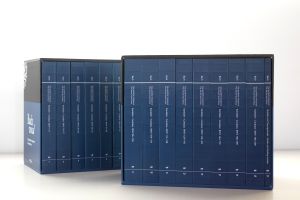
Ever since Carus-Verlag was founded in 1972, publishing the music of Johann Sebastian Bach has been a special focus for us. In the 2017 Reformation anniversary year we completed the Bach vocal project. Bach’s complete sacred vocal works are now available in modern “Urtext” editions, together with performance material. A complete edition of all the full scores is also available in a high quality box set.
Personal details
-
Editor
Uwe Wolf
| 1961As a musicologist, Dr. Uwe Wolf is particularly at home in the 17th and 18th centuries. The focus of his work ranges from the time of Monteverdi and Schütz to Bach and the generation of Bach's sons and pupils through to Viennese Classicism. He has been head of the editorial department at Carus-Verlag since October 2011. Prior to this, he worked in Bach research for over 20 years. Personal details
-
Continuo realization
Paul Horn
| 1922-2016Paul Horn war ein deutscher Kirchenmusiker, Organist, Komponist und Musikwissenschaftler. Er studierte Kirchenmusik und Orgel an der Evangelischen Kirchenmusikschule Esslingen am Neckar bei Hans-Arnold Metzger und Musikwissenschaft, Theologie und Geschichte an der Universität Tübingen. Seine berufliche Laufbahn begann als Kantor an der Evangelischen Michaelskirche in Stuttgart-Degerloch. 1954 wurde er Kantor an der Evangelischen Stadtkirche Ravensburg, eine Position, die er bis zu seiner Pensionierung innehatte. Als Musikwissenschaftler arbeitete Horn bis ins hohe Alter eng mit Carus zusammen. So stammen zahlreiche Carus-Klavierauszüge aus seiner Feder. Personal details
-
Translator
Jutta Wicker
Reviews on our website can only be submitted by customers with a registered user account. A check whether the rated products were actually purchased does not take place.
No feedback available for this product.
Frequent questions about this work
 There are no questions and answers available so far or you were unable to find an answer to your specific question about this work? Then click here and send your specific questions to our Customer Services!