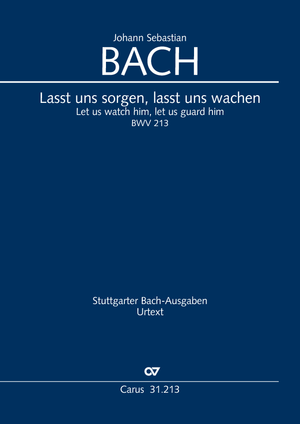
Let us watch him, let us guard him
Hercules at the crossroads (Dramma per musica) BWV 213, 1733
What does Bach’s Christmas Oratorio have to do with Hercules? More than you might think at first glance. In the fall of 1733, with the eleventh birthday of the Saxon Crown Prince Friedrich Christian fast approaching, Johann Sebastian Bach composed the secular cantata Lasst uns sorgen, lasst uns wachen (Let us watch him, let us guard him), which he then performed on the prince’s birthday (September 5) with the Collegium Musicum in the garden of Zimmermann’s coffeehouse in Leipzig.
The libretto by Picander tells the mythological story of the young Hercules, who, forced to choose between lust and virtue, naturally chooses the “right” path. The fact that Hercules is intended to represent the young Crown Prince is already suggested in the opening choral movement before becoming explicit in the closing chorus.
Most of the choruses and arias in the cantata are familiar today through their incorporation by Bach into his later Christmas Oratorio, BWV 248. For example, the festive opening chorus “Lasst uns sorgen, lasst uns wachen” (Let us watch him, let us guard him) forms the opening chorus “Fallt mit Danken, fallt mit Loben” (Bow ye, thankful, kneel and praise ye) of the New Year’s cantata. While the musical impact is no doubt altered by the unfamiliar thematic embedding, the audience is sure to make many pleasant rediscoveries!




Purchase
Additional product information
-
Composer
Johann Sebastian Bach
| 1685-1750Johann Sebastian Bach is one of the most important composers of Western music history. He came from a widely ramified musical dynasty, which produced numerous musicians and organists in the Thuringian-Saxon area.
Bach vocal
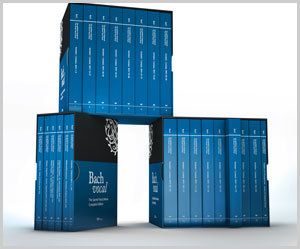
Ever since Carus-Verlag was founded in 1972, publishing the music of Johann Sebastian Bach has been a special focus for us. In the 2017 Reformation anniversary year we completed the Bach vocal project. Bach’s complete sacred vocal works are now available in modern “Urtext” editions, together with performance material. A complete edition of all the full scores is also available in a high quality box set.
Personal details
-
Editor
Uwe Wolf
| 1961As a musicologist, Dr. Uwe Wolf is particularly at home in the 17th and 18th centuries. The focus of his work ranges from the time of Monteverdi and Schütz to Bach and the generation of Bach's sons and pupils through to Viennese Classicism. He has been head of the editorial department at Carus-Verlag since October 2011. Prior to this, he worked in Bach research for over 20 years. Personal details
-
Songwriter / Librettist
Christian Friedrich Henrici (Picander)
| 1700-1764
-
Continuo realization
Daniel Ivo de Oliveira
-
Continuo realization
Paul Horn
| 1922-2016Paul Horn war ein deutscher Kirchenmusiker, Organist, Komponist und Musikwissenschaftler. Er studierte Kirchenmusik und Orgel an der Evangelischen Kirchenmusikschule Esslingen am Neckar bei Hans-Arnold Metzger und Musikwissenschaft, Theologie und Geschichte an der Universität Tübingen. Seine berufliche Laufbahn begann als Kantor an der Evangelischen Michaelskirche in Stuttgart-Degerloch. 1954 wurde er Kantor an der Evangelischen Stadtkirche Ravensburg, eine Position, die er bis zu seiner Pensionierung innehatte. Als Musikwissenschaftler arbeitete Horn bis ins hohe Alter eng mit Carus zusammen. So stammen zahlreiche Carus-Klavierauszüge aus seiner Feder. Personal details
Reviews on our website can only be submitted by customers with a registered user account. A check whether the rated products were actually purchased does not take place.
No feedback available for this product.
Frequent questions about this work
 There are no questions and answers available so far or you were unable to find an answer to your specific question about this work? Then click here and send your specific questions to our Customer Services!