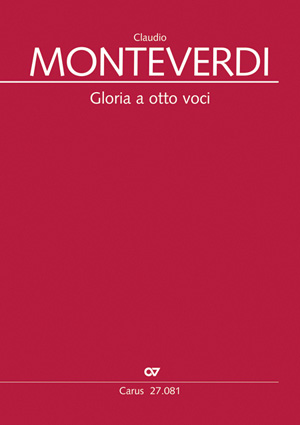
Gloria a otto voci
SV 307
The Gloria for two four-part choirs arid continuo is one of the few among his works which were not published during Monteverdi's lifetime but which have nevertheless survived the centuries. This richly fashioned composition, in which concertante passages for various groups of voices alternate with tutti sections, already suggests the later cantata mass. An artistic effect to be especially valued is the repetition of the joyful coloratura music of the opening section set to the concluding "in Gloria Dei Patris".
Explore
 View
View

Purchase
Additional product information
-
Composer
Claudio Monteverdi
| 1567-1643During his youth in Cremona, Monteverdi received his first musical training from Marc'Antonio Ingegneri, the maestro di cappella at the Cathedral. After making his name with his first publications, including his First Book of Madrigals, he moved to the Gonzaga court in Mantua in 1590: he remained in the service of the family for twenty-two years, first as singer and violist, and later as maestro di cappella. There he composed further books of madrigals and, with L'Orfeo in 1607, one of the earliest operas in the history of music. The Vespers of the Blessed Virgin were also written in Mantua in 1610. In 1613 became Monteverdi maestro di cappella at St Mark's in Venice. He spent thirty musically fruitful years in this post. He composed sacred works, but remained interested in secular music and published his most extensive secular collections with books six to eight of his Madrigals. After the opening of the Venice opera house in 1637, the first public opera house ever , he returned to composing opera once more: both of his late operas, Il ritorno d'Ulisse in Patria and L'incoronazione di Poppea received their first performances here. Personal details
-
Editor
Barbara Neumeier
| 1980
-
Continuo realization
Paul Horn
| 1922-2016Paul Horn war ein deutscher Kirchenmusiker, Organist, Komponist und Musikwissenschaftler. Er studierte Kirchenmusik und Orgel an der Evangelischen Kirchenmusikschule Esslingen am Neckar bei Hans-Arnold Metzger und Musikwissenschaft, Theologie und Geschichte an der Universität Tübingen. Seine berufliche Laufbahn begann als Kantor an der Evangelischen Michaelskirche in Stuttgart-Degerloch. 1954 wurde er Kantor an der Evangelischen Stadtkirche Ravensburg, eine Position, die er bis zu seiner Pensionierung innehatte. Als Musikwissenschaftler arbeitete Horn bis ins hohe Alter eng mit Carus zusammen. So stammen zahlreiche Carus-Klavierauszüge aus seiner Feder. Personal details
Reviews
2708100
Das Werk kann sowohl solistisch als auch chorisch aufgeführt werden. Die Ausführung des Continuoparts mit Orgel liegt stilistisch nahe...
Toccatta 01/02/2016
Reviews on our website can only be submitted by customers with a registered user account. A check whether the rated products were actually purchased does not take place.
No feedback available for this product.
Frequent questions about this work
 There are no questions and answers available so far or you were unable to find an answer to your specific question about this work? Then click here and send your specific questions to our Customer Services!