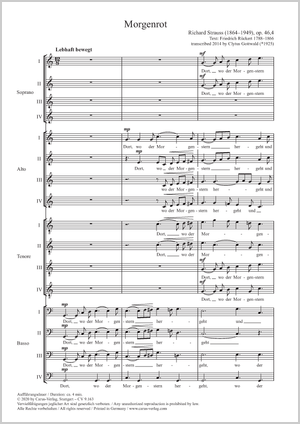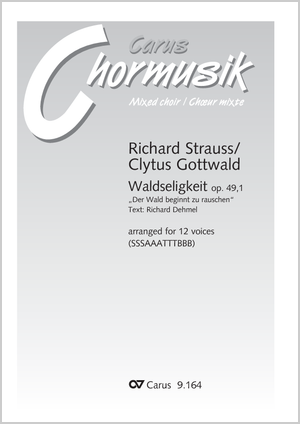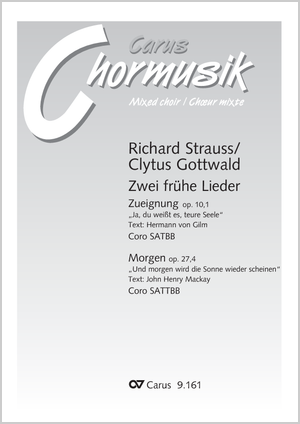
Two Early Songs. Vocal transcriptions by Clytus Gottwald
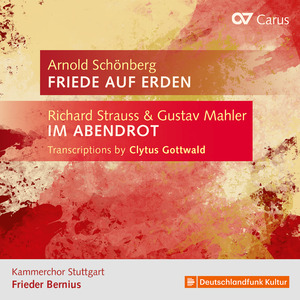
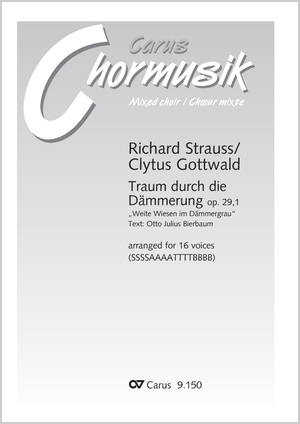
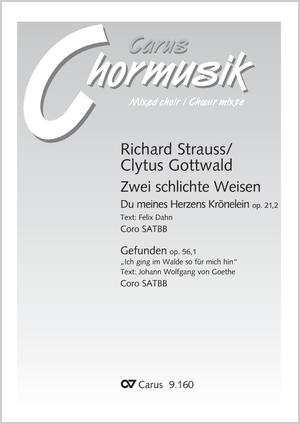
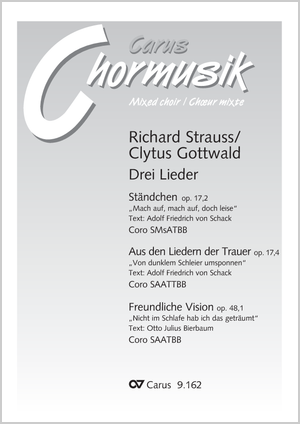
For almost 30 years the conductor and musicologist Clytus Gottwald made transcriptions of songs and instrumental pieces for unaccompanied choir by a wide variety of different composers. They are performed throughout the world with huge success.
Richard Strauss left a wealth of wonderfully sensitive and subtle songs from all decades of his compositional output, many of them written specifically for his wife, the singer Pauline Strauss-de Ahna
 View
View
 Listen
(2)
Listen
(2)
- Dedication
- Tomorrow
 Additional material
- Purchase additional material as a download product.
-
 Digital text (without sheet music) incl. printing licence, html file, singing text, originalhtml file, singing text, original (Sample)Unbenanntes Dokument Zueignung
Ja, du weißt es, teure Seele,
dass ich fern von dir mich quäle,
Liebe macht die Herzen krank,
habe Dank.Einst hielt ich, der Freiheit Zecher,
hoch den Amethystenbecher,
und du segnetest den Trank,
habe Dank.Und beschworst darin die Bösen,
bis ich, was ich nie gewesen,
heilig ans Herz dir sank,
habe Dank....
-
Digital text (without sheet music) incl. printing licence, html file, singing text, english translationhtml file, singing text, english translation (Sample)Unbenanntes Dokument Dedication
Yes, you know it, precious soul,
how I suffer, faraway from you,
love sickens hearts,
give thanks.Once did I, the drinker of freedom,
raise high my amethyst cup,
and you blessed the drink,
give thanks.And you conjured up the evil within it,
till I, as I had never been before,
sank, blessed upon your heart,
give thanks....
-
Digital text (without sheet music) incl. printing licence, html file, singing text, french translationhtml file, singing text, french translation (Sample)Unbenanntes Dokument Dédicace
Oui, tu le sais, chère âme,
Être loin de toi me torture,
L’amour rend les coeurs malades,
Merci à toi.Assoiffé de liberté,
Je levai alors la coupe d’améthyste,
Et tu en bénis le breuvage,
Merci à toi.Et tu y conjuras les démons,
Jusqu’à ce que je me répandisse en ton coeur,
Pur comme je ne l’avais jamais été,
Merci à toi....
Contents

-
Composer
Richard Strauss
| 1864-1949The son of musician Franz Joseph Strauss and his wife Josephine began composing at the age of six, and by his 18th birthday he had already written around 140 pieces, including almost 60 songs and over 40 piano works. His stellar career began in 1881 with his opus 1, the Festive March for large orchestra. In 1886, Strauss took up a position as third conductor at the Court Opera in his hometown of Munich. There he had time to deepen his repertoire. In the following four years, he composed numerous songs, including Ständchen op. 17,2, which was published by Carus-Verlag together with Von dunklem Schleier umsponnen op. 17,4 and Nicht im Schlafe hab ich das geträumt op. 48,1. In 1905 and many song compositions later, the already celebrated Richard Strauss also wrote a success story with an opera. The opera adaptation of Oscar Wild's Salome, whose text Strauss himself translated into German, is regarded by his fans as the epitome of modern opera music. Personal details
-
Arranger
Clytus Gottwald
| 1925-2023The choral conductor, composer and musicologist Clytus Gottwald (1925 - 2023) made significant contributions to contemporary choral music. As editor for New Music at Südfunk Stuttgart and founder and director of the Schola Cantorum Stuttgart, he was in productive exchange with his contemporaries, Pierre Boulez, Mauricio Kagel, György Ligeti, Luigi Nono, Karlheinz Stockhausen and many others. With his Schola Cantorum, a 16-voice chamber vocal ensemble, Gottwald decisively shaped the a cappella choral culture of the highest technical level that is taken for granted today. Clytus Gottwald's transcriptions of piano songs and instrumental pieces for unaccompanied choir are appreciated by choirs all over the world. Modelled on the style of Ligeti, his works set the highest of musical standards. Clytus Gottwald has received several awards for his services, including the Cultural Prize of Baden-Württemberg in 2009, the European Church Music Prize in 2012, and the Cross of Merit of the Federal Republic of Germany in 2014. His importance for the development of contemporary choral music cannot be overestimated. Personal details
Reviews on our website can only be submitted by customers with a registered user account. A check whether the rated products were actually purchased does not take place.
Frequent questions about this work
 There are no questions and answers available so far or you were unable to find an answer to your specific question about this work? Then click here and send your specific questions to our Customer Services!