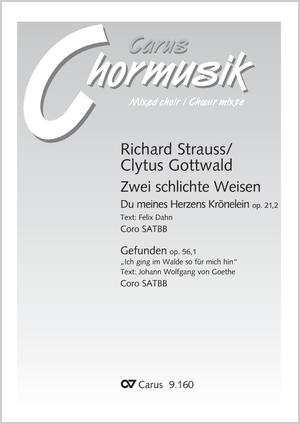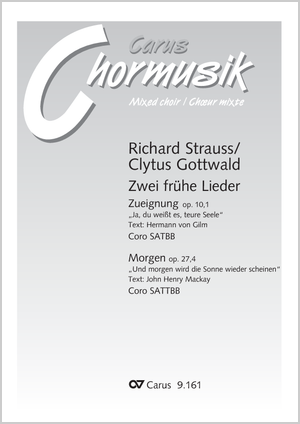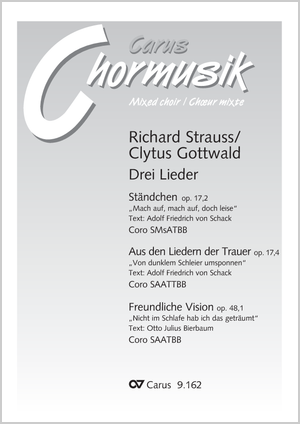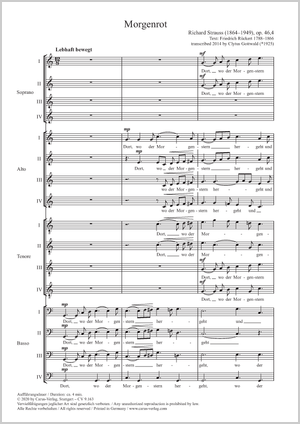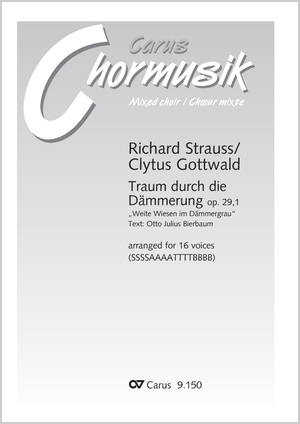
Dream through the Twilight. Vocal transcription by Clytus Gottwald
Vokaltranskription von Clytus Gottwald op. 29,1
For almost 30 years the conductor and musicologist Clytus Gottwald has made transcriptions of songs and instrumental pieces for unaccompanied choir by a wide variety of different composers, which have been performed throughout the world with huge success. Richard Strauss left a wealth of wonderfully sensitive and subtle songs from all decades of his compositional output, many of them written specifically for his wife, the singer Pauline Strauss-de Ahna.
Explore
 View
View
 Listen
(1)
Listen
(1)
- Dream through the Twilight. Vocal transcription by Clytus Gottwald
 Additional material
- Purchase additional material as a download product.
-
 Digital text (without sheet music) incl. printing licence, html file, singing text, originalhtml file, singing text, original (Sample)Traum durch die Dämmerung
Weite Wiesen im Dämmergrau;
die Sonne verglomm, die Sterne ziehn,
nun geh ich hin zu der schönsten Frau,
weit über Wiesen im Dämmergrau,
tief in den Busch von Jasmin.
Durch Dämmergrau in der Liebe Land;
ich gehe nicht schnell, ich eile nicht;
mich zieht ein weiches, samtenes Band
durch Dämmergrau in der Liebe Land,
in ein blaues, mildes Licht.Otto Julius Bierbaum
...
-
Digital text (without sheet music) incl. printing licence, html file, singing text, english translationhtml file, singing text, english translation (Sample)Dream in the twilight Vast meadows in gray of twilight;
the sun dies away, the stars move on,
now I go to the most beautiful woman,
far over meadows in gray of twilight,
deep into the bush of jasmine.
Through gray of twilight in the land of love; I move, not quickly, I hurry not;
I am drawn by a tender, velvet bond, through gray of twilight in love’s land,
into a blue, soft light.Otto Julius Bierbaum
Translation: Earl Rosenbaum
...
-
Digital text (without sheet music) incl. printing licence, html file, singing text, french translationhtml file, singing text, french translation (Sample)Rêve au crépuscule
Vastes prairies dans le gris du crépuscule ;
le soleil s’éteint, les étoiles s’élèvent,
je vais à la rencontre de la plus belle des femmes,
par les vastes prairies dans le gris du crépuscule,
au plus profond du bosquet de jasmin.Dans le gris du crépuscule au pays de l’amour ;
je ne vais pas vite, je ne me hâte pas ;
un doux ruban de velours me guide
dans le gris du crépuscule au pays de l’amour,
vers une douce lumière bleutée.Otto Julius Bierbaum
Traduction: Sylvie Coquillat
...
Purchase
Additional product information
-
Composer
Richard Strauss
| 1864-1949The son of musician Franz Joseph Strauss and his wife Josephine began composing at the age of six, and by his 18th birthday he had already written around 140 pieces, including almost 60 songs and over 40 piano works. His stellar career began in 1881 with his opus 1, the Festive March for large orchestra. In 1886, Strauss took up a position as third conductor at the Court Opera in his hometown of Munich. There he had time to deepen his repertoire. In the following four years, he composed numerous songs, including Ständchen op. 17,2, which was published by Carus-Verlag together with Von dunklem Schleier umsponnen op. 17,4 and Nicht im Schlafe hab ich das geträumt op. 48,1. In 1905 and many song compositions later, the already celebrated Richard Strauss also wrote a success story with an opera. The opera adaptation of Oscar Wild's Salome, whose text Strauss himself translated into German, is regarded by his fans as the epitome of modern opera music. Personal details
-
Songwriter / Librettist
Otto Julius Bierbaum
| 1865-1910
-
Arranger
Clytus Gottwald
| 1925-2023The choral conductor, composer and musicologist Clytus Gottwald (1925 - 2023) made significant contributions to contemporary choral music. As editor for New Music at Südfunk Stuttgart and founder and director of the Schola Cantorum Stuttgart, he was in productive exchange with his contemporaries, Pierre Boulez, Mauricio Kagel, György Ligeti, Luigi Nono, Karlheinz Stockhausen and many others. With his Schola Cantorum, a 16-voice chamber vocal ensemble, Gottwald decisively shaped the a cappella choral culture of the highest technical level that is taken for granted today. Clytus Gottwald's transcriptions of piano songs and instrumental pieces for unaccompanied choir are appreciated by choirs all over the world. Modelled on the style of Ligeti, his works set the highest of musical standards. Clytus Gottwald has received several awards for his services, including the Cultural Prize of Baden-Württemberg in 2009, the European Church Music Prize in 2012, and the Cross of Merit of the Federal Republic of Germany in 2014. His importance for the development of contemporary choral music cannot be overestimated. Personal details
Reviews on our website can only be submitted by customers with a registered user account. A check whether the rated products were actually purchased does not take place.
No feedback available for this product.
Frequent questions about this work
 There are no questions and answers available so far or you were unable to find an answer to your specific question about this work? Then click here and send your specific questions to our Customer Services!