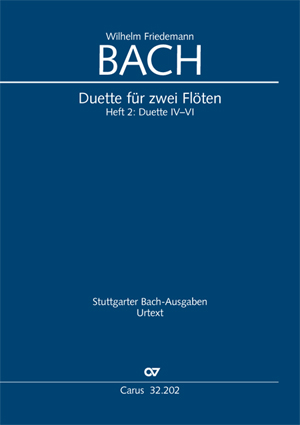
Duette für zwei Flöten, Band 2
The six flute duets were obviously conceived as a self-contained set of works and are published in two volumes. The six works reveal W. F. Bach's supreme mastery of contrapuntal writing. The uncompromising professional standards are documented in the harmonic and polyphonic audacity of the pieces, just as they are in the technical difficulties that Bach demands of performers. Almost no other composer since J. S. Bach has developed the art of two-part writing, with such a high degree of harmonic agility, melodic flow and formal elegance, to the level that Wilhelm Friedemann Bach achieved in these six compositions which, in a certain sense, represent a summation of his life's work.



Purchase
Additional product information

-
Composer
Wilhelm Friedemann Bach
| 1710-1784Wilhelm Friedemann Bach, the oldest son of Johann Sebastian, enjoyed the reputation of an outstanding, but at the same time one of the most independent-minded composers of his age. His work represents the ambitious attempt to absorb the legacy of his father and to develop the taste of his own generation further. Lofty artistic ambitions are to be found in almost all of W. F. Bach's works – from the early piano pieces via the cantatas of his middle period to the late sonatas and fantasias. Wilhelm Friedemann Bach wrote keyboard and chamber music, concertos and sacred cantatas. On a high level of technical ability he created a fascinating synthesis of baroque complexities and the emotionally charged galant style. While his instrumental works were written for the most part in Dresden (1733–1746) and Berlin (1774–1784) and are in the style of splendid courtly music, the vocal works date from his time as organist and director of music at the Marktkirche in Halle (1746–1764); they are distinguished by their expressive boldness and virtuosity. Personal details
Reviews
Die sechs Flötenduette von Wilhelm Friedemann Bach gehören zu dem schönsten, was im Spätbarock [...] für Traversflöte geschrieben wurde.
Inés Zimmermann, Tibia Nr. 4/2012
Ces six sonates sont les duos les plus expressifs, les plus ambitieux et les mieux écrits pour la flûtes de cette époques.
Traversières, N°103, 2012
Reviews on our website can only be submitted by customers with a registered user account. A check whether the rated products were actually purchased does not take place.
No feedback available for this product.
Frequent questions about this work
 There are no questions and answers available so far or you were unable to find an answer to your specific question about this work? Then click here and send your specific questions to our Customer Services!