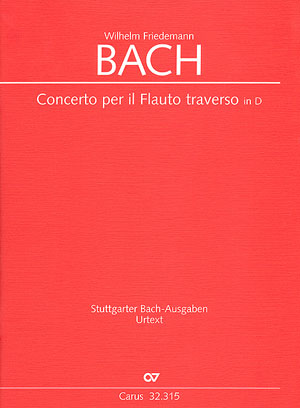
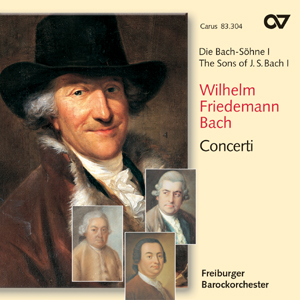
With the first appearance of this three-movement concerto for flute, 2 violins, viola and basso continuo, Wilhelm Friedemann Bach’s only surviving flute concerto is made accessible to a wider musical audience. The transparent delicacy of the composition is visible in the orchestral movement. Almost continuously written in 3 parts the concerto clearly bears the individual artistic traits of the eldest of Bach’s sons. The critical edition is based on the only known source, from the library of the ‘Berliner Singakademie’, will be contained in volume IV/2 of the complete edition of Wilhelm Friedemann Bach’s works.
Explore


 Listen
(4)
Listen
(4)
- Un poco Allegro
- Un poco Allegro
- Largo
- Vivace
Purchase
Additional product information
Contents
-
Composer
Wilhelm Friedemann Bach
| 1710-1784Wilhelm Friedemann Bach, the oldest son of Johann Sebastian, enjoyed the reputation of an outstanding, but at the same time one of the most independent-minded composers of his age. His work represents the ambitious attempt to absorb the legacy of his father and to develop the taste of his own generation further. Lofty artistic ambitions are to be found in almost all of W. F. Bach's works – from the early piano pieces via the cantatas of his middle period to the late sonatas and fantasias. Wilhelm Friedemann Bach wrote keyboard and chamber music, concertos and sacred cantatas. On a high level of technical ability he created a fascinating synthesis of baroque complexities and the emotionally charged galant style. While his instrumental works were written for the most part in Dresden (1733–1746) and Berlin (1774–1784) and are in the style of splendid courtly music, the vocal works date from his time as organist and director of music at the Marktkirche in Halle (1746–1764); they are distinguished by their expressive boldness and virtuosity. Personal details
-
Editor
Peter Wollny
| 1961
-
Editor
Sergej Kudriachov
Reviews
Wilhelm Friedemann Bach: Concerto per il Flauto tTaverso in D BR WFB C 15
Wilhelm Friedemann Bach: Concerto per il Flauto tTaverso in D BR WFB C 15
Three recordings of this concerto have reached us so far, the last (from Carus) proclaiming itself as the first (see p. 21). The work itself has appeared in various catalogues, but was not taken seriously since the source is anonymous, apart from a late, implausible ascription to Quantz. The Quantz thematic catalogue hives it off as QV 5: Anh.6; the W. F. Bach catalogue by Falck (1913) calls it spurious, a judgment with which Peter Wollny agreed in his 1993 Harvard thesis on WFB. There is some objective reason for the ascription: WFB’s hand in the figuring of the continuo part was noticed two centuries ago. But study of the music (plus, a cynical observer might surmise, a desire to exploit the rediscovery of the Sing-Akademie library in Kiev) convinces Wollny, and probably the listener to any of the recordings, that the ascription is at least plausible, perhaps more. This edition is an extract from a future vol. IV / 2 of a projected complete edition of WFB, so editorial commentary is deferred to that. Assuming that parts are available, it is a valuable addition to the flautist’s repertoire; the accompaniment is for strings and harpsichord.
Quelle: Early Music Review April 2003
Reviews on our website can only be submitted by customers with a registered user account. A check whether the rated products were actually purchased does not take place.
No feedback available for this product.
Frequent questions about this work
 There are no questions and answers available so far or you were unable to find an answer to your specific question about this work? Then click here and send your specific questions to our Customer Services!