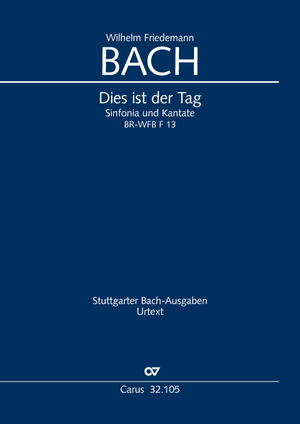
This is the day
Symphony and cantata BR-WFB F 13
Eine - bis auf den Schlusschoral - rein solistische Pfingstkantate des ältesten Bach-Sohnes ist eine lohnende "Ausgrabung", da man Wilhelm Friedemann, wenn überhaupt, dann vor allem als Instrumentalkomponist kennt (Konzerte, Sinfonien, Orgel- und Cembalomusik). Der Kantate vorangestellt ist eine ebenfalls aus Bachs Hallenser Zeit stammende dreisätzige Sinfonia, die mit ihren 2 Oboen und Hörnern bestens geeignet ist, in die festliche Pfingstkantate einzustimmen. Auch als eigenes Orchesterstück ist die Sinfonia ein attraktiver Programmpunkt.
Explore
 View
View

Purchase
Additional product information
-
Composer
Wilhelm Friedemann Bach
| 1710-1784Wilhelm Friedemann Bach, the oldest son of Johann Sebastian, enjoyed the reputation of an outstanding, but at the same time one of the most independent-minded composers of his age. His work represents the ambitious attempt to absorb the legacy of his father and to develop the taste of his own generation further. Lofty artistic ambitions are to be found in almost all of W. F. Bach's works – from the early piano pieces via the cantatas of his middle period to the late sonatas and fantasias. Wilhelm Friedemann Bach wrote keyboard and chamber music, concertos and sacred cantatas. On a high level of technical ability he created a fascinating synthesis of baroque complexities and the emotionally charged galant style. While his instrumental works were written for the most part in Dresden (1733–1746) and Berlin (1774–1784) and are in the style of splendid courtly music, the vocal works date from his time as organist and director of music at the Marktkirche in Halle (1746–1764); they are distinguished by their expressive boldness and virtuosity. Personal details
-
Editor
Paul Horn
| 1922-2016Paul Horn war ein deutscher Kirchenmusiker, Organist, Komponist und Musikwissenschaftler. Er studierte Kirchenmusik und Orgel an der Evangelischen Kirchenmusikschule Esslingen am Neckar bei Hans-Arnold Metzger und Musikwissenschaft, Theologie und Geschichte an der Universität Tübingen. Seine berufliche Laufbahn begann als Kantor an der Evangelischen Michaelskirche in Stuttgart-Degerloch. 1954 wurde er Kantor an der Evangelischen Stadtkirche Ravensburg, eine Position, die er bis zu seiner Pensionierung innehatte. Als Musikwissenschaftler arbeitete Horn bis ins hohe Alter eng mit Carus zusammen. So stammen zahlreiche Carus-Klavierauszüge aus seiner Feder. Personal details
Reviews on our website can only be submitted by customers with a registered user account. A check whether the rated products were actually purchased does not take place.
No feedback available for this product.
Frequent questions about this work
 There are no questions and answers available so far or you were unable to find an answer to your specific question about this work? Then click here and send your specific questions to our Customer Services!