Praise of Music

Praise of Music

Music accompanies us in every aspect of life. It comforts us, inspires us, unites us, and lifts us up. For centuries, composers have expressed its extraordinary effect by praising music through music itself.

We’ve compiled a selection of magnificent choral works for you. Some were composed in honor of St. Cecilia, the patron saint of music. Others celebrate the power of music in other spiritual or secular contexts and describe its ability to transform sorrow, ignite love, or move hearts. Let these masterworks inspire your next concert program!


  • Beethoven: Fantasie, Op. 80

    When on music's mighty pinion

    Souls of men to heaven rise,

    Then doth vanish earth's dominion,

    Man is native to the skies.

    Beethoven’s Fantasy for Piano, Choir, and Orchestra is a hymn to music itself. After a virtuoso piano introduction, a lively dialogue develops between the piano and orchestra, culminating in a jubilant choral finale, which is often interpreted as a precursor to the Ode to Joy in his Ninth Symphony.


  • Høybye: Let the Music Flow

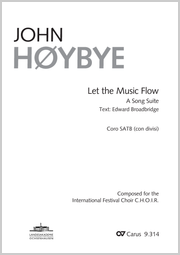
    Let the Music Flow by John Høybye was premiered at the international choir festival C.H.O.I.R. 2024. It celebrates the joyful shared experience of singing together. Edward Broadbridge’s text describes how individual voices unite and music becomes a tangible force of peace and human connection. Høybye fuses jazzy harmonies and energetic rhythms in a hymn to music full of joie de vivre and good humor.

  • Purcell: Hail! Bright Cecilia

    “Hail! Bright Cecilia, hail to thee. Great patroness of us and harmony!”
    With these words Purcell's magnificent ode honors St. Cecilia. Beginning in 1683, the London Musical Society performed festive music every year on November 22, St. Cecilia's Day. Purcell wrote several odes for this occasion, of which Hail! Bright Cecilia was his last, most expansive, and probably also most popular. This paean to the power of music is one of the highlights of English choral odes of that era.


  • Purcell: If Music Be the Food of Love

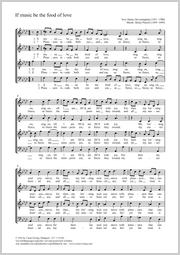
    Purcell’s secular works also celebrate music as a creative and moving force. If Music Be the Food of Love, one of his best-known songs, is available from Carus in a four-part choral arrangement. Featuring a heartfelt melody that still captivates listeners today, Purcell captures the notion of poet Colonel Henry Heveningham that music is both the expression and the nourishment of love. 

  • Hensel: Wer will mir wehren zu singen

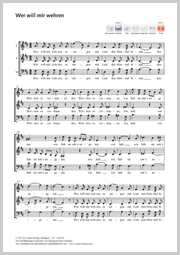
    Fanny Hensel's song Wer will mir wehren zu singen (Who will keep me from singing?) is a lively setting of Goethe's poem Unvermeidlich (Inevitable) for soprano, alto, and a male voice. The lilting 6/8 rhythm and the flowing melody underscore the optimistic message of the text about the freedom of artistic expression. Our single editions are available in D major and E-flat major.

  • Gounod: Messe solennelle de sainte Cécile

    In 1855 Gounod composed a mass in honor of St. Cecilia that soon became known far beyond the borders of France and achieved a popularity matched by few other sacred compositions. In his St. Cecilia Mass Gounod combines sublime simplicity with operatic drama and vivid orchestral color. Even during Gounod’s lifetime, several arrangements for smaller forces appeared, including a version for equal voices with organ/piano.

  • Handel: Alexander's Feast

    The full title of John Dryden's text spells out the theme: Alexander's Feast, or, The Power of Musick. This power is depicted in a feast celebrated by Alexander the Great after his victory over the Persians. In his songs about the events the singer Timotheus arouses powerful emotions – jubilation, compassion, love, revenge – and he is ultimately hailed as a forerunner of St. Cecilia. The wide emotional range of the text provided Handel with rich material for vivid musical contrasts and expressive tone painting.

  • Handel: Ode for St. Cecilia's Day

    Georg Friedrich Handel revived the tradition of Cecilian celebrations in London, and his Ode for St. Cecilia's Day, a festive hymn in praise of music, was composed for this occasion. Two magnificent choruses frame several arias in which Handel highlights the timbres of individual instruments. His own instrument, the organ, shines with particular virtuosic radiance. The ode was performed on St. Cecilia's Day in 1739 as the third part of Alexander's Feast. A recording of this version conducted by Peter Neumann is available from Carus.

  • Wolfram Buchenberg: Liebes-Lied

    Rilke’s poem Liebes-Lied (Love Song) pictures the love between two people as two strings on a stringed instrument vibrating in unison. Buchenberg takes up this image in his delictate, ethereal setting for eight-part choir – a parable of love in which music acts as the ultimate binding force.

  • Weber: Missa sancta No. 2 (Missa Jubilea)

    Carl Maria von Weber is best known as an opera composer, but as Kapellmeister of the Court Theater in Dresden he also wrote sacred music. His so-called Missa Jubilea, now known as the Jubel-Messe or Jubilation Mass, was written for the festive church service celebrating the golden wedding anniversary of the Saxon royal couple. Upon completing it, Weber wrote in his diary, “Mass completely finished. Glory be to God in the highest. To Him alone be thanks and praise” – a testimony to Weber's deep conviction that his artistic talents were a gift from heaven.

  • Palestrina: Missa Papae Marcelli

    The Missa Papae Marcelli is one of the best-known works of the Renaissance. The myth that it saved polyphonic church music from being banned by the Council of Trent is now considered disproved, but it permanently shaped Palestrina's image as the “savior of church music.” In the 19th and early 20th centuries, followers of the Cecilian reforms regarded his style as the ideal of liturgical church music. To this day the mass continues to fascinate listeners with its combination of complex polyphony and clear text setting. For choirs wishing to explore this style, the individual movements of the mass are also available separately (Carus 27.906/10 – /70).