Explore


Purchase
Additional product information
-
Composer
Anton Bruckner
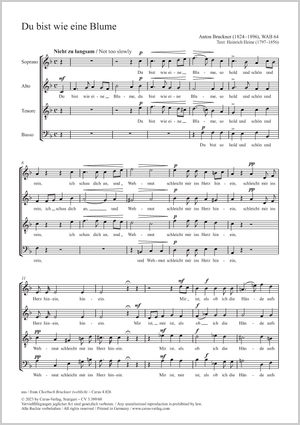
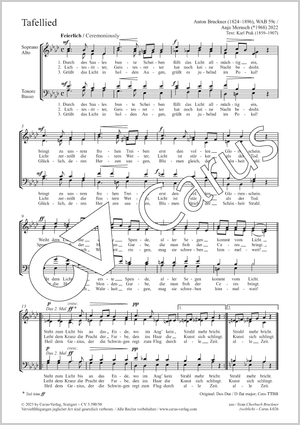
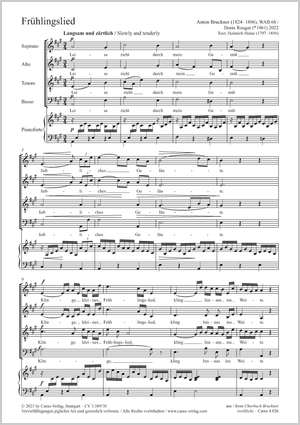
| 1824-1896Anton Bruckner was born in Ansfelden (Austria) in 1824 and did not have a particularly easy life. The Austrian composer came from a simple, rural background and was plagued by self-doubt throughout his life. After the death of his father, he was accepted as a choirboy at St Florian's Abbey at the age of 13. After several years as a school assistant and self-taught organ and piano studies, he initially worked as an organist in St Florian. In 1855 he was appointed cathedral organist in Linz. After an introduction to music theory and instrumentation by Simon Sechter and Otto Kitzler, Bruckner discovered Richard Wagner as an artistic role model, whom he admired throughout his life and also visited several times in Bayreuth.
In 1868 Anton Bruckner became professor of basso continuo, counterpoint and organ at the Vienna Conservatory, ten years later court organist. In 1891 he was awarded an honorary doctorate from the University of Vienna. He was regarded as an important organ virtuoso of his time, but his compositional recognition was a long time coming. It was not until the Symphony No. 7 in E major, composed between 1881 and 1883, with the famous Adagio, which was written under the impression of Wagner's death, that he received the recognition he had hoped for, even if he did not want to accept it in view of his tendency towards scepticism and self-criticism.
Anton Bruckner was a solitary composer who did not want to follow any school or doctrine. He wrote both sacred and secular works in all their facets. In addition to numerous motets, Bruckner composed three masses, the Missa Solemnis in B flat minor (1854) and the Te Deum (1881-84; CV 27.190/00), which is available from Carus-Verlag. As a symphonist, he wrote a total of nine symphonies and many symphonic studies from 1863 onwards, whereby he tended to revise finished versions several times. Bruckner's orchestral works were long considered unplayable, but for the tonal language of their time they were merely unusually bold sound monuments on the border between late Romanticism and Modernism, uniting traditions from Beethoven to Wagner and folk music.
Personal details
-
Songwriter / Librettist
Heinrich Heine
| 1797-1856Heinrich Heine (1797–1856) is regarded as one of the most important German poets of the 19th century. He was born in Düsseldorf and is best known for his lyric poetry, which combines Romanticism with sharp social criticism. Many of his works deal with love, nature and freedom. Because of his political views, Heine lived in exile in Paris for many years.
He also occupies a prominent place in the history of music. His lyrical texts were set to music by numerous composers and had a particularly profound influence on the Romantic art song. Robert Schumann, Franz Schubert, Felix Mendelssohn Bartholdy and Hugo Wolf, in particular, created musical works of enduring significance based on Heine’s poems. The poetic combination of linguistic simplicity, emotional depth and often ironic ambiguity offered composers a wide range of possibilities for musical interpretation. As a result, Heine’s poetry became a central part of the Romantic art-song repertoire and continues to influence vocal music to this day.
Personal details
-
Arranger
Denis Rouger
| 1961Denis Rouger gained his initial musical experience as the son of a Parisian family of musicians and during his studies at the Conservatoire National Supérieur de Musique de Paris, where he received first prizes in harmony, fugue and counterpoint.
He was a lecturer and choirmaster at the University of Paris-Sorbonne for 20 years and choirmaster at Notre-Dame de Paris Cathedral for 10 years. He is honorary conductor of the Parisian church La Madeleine. He also collaborates with numerous ensembles in Germany. He has been invited as a guest conductor by radio choirs, the Balthasar-Neumann-Chor, the Baden-Württemberg State Youth Choir and the Stuttgart Philharmonic Orchestra, among others. Concerts have taken him to Italy, the Netherlands, Canada, Russia, the United Arab Emirates and Switzerland (Lucerne Festival).
He gives master classes in Sweden, Bulgaria, France, Germany, as well as in Switzerland.
Denis Rouger has been Professor of Choral Conducting at the Stuttgart State University of Music and Performing Arts since 2011. The chamber choir he founded at the university in the fall of 2011 won first prize at the International Choir Competition in Mosbach (Germany) in 2014.
In addition to his work as a choirmaster, he composes and arranges French and German songs for choir. His arrangements on the CDs Kennst Du das Land ... and ... wo die Zitronen blühn (Carus) were well received by the press and radio. In collaboration with Carus-Verlag, he has edited the choir book Französische Chormusik, which received the German Music Edition Award “Best Edition” in 2019.
In 2016, Denis Rouger founded the figure humaine kammerchor (www.figurehumaine.de), with which he regularly gives concerts at renowned festivals.
Personal details
Reviews on our website can only be submitted by customers with a registered user account. A check whether the rated products were actually purchased does not take place.
No feedback available for this product.
Frequent questions about this work
 There are no questions and answers available so far or you were unable to find an answer to your specific question about this work? Then click here and send your specific questions to our Customer Services!