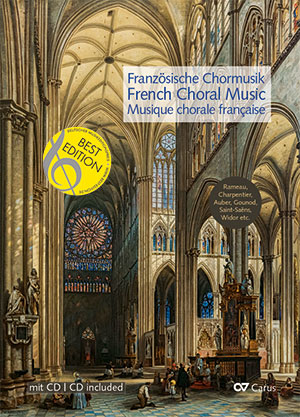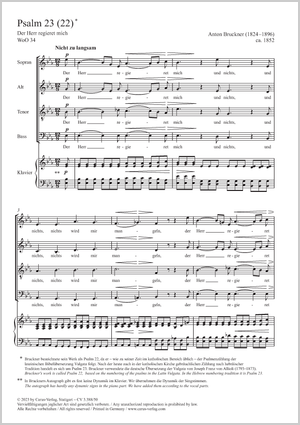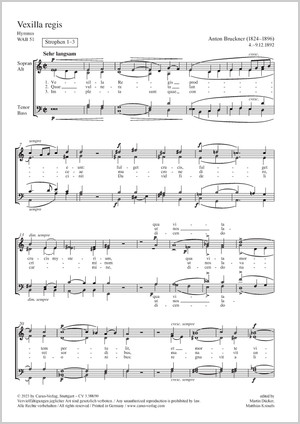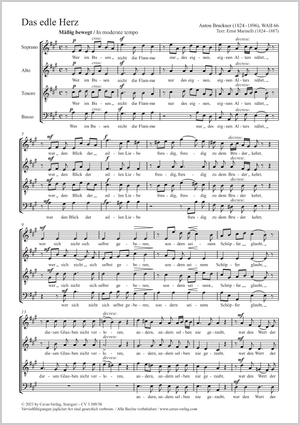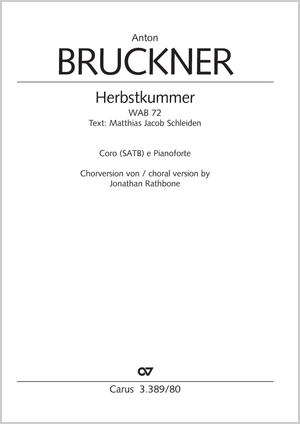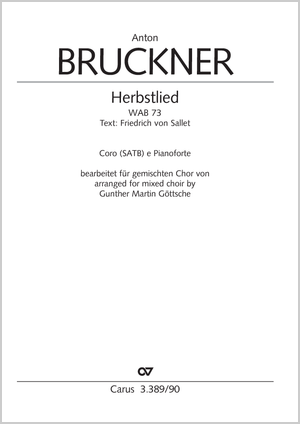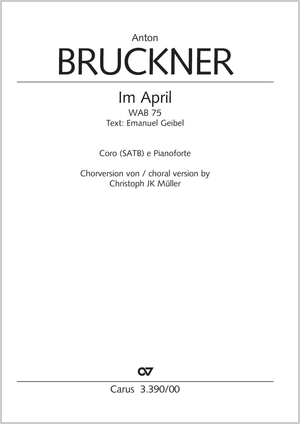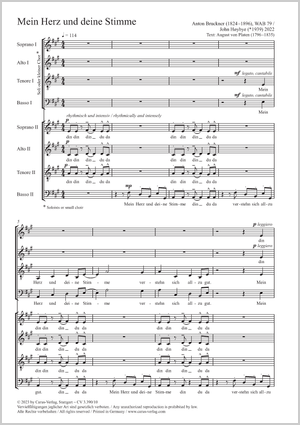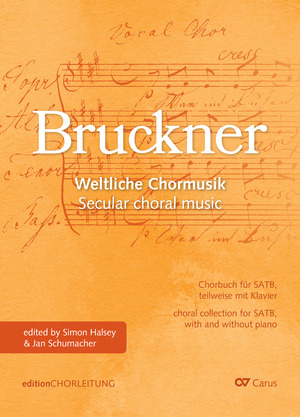
Choral Collection Bruckner. Secular choral music
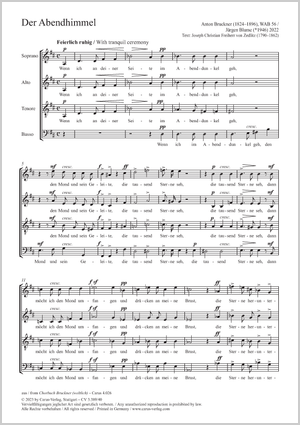
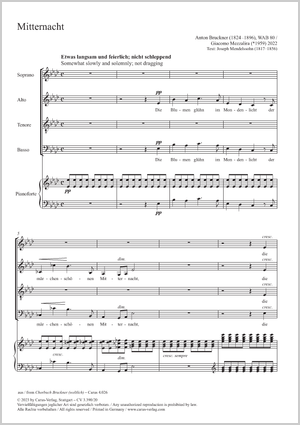
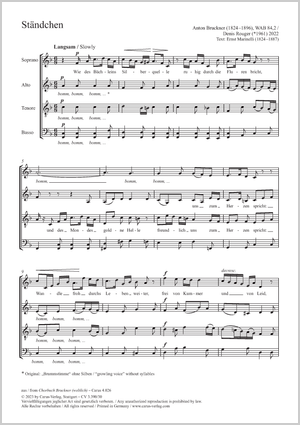
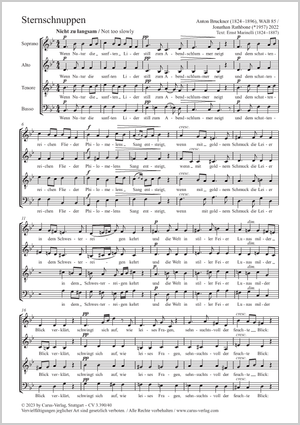
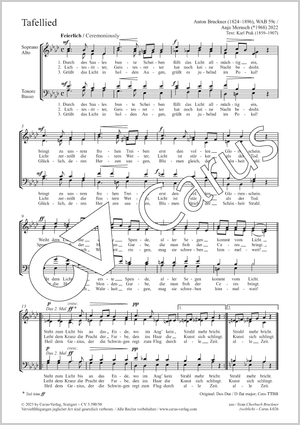
At times Romantic, at other times with a jazzy touch, the Choral collection Bruckner. Secular choral music is full of exciting discoveries and new arrangements at various levels of difficulty. Anton Bruckner’s secular choral music is often overshadowed by his great symphonies and sacred choral works – unfairly, as choral experts Simon Halsey and Jan Schumacher prove with their small but fine selection of choral music inspired by secular texts.
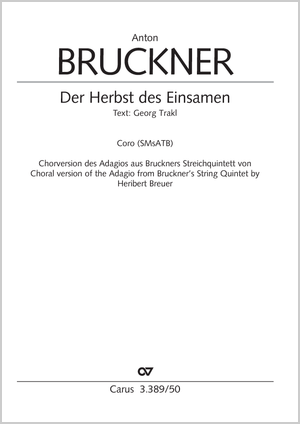
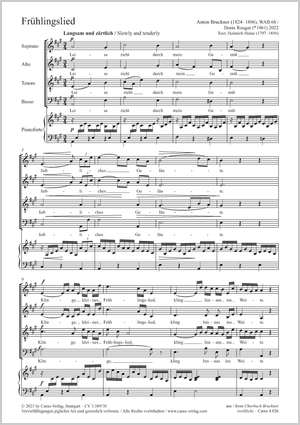
Bruckner left only a few movements for mixed choir; instead, his music for male voices constitutes a far larger body of work. For this collection, renowned arrangers from Germany, England, Denmark, and Italy have specially reworked the most beautiful of these choral movements for SATB, enabling this great repertoire to be performed by mixed choirs. Two original SATB compositions are also included. Furthermore, the choral collection features arrangements of songs originally written for solo voice and piano with texts by such poets as Heinrich Heine and Emanuel Geibel. Another highlight is an arrangement of the Adagio from Bruckner’s String Quintet WAB 112, which Heribert Breuer has created for choir to a text by Georg Trakl.
- 16 SATB settings, several with keyboard accompaniment
- Selected by Simon Halsey and Jan Schumacher
- Modern SATB arrangements of male-voice works and solo songs, as well as original compositions
- Affordable complete volume (editionCHOR) as well as separate editions available in print and digitally
 View
View


 Listen
(4)
Listen
(4)
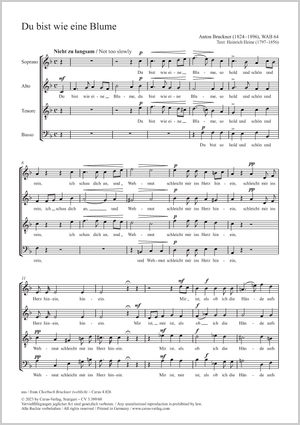
- Du bist wie eine Blume
- Das edle Herz
- Herbstkummer
- Mein Herz und deine Stimme
Contents

-
Composer
Anton Bruckner
| 1824-1896Anton Bruckner was born in Ansfelden (Austria) in 1824 and did not have a particularly easy life. The Austrian composer came from a simple, rural background and was plagued by self-doubt throughout his life. After the death of his father, he was accepted as a choirboy at St Florian's Abbey at the age of 13. After several years as a school assistant and self-taught organ and piano studies, he initially worked as an organist in St Florian. In 1855 he was appointed cathedral organist in Linz. After an introduction to music theory and instrumentation by Simon Sechter and Otto Kitzler, Bruckner discovered Richard Wagner as an artistic role model, whom he admired throughout his life and also visited several times in Bayreuth.
In 1868 Anton Bruckner became professor of basso continuo, counterpoint and organ at the Vienna Conservatory, ten years later court organist. In 1891 he was awarded an honorary doctorate from the University of Vienna. He was regarded as an important organ virtuoso of his time, but his compositional recognition was a long time coming. It was not until the Symphony No. 7 in E major, composed between 1881 and 1883, with the famous Adagio, which was written under the impression of Wagner's death, that he received the recognition he had hoped for, even if he did not want to accept it in view of his tendency towards scepticism and self-criticism.
Anton Bruckner was a solitary composer who did not want to follow any school or doctrine. He wrote both sacred and secular works in all their facets. In addition to numerous motets, Bruckner composed three masses, the Missa Solemnis in B flat minor (1854) and the Te Deum (1881-84; CV 27.190/00), which is available from Carus-Verlag. As a symphonist, he wrote a total of nine symphonies and many symphonic studies from 1863 onwards, whereby he tended to revise finished versions several times. Bruckner's orchestral works were long considered unplayable, but for the tonal language of their time they were merely unusually bold sound monuments on the border between late Romanticism and Modernism, uniting traditions from Beethoven to Wagner and folk music.
Personal details
-
Editor
Simon Halsey
Halsey occupies a unique position in classical music. He is the trusted advisor on choral singing to the world’s greatest conductors, orchestras and choruses; as an ambassador for choral singing to amateurs of every age, ability and background he has led ground-breaking massed choral events, notably for New York’s Lincoln Center. He holds positions, among others, as Choral Director of London Symphony Orchestra and Chorus, Chorus Director of City of Birmingham Symphony Orchestra Chorus, Principal Guest Conductor and Choral Ambassador of Orfeó Català Choirs, Creative Director for Choral Music and Projects at WDR Rundfunkchor, Conductor Laureate of Rundfunkchor Berlin and Professor and Director of Choral Activities at University of Birmingham. Halsey’s numerous awards include three Grammys for his recordings with the Rundfunkchor Berlin. He was made Commander of the British Empire in 2015, was awarded The Queen’s Medal for Music in 2014, and received the Officer’s Cross of the Order of Merit of the Federal Republic of Germany in 2011 in recognition of his outstanding contribution to choral music in Germany. Personal details
-
Editor
Jan Schumacher
| 1980Professor Jan Schumacher is Director of Music at Goethe University in Frankfurt am Main and conductor of Camerata Musica Limburg. He has been teaching choral conducting to beginners and advanced students for over twenty years, regularly leads international conducting courses and master classes and is active worldwide as a guest conductor, adjudicator and seminar leader. He is Chairman of the Choral Advisory Board of the German Music Council and Vice President of the International Federation for Choral Music (IFCM). As an author and editor he has been associated with Carus-Verlag for many years. Personal details
Reviews
Anschauen – auswählen! Interessante Stücke sind da zweifellos zu finden.
Chor aktuell, September 2023
[Den] neu eingerichteten Stimmen merkt man chorpraktisches Gespür und Sangbarkeit an.
Chorzeit, November 2023
Reviews on our website can only be submitted by customers with a registered user account. A check whether the rated products were actually purchased does not take place.
the secular Bruckner songs are a great addition. But if I make a decision to buy one or more, I would like to have an audio or video impression of these choral works. Can you provide me with these examples or give me a tip where I can hear this Bruckner repertoire in choral form.
Thank you
Jos Vlietstra
Frequent questions about this work
 There are no questions and answers available so far or you were unable to find an answer to your specific question about this work? Then click here and send your specific questions to our Customer Services!