Explore


Purchase
Additional product information
-
Composer
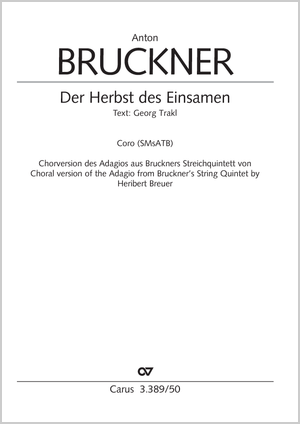
Anton Bruckner
| 1824-1896Anton Bruckner was born in Ansfelden (Austria) in 1824 and did not have a particularly easy life. The Austrian composer came from a simple, rural background and was plagued by self-doubt throughout his life. After the death of his father, he was accepted as a choirboy at St Florian's Abbey at the age of 13. After several years as a school assistant and self-taught organ and piano studies, he initially worked as an organist in St Florian. In 1855 he was appointed cathedral organist in Linz. After an introduction to music theory and instrumentation by Simon Sechter and Otto Kitzler, Bruckner discovered Richard Wagner as an artistic role model, whom he admired throughout his life and also visited several times in Bayreuth.
In 1868 Anton Bruckner became professor of basso continuo, counterpoint and organ at the Vienna Conservatory, ten years later court organist. In 1891 he was awarded an honorary doctorate from the University of Vienna. He was regarded as an important organ virtuoso of his time, but his compositional recognition was a long time coming. It was not until the Symphony No. 7 in E major, composed between 1881 and 1883, with the famous Adagio, which was written under the impression of Wagner's death, that he received the recognition he had hoped for, even if he did not want to accept it in view of his tendency towards scepticism and self-criticism.
Anton Bruckner was a solitary composer who did not want to follow any school or doctrine. He wrote both sacred and secular works in all their facets. In addition to numerous motets, Bruckner composed three masses, the Missa Solemnis in B flat minor (1854) and the Te Deum (1881-84; CV 27.190/00), which is available from Carus-Verlag. As a symphonist, he wrote a total of nine symphonies and many symphonic studies from 1863 onwards, whereby he tended to revise finished versions several times. Bruckner's orchestral works were long considered unplayable, but for the tonal language of their time they were merely unusually bold sound monuments on the border between late Romanticism and Modernism, uniting traditions from Beethoven to Wagner and folk music.
Personal details
-
Songwriter / Librettist
Georg Trakl
| 1887-1914
-
Arranger
Heribert Breuer
| 1945Heribert Breuer was born on 27 September 1945 in Heidelberg. He spent the first half of his life as a cantor in Lübeck, Würzburg and Aachen. After leaving the church, he took up a professorship at the Berlin University of the Arts, where he remained until his retirement in 2010. He was awarded the Rome Prize (Villa Massimo), the Bavarian State Prize and scholarships in Olevano and Worpswede. As a conductor and organist, he travelled extensively in Spain and South America. His compositional work increasingly specialised in unusual versions of old masters: Bach's ‘Art of Fugue’ and the Goldberg Variations, Schubert's ‘Swan Song’, Brahms' Requiem and the ‘Four Serious Songs’ for chamber ensemble. Many of these works were written for the Berlin Bach Academy, which he founded in 1991. His hobbies include travelling, the Spanish language and the wines of Hermann Dörflinger. (August 2025) Personal details
Reviews on our website can only be submitted by customers with a registered user account. A check whether the rated products were actually purchased does not take place.
No feedback available for this product.
Frequent questions about this work
 There are no questions and answers available so far or you were unable to find an answer to your specific question about this work? Then click here and send your specific questions to our Customer Services!