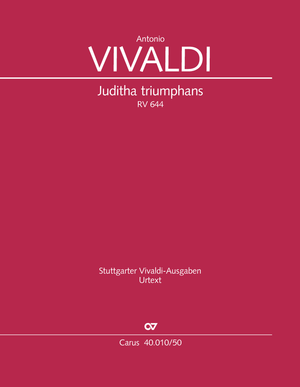
Juditha triumphans
RV 644, 1716
Juditha triumphans devicta Holofernis barbariae or “The triumphant Juditha, defeating the barbaric Holofernes” is the title of Vivaldi’s only surviving oratorio. It tells the story recounted in the apocryphal Biblical Book of Judith of the Jewish widow Judith who defeats the Assyrian general Holofernes when he besieges her hometown of Bethulia. The oratorio was intended to be understood as an allegory for the victory of the Venetian navy over the Ottoman Empire.
The choice of the deeply devout Judith as the heroine can certainly also be attributed to the all-female ensembles of the Ospedale della Pietà in Venice, where Vivaldi served as maestro de’ concerti. He directed the premiere in 1716/17 with these female musicians, whose brilliance was famous far beyond the city borders.
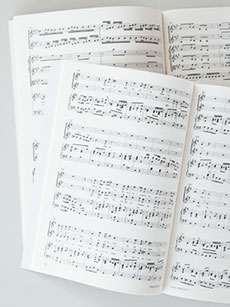
The oratorio’s impressively rich orchestration includes, alongside the standard instruments of the period, the mandolin, viola da gamba, theorbo, and chalumeau. The Urtext edition by Berthold Over offers flexible and practical performance materials for both period and modern ensembles. This oratorio, which can be performed by concert choirs as well as on the operatic stage, is Vivaldi’s only surviving large-scale sacred work for choir and orchestra.
 View
View

-
Composer
Antonio Vivaldi
| 1678-1741Antonio (Lucio) Vivaldi was an Italian composer and violinist of the Baroque period.
It is assumed that his father, who was a musician himself, was responsible for Vivaldi's musical education. However, he began his professional career as a priest, which earned him the nickname Il prete rosso (the red-haired priest).
From 1703, Vivaldi worked intermittently as a violin teacher and composer at the Ospedale della Pietà, an orphanage for girls in Venice, until shortly before his death. Initially, he also worked there as a priest, but relinquished this role after three years. He wrote numerous chamber music works and concertos for his pupils at the Pietà. The famous Four Seasons are particularly well-known and often performed today. Vivaldi also composed sacred and secular vocal music and was an opera composer and director.
Of over 800 works known today, only 135 were published during Vivaldi's lifetime. After his death, Vivaldi's compositions were initially largely forgotten. Many of his works were rediscovered and published, particularly in the 20th century. Among them is the Gloria in D RV 589, the very first sheet music edition published by Carus-Verlag.
Personal details
-
Songwriter / Librettist
Giacomo Cassetti
-
Vocal score arranger
Daniel Ivo de Oliveira
Reviews on our website can only be submitted by customers with a registered user account. A check whether the rated products were actually purchased does not take place.
Frequent questions about this work
 There are no questions and answers available so far or you were unable to find an answer to your specific question about this work? Then click here and send your specific questions to our Customer Services!