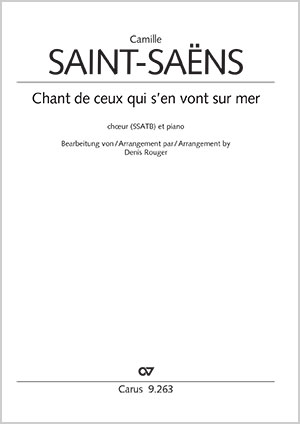

In the swirling piano part you can hear the storm raging. In the midst of the raging waves and the dark tide, the sailor, filled with despair, thinks of everything which is near and dear to him and of what he fears losing. In his mind’s eye he sees his house, his beloved, and people he loves. But his home is far away, and the sky black, not “azure”. He veritably cries out his pain at parting and his fear: “Farewell, fatherland, the waves are raging. Farewell, fatherland, azure!”
This work was composed as an art song for solo voice and piano. Denis Rouger has skilfully adapted it to suit the needs and expressive possibilities of a larger ensemble, without losing any of the qualities of the original in the process. Each part in the choir has a melodic line drawn from the harmonic and rhythmic framework. In the process, the variety and refinement of the choral language combines with an enormous flexibility in form and expression, as French mélodies or German art song demand from a soloist and pianist.
The song has been recorded by the figure humaine chamber choir on the CD ...wo die Zitronen blühn (Carus 83.514).
Explore
 View
View
 Listen
(1)
Listen
(1)
- Chant de ceux qui s'en vont sur mer
 Practise
-
Pronouncing Aid
- Chant de ceux qui s'en vont sur mer
 Additional material
- Purchase additional material as a download product.
-
 Digital text (without sheet music) incl. printing licence, html file, singing text, originalhtml file, singing text, original (Sample)Chant de ceux qui s'en vont sur mer
Adieu, patrie ! L’onde est en furie.
Adieu, patrie, Azur !
Adieu, maison, treille au fruit mûr,
Adieu, les fleurs d’or du vieux mur !
Adieu, patrie ! Ciel, forêt, prairie !
Adieu, patrie, Azur !
Adieu, patrie ! L’onde est en furie.
Adieu, patrie, Azur !
Adieu, fiancée au front pur,
Le ciel est noir, le vent est dur.
Adieu, patrie ! Lise, Anna, Marie !
Adieu, patrie, Azur !
Adieu, patrie ! L’onde est en furie.
Adieu, patrie, Azur !
Notre œil, que voile un deuil futur,
Va du flot sombre au sort obscur !
Adieu, patrie ! Pour toi mon cœur prie.
Adieu, patrie ! Azur !
Victor Hugo (1802–1885)...
-
Digital text (without sheet music) incl. printing licence, html file, singing text, german translationhtml file, singing text, german translation (Sample)Gesang derer, die aufs Meer hinausziehen Adieu, Vaterland! Die Wellen toben.
Adieu, Vaterland, Azur!
Adieu, Haus, Weinlaube voller reifer Früchte,
Adieu, güldene Blumen auf der alten Mauer!
Adieu, Vaterland! Himmel, Wald, Wiese!
Adieu, Vaterland, Azur!
Adieu, Vaterland! Die Wellen toben.
Adieu, Vaterland, Azur!
Adieu, Verlobte mit der reinen Stirn,
der Himmel ist schwarz, der Wind ist ungestüm.
Adieu, Vaterland! Lise, Anna, Marie!
Adieu, Vaterland, Azur!
Adieu, Vaterland! Die Wellen toben.
Adieu, Vaterland, Azur!
Unser Auge, das eine zukünftige Trauer trübt, wandert
von der dunklen Flut zum finsteren Schicksal!
Adieu, Vaterland! Für dich betet mein Herz.
Adieu, Vaterland, Azur!
...
Purchase
Additional product information
-
Composer
Camille Saint-Saëns
| 1835-1921Camille Saint-Saëns was a true multi-talent. He was a pianist, conductor, organist, musicologist, music teacher and composer and became famous above all for the Carnival of the Animals and the opera Samson et Dalila.
He composed his Symphony in A major at the age of 15 and was accepted to the University of Paris at the age of 16. Saint-Saëns studied piano, organ and composition at the Paris Conservatoire and became organist of Saint-Séverin in Paris in 1852. In the same year, he also met Franz Liszt, who subsequently exerted an influence on Saint-Saëns' compositional work. A year later, he celebrated his musical debut as a composer. The opera Samson et Dalila, which premiered in Weimar in 1877, brought him lasting success in opera houses to this day. His Christmas oratorio Oratorio de Noël, which is available from Carus-Verlag, is probably the best-known of his sacred works. Personal details
-
Songwriter / Librettist
Victor Hugo
| 1802-1885
-
Arranger
Denis Rouger
| 1961Denis Rouger gained his initial musical experience as the son of a Parisian family of musicians and during his studies at the Conservatoire National Supérieur de Musique de Paris, where he received first prizes in harmony, fugue and counterpoint.
He was a lecturer and choirmaster at the University of Paris-Sorbonne for 20 years and choirmaster at Notre-Dame de Paris Cathedral for 10 years. He is honorary conductor of the Parisian church La Madeleine. He also collaborates with numerous ensembles in Germany. He has been invited as a guest conductor by radio choirs, the Balthasar-Neumann-Chor, the Baden-Württemberg State Youth Choir and the Stuttgart Philharmonic Orchestra, among others. Concerts have taken him to Italy, the Netherlands, Canada, Russia, the United Arab Emirates and Switzerland (Lucerne Festival).
He gives master classes in Sweden, Bulgaria, France, Germany, as well as in Switzerland.
Denis Rouger has been Professor of Choral Conducting at the Stuttgart State University of Music and Performing Arts since 2011. The chamber choir he founded at the university in the fall of 2011 won first prize at the International Choir Competition in Mosbach (Germany) in 2014.
In addition to his work as a choirmaster, he composes and arranges French and German songs for choir. His arrangements on the CDs Kennst Du das Land ... and ... wo die Zitronen blühn (Carus) were well received by the press and radio. In collaboration with Carus-Verlag, he has edited the choir book Französische Chormusik, which received the German Music Edition Award “Best Edition” in 2019.
In 2016, Denis Rouger founded the figure humaine kammerchor (www.figurehumaine.de), with which he regularly gives concerts at renowned festivals.
Personal details
Reviews on our website can only be submitted by customers with a registered user account. A check whether the rated products were actually purchased does not take place.
No feedback available for this product.
Frequent questions about this work
 There are no questions and answers available so far or you were unable to find an answer to your specific question about this work? Then click here and send your specific questions to our Customer Services!