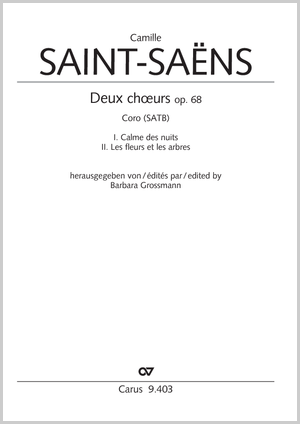
Deux chœurs
op. 68
In a letter from 1916, Camille Saint-Saëns wrote: “The voice is the most beautiful instrument; all others are only a more or less distant imitation.” This great appreciation for singing is reflected in his numerous vocal works, which encompass well over a hundred songs and around 20 pieces for choir, including the Deux chœurs from 1882 and 1883 - two movements in the rare in a rare voicing for mixed choir in Saint-Saëns’ vocal oeuvre.
Here Saint-Saëns set two nature poems, which he possibly wrote himself. Radiating a profound tranquility, Calme des nuits describes the vastness and stillness of the night, in which every single sound can resonate in the soul. Les fleurs et les arbres praises the comfort that we can draw from nature as well as from art.
 View
View
 Practise
-
Pronouncing Aid
- Calme des nuits
- Les fleurs et les arbres
 Additional material
- Purchase additional material as a download product.
-
 Digital text (without sheet music) incl. printing licence, html file, singing text, german translationhtml file, singing text, german translation (Sample)Zwei Chöre I. Nächtliche Ruhe
Nächtliche Ruhe, abendliche Kühle,
weiter Glanz des Weltenraums,
großes Schweigen der schwarzen Höhlen,
Ihr verzaubert die tiefgründigen Seelen.Das Strahlen der Sonne, die Heiterkeit,
II. Blumen und Bäume
der Lärm gefallen den Leichtfertigeren.
Allein der Dichter wird beherrscht
von der Liebe zu den stillen Dingen.Blumen und Bäume,
Bronzen und Marmor,
Gold und Email,
...
-
Digital text (without sheet music) incl. printing licence, html file, singing text, english translationhtml file, singing text, english translation (Sample)Two choirs I. Calm nights
Calm nights, cool fresh evenings,
Vast splendor of the universe,
Deep silence of black caverns,
You enchant the profound souls.The brilliance of the sun, the blitheness,
II. The flowers and the trees
The noise pleases the those who are more frivolous.
Only the poet is haunted
By the love of tranquil things.The flowers and the trees,
The bronzes, the marbles,
The golds, the enamels,
...
-
Digital text (without sheet music) incl. printing licence, html file, singing text, originalhtml file, singing text, original (Sample)Deux chœurs I. Calme des nuits
Calme des nuits, fraîcheur des soirs,
Vaste scintillement des mondes,
Grand silence des antres noirs,
Vous charmez les âmes profondes.L'éclat du soleil, la gaîté,
II. Les fleurs et les arbres
Le bruit plaisent aux plus futiles.
Le poète seul est hanté
Par l'amour des choses tranquilles.Les fleurs et les arbres,
Les bronzes, les marbres,
Les ors, les émaux,
...
Contents
-
Composer
Camille Saint-Saëns
| 1835-1921Camille Saint-Saëns was a true multi-talent. He was a pianist, conductor, organist, musicologist, music teacher and composer and became famous above all for the Carnival of the Animals and the opera Samson et Dalila.
He composed his Symphony in A major at the age of 15 and was accepted to the University of Paris at the age of 16. Saint-Saëns studied piano, organ and composition at the Paris Conservatoire and became organist of Saint-Séverin in Paris in 1852. In the same year, he also met Franz Liszt, who subsequently exerted an influence on Saint-Saëns' compositional work. A year later, he celebrated his musical debut as a composer. The opera Samson et Dalila, which premiered in Weimar in 1877, brought him lasting success in opera houses to this day. His Christmas oratorio Oratorio de Noël, which is available from Carus-Verlag, is probably the best-known of his sacred works. Personal details
-
Editor
Barbara Grossmann
| 1978
Reviews on our website can only be submitted by customers with a registered user account. A check whether the rated products were actually purchased does not take place.
Frequent questions about this work
 There are no questions and answers available so far or you were unable to find an answer to your specific question about this work? Then click here and send your specific questions to our Customer Services!