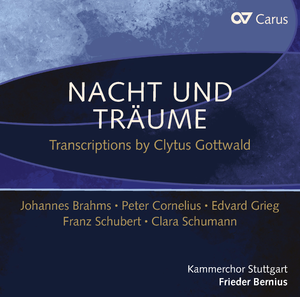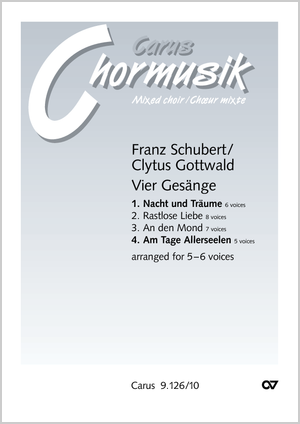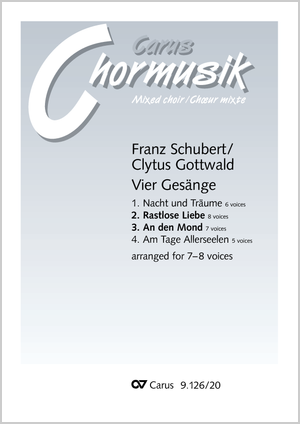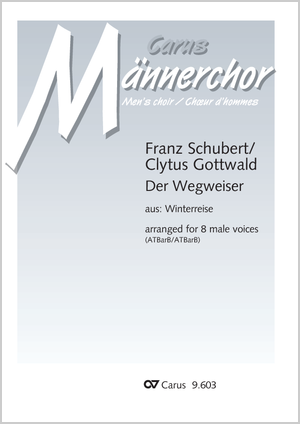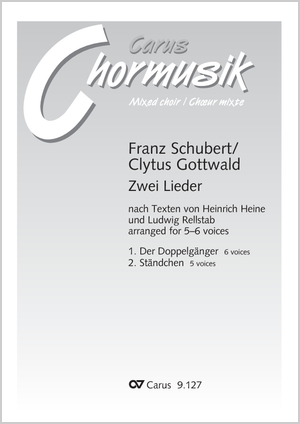
Zwei Lieder nach Texten von Heinrich Heine und Ludwig Rellstab
Vocal transcriptions by Clytus Gottwald
 View
View
 Listen
(2)
Listen
(2)
- Der Doppelgänger
- Ständchen
 Additional material
- Purchase additional material as a download product.
-
 Digital text (without sheet music) incl. printing licence, html file, singing text, originalhtml file, singing text, original (Sample)Unbenanntes Dokument Der Doppelgänger
Still ist die Nacht, es ruhen die Gassen,
in diesem Hause wohnte mein Schatz;
sie hat schon längst die Stadt verlassen,
doch steht noch das Haus auf demselben Platz.Da steht auch ein Mensch und starrt in die Höhe,
und ringt die Hände vor Schmerzensgewalt;
mir graust es, wenn ich sein Antlitz sehe –
der Mond zeigt mir meine eigne Gestalt.Du Doppelgänger, du bleicher Geselle,
was äffst du nach mein Liebesleid,
das mich gequält auf dieser Stelle
so manche Nacht in alter Zeit?...
-
Digital text (without sheet music) incl. printing licence, html file, singing text, english translationhtml file, singing text, english translation (Sample)Unbenanntes Dokument The Doppelgänger
The night is silent, the streets are quiet,
this house is where my sweetheart lived;
she left town a long time ago,
but the hause still stands in the same place.And a man is standing there, gazing upwards
and wringing his hands in anguish;
I shudder when I see its face –
the moon reveals my own shape to me.Doppelgänger, you pallid fellow!
why are you mimicking my heartache
that tormented me on this spot
on so many a night, long ago?...
-
Digital text (without sheet music) incl. printing licence, html file, singing text, french translationhtml file, singing text, french translation (Sample)Unbenanntes Dokument Le sosie
Calme est la nuit, les rues sont tranquilles,
ici, la maison où demeurait ma mie.
Voilà longtemps qu'elle a quitté la ville.
Mais la maison est toujours à sa place.Un homme est là, immobile, les yeux levés,
il se tord les mains de désespoir.
Je fremis en regardant son visage.
La lune me renvoie ma propre image.O tu sosie ! Tu blême compagnon !
Pourquoi singes-tu les affres de l’amour
qui jadis, en ce même lieu,
m’ont tourmenté durant tant de nuits?...

-
Composer
Franz Schubert
| 1797-1828Throughout most of his life Franz Schubert was concerned with church music. When he was eleven he was chosen as treble soloist at his local church in the Vienna suburb of Lichtenthal and soon afterwards he was admitted to the choir of the Imperial Court Chapel, directed by Antonio Salieri. Soon he also began to compose; his earliest surviving sacred pieces date from 1812. During his lifetime his church music achieved a comparatively wide degree of acceptance but after his death, most notably, his smaller works were unjustly forgotten. The Carus programme encompasses Schubert’s complete sacred compositions and it is intended to emphasize the wide range of his works in this area. Many of the smaller liturgical compositions are published here for the first time in separate editions. What is to be discovered is a fascinating œuvre, rooted in the ‘stile antico’ of Antonio Salieri and in the compositions of the Viennese classical masters, but whose exquisite lyricism and harmonic subtlety reveal a typically Schubertian world of expression: works with great power of conviction and exceptional musical beauty. Personal details
-
Songwriter / Librettist
Heinrich Heine
| 1797-1856Heinrich Heine (1797–1856) is regarded as one of the most important German poets of the 19th century. He was born in Düsseldorf and is best known for his lyric poetry, which combines Romanticism with sharp social criticism. Many of his works deal with love, nature and freedom. Because of his political views, Heine lived in exile in Paris for many years.
He also occupies a prominent place in the history of music. His lyrical texts were set to music by numerous composers and had a particularly profound influence on the Romantic art song. Robert Schumann, Franz Schubert, Felix Mendelssohn Bartholdy and Hugo Wolf, in particular, created musical works of enduring significance based on Heine’s poems. The poetic combination of linguistic simplicity, emotional depth and often ironic ambiguity offered composers a wide range of possibilities for musical interpretation. As a result, Heine’s poetry became a central part of the Romantic art-song repertoire and continues to influence vocal music to this day.
Personal details
-
Songwriter / Librettist
Ludwig Rellstab
| 1799-1860
-
Arranger
Clytus Gottwald
| 1925-2023The choral conductor, composer and musicologist Clytus Gottwald (1925 - 2023) made significant contributions to contemporary choral music. As editor for New Music at Südfunk Stuttgart and founder and director of the Schola Cantorum Stuttgart, he was in productive exchange with his contemporaries, Pierre Boulez, Mauricio Kagel, György Ligeti, Luigi Nono, Karlheinz Stockhausen and many others. With his Schola Cantorum, a 16-voice chamber vocal ensemble, Gottwald decisively shaped the a cappella choral culture of the highest technical level that is taken for granted today. Clytus Gottwald's transcriptions of piano songs and instrumental pieces for unaccompanied choir are appreciated by choirs all over the world. Modelled on the style of Ligeti, his works set the highest of musical standards. Clytus Gottwald has received several awards for his services, including the Cultural Prize of Baden-Württemberg in 2009, the European Church Music Prize in 2012, and the Cross of Merit of the Federal Republic of Germany in 2014. His importance for the development of contemporary choral music cannot be overestimated. Personal details
Reviews on our website can only be submitted by customers with a registered user account. A check whether the rated products were actually purchased does not take place.
Frequent questions about this work
 There are no questions and answers available so far or you were unable to find an answer to your specific question about this work? Then click here and send your specific questions to our Customer Services!