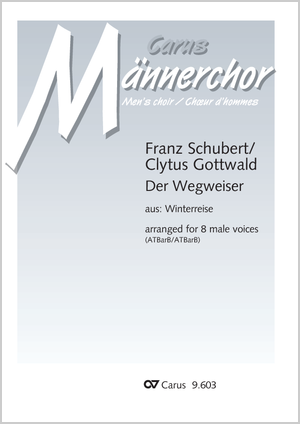
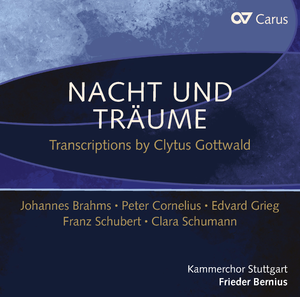
Der Wegweiser is one of Schubert’s lieder from his Winterreise with bittersweet, melancholy character. Clytus Gottwald has arrangenged this song for 8-voice men’s choir a cappella. The arrangement was commissioned by ChorWerk Ruhr and it received its world premiere performance by this ensemble, conducted by Peter Neumann on 23 November 2003 in Mühlheim/Ruhr (Germany).
Explore
 View
View
 Listen
(1)
Listen
(1)
- Der Wegweiser
 Additional material
- Purchase additional material as a download product.
-
 Digital text (without sheet music) incl. printing licence, html file, singing text, originalhtml file, singing text, original (Sample)Unbenanntes Dokument Der Wegweiser
Was vermeid ich denn die Wege,
wo die ander’n Wandrer gehn,
suche mir versteckte Stege
durch verschneite Felsenhöhn?Habe ja doch nichts begangen,
dass ich Menschen sollte scheu’n,
welch ein törichtes Verlangen
treibt mich in die Wüstenei’n?Weiser stehen auf den Wegen,
weisen auf die Städte zu,
und ich wand’re sonder Maßen,
ohne Ruh und suche Ruh....
-
Digital text (without sheet music) incl. printing licence, html file, singing text, english translationhtml file, singing text, english translation (Sample)Unbenanntes Dokument The signpost
Why do I avoid the roads
which other travellers take,
and seek hidden paths,
through snow-clad, rocky heights?Yet no wrong have I committed,
that I should shun mankind.
What foolish desire
drives me to the wilderness?Signposts stand along the roads,
pointing towards the towns;
and I wander ceaselessly,
restless, yet seeking rest....
-
Digital text (without sheet music) incl. printing licence, html file, singing text, french translationhtml file, singing text, french translation (Sample)Unbenanntes Dokument Le poteau indicateur
Pourquoi donc éviter les chemins
que font les autres voyageurs,
chercher des sentiers cachés
à travers les rocs enneigés ?Je n’ai pourtant rien commis
que puisse me faire craindre les hommes.
Quel desir insensé
m’entraîne dans ces contrées desolées ?II y a le long des routes des poteaux
indiquant la direction des villes
et moi, je marche inlassablement,
sans répit mais cherchant le répit....
Purchase
Additional product information
-
Composer
Franz Schubert
| 1797-1828Throughout most of his life Franz Schubert was concerned with church music. When he was eleven he was chosen as treble soloist at his local church in the Vienna suburb of Lichtenthal and soon afterwards he was admitted to the choir of the Imperial Court Chapel, directed by Antonio Salieri. Soon he also began to compose; his earliest surviving sacred pieces date from 1812. During his lifetime his church music achieved a comparatively wide degree of acceptance but after his death, most notably, his smaller works were unjustly forgotten. The Carus programme encompasses Schubert’s complete sacred compositions and it is intended to emphasize the wide range of his works in this area. Many of the smaller liturgical compositions are published here for the first time in separate editions. What is to be discovered is a fascinating œuvre, rooted in the ‘stile antico’ of Antonio Salieri and in the compositions of the Viennese classical masters, but whose exquisite lyricism and harmonic subtlety reveal a typically Schubertian world of expression: works with great power of conviction and exceptional musical beauty. Personal details
-
Songwriter / Librettist
Wilhelm Müller
| 1794-1827
-
Arranger
Clytus Gottwald
| 1925-2023The choral conductor, composer and musicologist Clytus Gottwald (1925 - 2023) made significant contributions to contemporary choral music. As editor for New Music at Südfunk Stuttgart and founder and director of the Schola Cantorum Stuttgart, he was in productive exchange with his contemporaries, Pierre Boulez, Mauricio Kagel, György Ligeti, Luigi Nono, Karlheinz Stockhausen and many others. With his Schola Cantorum, a 16-voice chamber vocal ensemble, Gottwald decisively shaped the a cappella choral culture of the highest technical level that is taken for granted today. Clytus Gottwald's transcriptions of piano songs and instrumental pieces for unaccompanied choir are appreciated by choirs all over the world. Modelled on the style of Ligeti, his works set the highest of musical standards. Clytus Gottwald has received several awards for his services, including the Cultural Prize of Baden-Württemberg in 2009, the European Church Music Prize in 2012, and the Cross of Merit of the Federal Republic of Germany in 2014. His importance for the development of contemporary choral music cannot be overestimated. Personal details
Reviews on our website can only be submitted by customers with a registered user account. A check whether the rated products were actually purchased does not take place.
No feedback available for this product.
Frequent questions about this work
 There are no questions and answers available so far or you were unable to find an answer to your specific question about this work? Then click here and send your specific questions to our Customer Services!