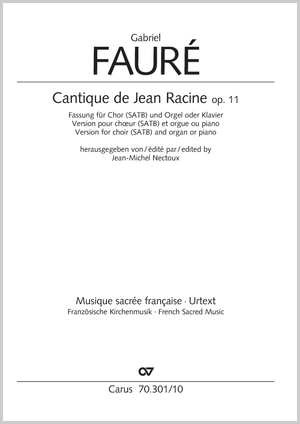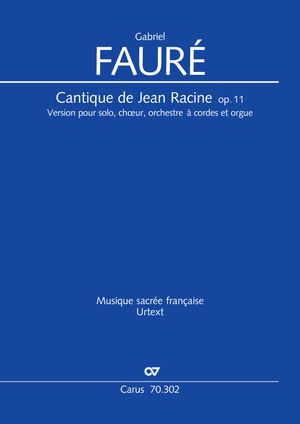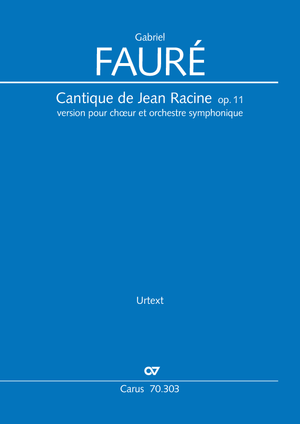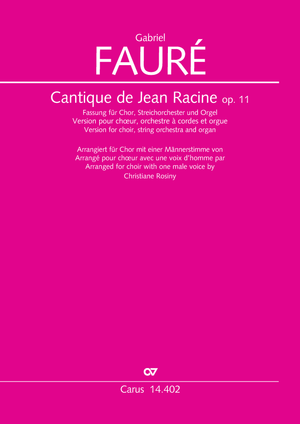
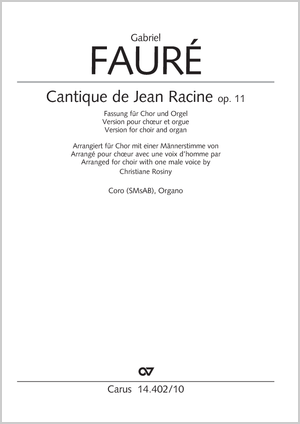
Gabriel Fauré composed the Cantique de Jean Racine in 1865 as the prize-winning final work of his musical training. The Cantique already possesses the typical Fauré characteristics of an expressive choral movement and, together with the Requiem composed much later, is one of the composer's most popular works.
Christiane Rosiny’s arrangement for SMsAB choir is aimed at mixed ensembles with a limited number of male voices as well as youth choirs. While soprano and bass remain practically unchanged, the middle voices are arranged for soprano and alto. The arrangement is a volume of the series SPLENDID SONORITY. Masterpieces arranged for choir with one male voice.
In addition to the score of the version for string orchestra, a version for organ is also available (Carus 14.402/10). The vocal parts (solo and chorus) are identical in both the string and organ versions. The organ reduction also serves as the choral score for both the string and organ versions.
| Original version | Version for choir with one male voice |
| Coro SATB, 2 Vl, Va, Vc, Cb, Org | Coro SMsAB, 2 Vl, Va, Vc, Cb, Org |



Purchase
Additional product information
-
Composer
Gabriel Fauré
| 1845-1924French composer, 1845-1924.
He was a pupil of Camille Saint-Saëns and studied at the Paris School of Sacred Music. Fauré worked as an organist and choirmaster and gave piano lessons and recitals in Parisian salons. He was able to improvise brilliantly on the piano, which is also reflected in his compositions. He was director of the Paris Conservatoire from 1905 to 1920.
Fauré mainly wrote vocal, piano and chamber music. He is best known for his piano songs for solo voice and his Requiem, which was also performed at his own funeral service.
Personal details
-
Songwriter / Librettist
Jean Racine
| -1699
-
Arranger
Christiane Rosiny
| 1978Christiane Rosiny has been working as a conductor and choir director since passing her state examination. She led numerous choirs before taking over as director of the Evangelische Singschule Prenzlauer Berg Nord in 2012, the choir school at Gethsemanekirche, which she developed into a large and inspiring choir school. For several years now, Christiane Rosiny has also been leading workshops on various aspects of choral and children’s choir conducting. In her work as a church musician, she creates arrangements and practical pieces for children’s and youth voices, which she publishes through Carus-Verlag, among others. In 2021, the Berlin Choral Association awarded Christiane Rosiny the Geschwister-Mendelssohn Medal in recognition of her outstanding contributions to Berlin’s choral life. Personal details
-
Translator
Heidi Kirmße
| 1925-2021Heidi Kirmße (1925–2021) studierte Schulmusik in Weimar und lebte dort als freischaffende Schriftstellerin, Herausgeberin und Übersetzerin. Für den Carus-Verlag erstellte sie insbesondere zahlreiche singbare deutsche Nachdichtungen aus unterschiedlichen Sprachen, u.a. für Kompositionen von Marc-Antoine Charpentier, Antonín Dvorák, Gabriel Fauré, Edvard Grieg, Georg Friedrich Händel, Jules Massenet, Sergei Rachmaninow, Max Reger, Gioachino Rossini, Veljo Tormis, Giuseppe Verdi u.a., doch trat sie auch mit eigenen Texten in Erscheinung. Über 500 mittlerweile unveröffentlichte oder mittlerweile vergriffene Texte ihres umfangreichen Schaffens als Dichterin und Übersetzerin sind bei Carus in einer separaten Datenbank erfasst und können bei Interesse erfragt werden. Von ihrem bewussten, hinterfragenden Umgang mit Worten zeugt Heidi Kirmßes Gedicht mit dem gleichlautenden Titel:
Worte
So viele Worte werden viel zu oft gesagt,
so viele Fragen werden nicht genug gefragt.
Wo keine Frage steht, wird niemals eine Antwort sein,
und durch Gewöhnung wird der Sinn der Worte klein.
Und ist das Wort verbraucht, sein Inhalt leer und fad,
so wird es nie mehr Ansporn sein zur Tat.
Wir stehn verwundert, geben auf und fühlen uns beschämt
und merken nicht, dass wir doch selbst die Kraft gelähmt.
Drum wolln wir sorgen, dass Gewohnheit uns nicht trügt,
wir wollen fragen, bis die Antwort uns genügt,
wir wollen jedes Wort genau auf seinen Sinn durchschaun
und nur auf solchem festen Boden sicher baun.Heidi KirmßePersonal details
Reviews on our website can only be submitted by customers with a registered user account. A check whether the rated products were actually purchased does not take place.
No feedback available for this product.
Frequent questions about this work
 There are no questions and answers available so far or you were unable to find an answer to your specific question about this work? Then click here and send your specific questions to our Customer Services!