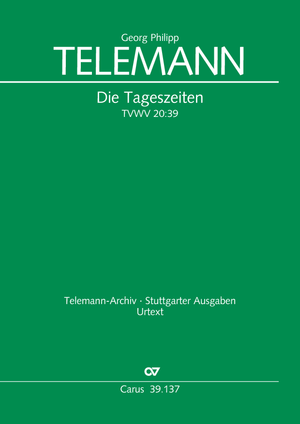
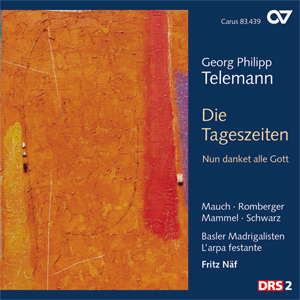
The cantata cycle Die Tageszeiten, which was composed in Hamburg in 1757, is one of the outstanding late works of Georg Philipp Telemann. A symphonie and four cantatas (each of which consists of an aria, accompagnato, aria, and chorus) portray, in a richly sensitive manner, the course of a day, beginning with the awakening of nature to the sunset. The poetry of Friedrich Wilhelm Zachariae and Telemann’s music herald the beauty of nature, as well as the greatness of God revealed within it. Colorful instrumentation and pictures in sound corresponding to each time of the day, delicate compositional structure, and an ingenious realization of the text characterize this work, whose musical idiom is at times reminiscent of Haydn.
Explore


 Listen
(17)
Listen
(17)
- Sinfonie
- Arie: Der Morgen kömmt, mit ihm die Freude
- Rezit.: Der ganze Himmel schwimmt im Glanz
- Arie: Allmächtger, groß im Sonnenglanz
- Chor: Willkommen, holdseliger Morgen!
- Arie: Der Mittag, begleitet von fälchenden
- Rezit.: Empfange mich
- Arie: Lass mich die süße Wollust fühlen
- Chor: Auf, folget dem feurigen Wagen
- Arie: Senke dich von Purpurwolken
- Rezit.: Der Wald steht dunkelgrün
- Arie: Komm, holder Schlaf!
- Chor: Vom Aufgang bis zum Niedergang
- Arie: O Nacht, und du, geweihte Stille!
- Rezit.: Sie kömmt; ihr helles Sternenkleid
- Arie: Wie wird des Grabes Nacht
- Chor: Der Herr ist Gott
 Additional material
- Purchase additional material as a download product.
-
 Digital text (without sheet music) incl. printing licence, html file, singing text, english translationhtml file, singing text, english translation (Sample)
The Morning (Soprano)
1. Symphony
Nimbly – Dallying and always lightly – Quickly2. Aria – Joyfully The morning is coming, and with it joy;
behold, the field adorns itself
for you with sparking jewels.
While you ascend from the sea
and present yourself in pomp to the peoples,
a half world rejoices over you.3. Recitative All the heaven is swimming in splendor,
the golden hours perform a dance
around you, greeting you, O sun.
And all the spheres resound
and all the forests sing,
and all the harmonies press on to Olympus,
and greet you, O sun!
To you sing the brilliant war trumpets
...
-
Digital text (without sheet music) incl. printing licence, html file, singing text, originalhtml file, singing text, original (Sample)
Der Morgen (Sopran)
1. Sinfonie Hurtig – Tändelnd, und immer gelinde – Geschwinde
2. Arie – Freudig Der Morgen kömmt, mit ihm die Freude.
O sieh, mit blitzendem Geschmeide
schmückt sich für dich das Feld.
Indem du aus dem Meere steigest
und dich mit Pomp den Völkern zeigest,
frohlockt dir eine halbe Welt.3. Rezitativ Der ganze Himmel schwimmt im Glanz;
die güldnen Stunden führen einen Tanz
um dich herum und grüßen, Sonne, dich!
Und alle Sphären klingen,
und alle Wälder singen,
und alle Harmonien dringen
auf zum Olymp und grüßen, Sonne, dich!
Dir singt die helle Kriegstrompete
...
-
Digital text (without sheet music) incl. printing licence, html file, Introductory text, frenchhtml file, Introductory text, french (Sample)Texte abrégé du livret du CD Carus 83.439
Klaus Hofmann
Traduction : Sylvie CoquillatLa longue vie de Georg Philipp Telemann est l’histoire d’un succès tel que ne le connurent que très peu de compositeurs à son époque. Il fit par trois fois le récit de sa vie, en 1718, en 1729 et en 1740. Dans les témoignages de 1718 et 1740, il décrit son parcours en détail d’une plume alerte et divertissante – et parfois, ses descriptions se lisent presque comme l’exposé d’un roman.
Un roman qui commence à Magdebourg, où Telemann naît le 14 mars 1681. Son père, prédicateur à l’église du Saint-Esprit, meurt dès 1685. Les dons musicaux du fils se révèlent très tôt, héritage venu de sa mère qui, après que le garçon de douze ans avait fait représenter un opéra de sa plume, et inquiète qu’il ne devienne un « saltimbanque, un funambule, un joueur des rues, un montreur de marmottes etc. », s’efforce cependant de l’orienter vers
...
-
Digital text (without sheet music) incl. printing licence, html file, Introductory text, englishhtml file, Introductory text, english (Sample)Abridged Text from the CD Carus 83.439
Klaus Hofmann
Translation: Elizabeth RobinsonGeorg Philipp Telemann’s long life was a success story, the like of which was enjoyed by very few composers of his era. He wrote his autobiography three times – in 1718, 1729 and 1740. In his 1718 and 1740 accounts, he described his career in detail, with an adept turn of phrase and in storytelling mode; in parts, his description reads almost like the plot of a novel.
The story begins in Magdeburg, where Telemann was born on 14 March 1681. His father, a clergyman at the Heilig-Geist-Kirche, died in 1685. His son’s musical ability was evident at an early age, inherited from his mother’s side of the family. However, after her twelve-year-old son performed an opera he had composed himself, Telemann’s mother, concerned that he would become a “juggler, tightrope walker, minstrel, marmot driver, etc.”,
...
-
Digital text (without sheet music) incl. printing licence, html file, Introductory text, germanhtml file, Introductory text, german (Sample)Gekürzter Booklet-Text der CD Carus 83.439
Klaus Hofmann
Telemanns überaus reiches kompositorisches Schaffen, der Ertrag eines Dreivierteljahrhunderts, umfasst nahezu alle Gattungen der Musik und reicht vom kleinen Cembalomenuett über Kammermusik unterschiedlichster Anlage und Besetzung bis hin zu Konzert und Orchestersuite und im vokalen Bereich vom Generalbasslied über Kammer- und Kirchenkantate bis zum Oratorium und zur Oper. Er selbst hat der Kirchenmusik in seinem Schaffen eine zentrale Rolle zugewiesen. „Dieses aber weiß [ich] wol“, schreibt er 1718, „daß ich allemahl die Kirchen-Music am meisten werth geschätzet / am meisten in anderen Autoribus ihrentwegen geforschet / und auch das meiste darinnen ausgearbeitet habe“. Schon damals müssen mehr als 500 Kirchenkompositionen vorgelegen haben, und weit über 1000 sind in den fast fünfzig Schaffensjahren, die Telemann noch beschieden sein sollten, hinzugekommen.
Allenthalben in seinem Werk zeigt sich Telemann als ein fortschrittlicher, dem neuen aufgeschlossener
...
Purchase
Additional product information
Contents
-
Composer
Georg Philipp Telemann
| 1681-1767Telemann's extremely rich compositional output, the fruits of three quarters of a century's work, encompasses almost all genres of music; in his vocal works it ranges from songs with basso continuo accompaniment to chamber and church cantatas, and to opera. In his own assessment, church music played a central role in his output; he alone probably composed over 1,600 church cantatas, as well as cantata-style funeral music settings (such as Du aber, Daniel, gehe hin), psalm settings (for example, Deus judicium tuum) and oratorios. Throughout his works Telemann showed himself to be a progressive composer, open to new trends and keen to experiment whilst exploring new directions; not without reason was he called a forerunner of classicism. However, his compositions constitute only a part of his importance to music history: as a music publisher, the author of publications for teaching, the director of middle-class music societies and initiator of public concerts, he made a considerable contribution to creating the preconditions for the support of the musically-educated middle classes in the ensuing era of music. Personal details
-
Editor
Brit Reipsch
Reviews
Untitled Document
Telemann, Georg Philipp: Die Tageszeiten
Die Tageszeiten Telemanns sind ein Zyklus, der stilistisch zwischen Oratorium und Kantate angesiedelt ist. Sie zählen zum Spätwerk des Komponisten, der sich in den 50iger-Jahren des 18. Jahrhunderts schwerpunktmäßig mit moderner deutscher Dichtung befasste, wie beispielsweise den Werken Klopstocks, dem Kreis der „Bremer Beiträger" oder Karl Wilhelm Ramler. Die für die Zeit innovative Sprachrhythmik und der Reichtum der geschilderten Empfindungen inspirierten Telemann zu seinem Werk. [...] Die vorliegende, sorgfältig gestaltete Edition macht dieses interessante Werk im Rahmen der Carus-Edition telemannscher Werke wieder einer breiteren Öffentlichkeit zugänglich und ist mit Sicherheit eine Bereicherung für viele Konzertprogramme.
Barbara Stühlmeyer
Quelle: Musica Sacra, 2/2010
Reviews on our website can only be submitted by customers with a registered user account. A check whether the rated products were actually purchased does not take place.
No feedback available for this product.
Frequent questions about this work
 There are no questions and answers available so far or you were unable to find an answer to your specific question about this work? Then click here and send your specific questions to our Customer Services!