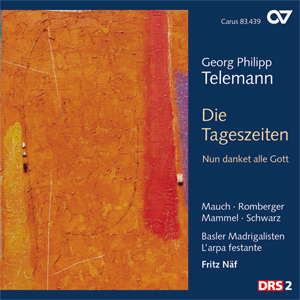
Die Tageszeiten, Nun Danket alle Gott
 Listen
(21)
Listen
(21)
- Sinfonie
- Arie: Der Morgen kömmt, mit ihm die Freude
- Rezit.: Der ganze Himmel schwimmt im Glanz
- Arie: Allmächtger, groß im Sonnenglanz
- Chor: Willkommen, holdseliger Morgen!
- Arie: Der Mittag, begleitet von fälchenden
- Rezit.: Empfange mich
- Arie: Lass mich die süße Wollust fühlen
- Chor: Auf, folget dem feurigen Wagen
- Arie: Senke dich von Purpurwolken
- Rezit.: Der Wald steht dunkelgrün
- Arie: Komm, holder Schlaf!
- Chor: Vom Aufgang bis zum Niedergang
- Arie: O Nacht, und du, geweihte Stille!
- Rezit.: Sie kömmt; ihr helles Sternenkleid
- Arie: Wie wird des Grabes Nacht
- Chor: Der Herr ist Gott
- Chor: Nun danket alle Gott
- Duett (Tenor, Bass): Der uns von Mutterleibe
- Aria (Alt): Er gebe uns ein fröhliches Herz
- Chor: Auf dass seine Gnade
 Additional material
-
 Digital text (without sheet music) incl. printing licence, html file, singing text, english translationhtml file, singing text, english translation (Sample)??
1. Solo Soprano and Chorus Now thank we all our God, who wondrous things has done through ages without end.
2. Duet (Tenor and Basso) Who from our mother’s loving arms has blest us with gifts of love for all your needs.
3. Aria (Alto) He gives to us a joyful heart and everlasting peace to cheer us in this time in Israel.
4. Chorus And his gracious mercy stays with us always and delivers us so long as we are living.
Jesus Sirach 50:24–26
Translation: Robert Scandrett...
-
Digital text (without sheet music) incl. printing licence, html file, singing text, originalhtml file, singing text, original (Sample)
1. Solo Sopran und Chor Nun danket alle Gott, der große Dinge tut an allen Enden.
2. Duett (Tenor und Bass) Der uns von Mutterleibe an lebendig erhält und tut uns alles Guts.
3. Arie (Alt) Er gebe uns ein fröhliches Herz, und verleihe immerdar Friede zu unsrer Zeit in Israel.
4. Chor Auf dass seine Gnade stets bei uns bleibe und erlöse uns, solange wir leben.
Jesus Sirach 50,24–26
...
-
Digital text (without sheet music) incl. printing licence, html file, Introductory text, frenchhtml file, Introductory text, french (Sample)Texte du CD Carus 83.439
Klaus Hofmann
Traduction (abrégée): Sylvie CoquillatLa longue vie de Georg Philipp Telemann est l’histoire d’un succès tel que ne le connurent que très peu de compositeurs à son époque. Il fit par trois fois le récit de sa vie, en 1718, en 1729 et en 1740. Dans les témoignages de 1718 et 1740, il décrit son parcours en détail d’une plume alerte et divertissante – et parfois, ses descriptions se lisent presque comme l’exposé d’un roman.
Un roman qui commence à Magdebourg, où Telemann naît le 14 mars 1681. Son père, prédicateur à l’église du Saint-Esprit, meurt dès 1685. Les dons musicaux du fils se révèlent très tôt, héritage venu de sa mère qui, après que le garçon de douze ans avait fait représenter un opéra de sa plume, et inquiète qu’il ne devienne un « saltimbanque, un funambule, un joueur des rues, un montreur de marmottes etc. », s’efforce cependant de l’orienter vers
...
-
Digital text (without sheet music) incl. printing licence, html file, Introductory text, englishhtml file, Introductory text, english (Sample)Text from the CD Carus 83.439
Klaus Hofmann
Translation (abridged): Elizabeth RobinsonGeorg Philipp Telemann’s long life was a success story, the like of which was enjoyed by very few composers of his era. He wrote his autobiography three times – in 1718, 1729 and 1740. In his 1718 and 1740 accounts, he described his career in detail, with an adept turn of phrase and in storytelling mode; in parts, his description reads almost like the plot of a novel.
The story begins in Magdeburg, where Telemann was born on 14 March 1681. His father, a clergyman at the Heilig-Geist-Kirche, died in 1685. His son’s musical ability was evident at an early age, inherited from his mother’s side of the family. However, after her twelve-year-old son performed an opera he had composed himself, Telemann’s mother, concerned that he would become a “juggler, tightrope walker, minstrel, marmot driver, etc.”,
...
-
Digital text (without sheet music) incl. printing licence, html file, Introductory text, germanhtml file, Introductory text, german (Sample)Booklet-Text der CD Carus 83.439
Klaus Hofmann
Georg Philipp Telemanns langes Leben ist eine Erfolgsgeschichte, wie sie nur wenigen Komponisten seiner Epoche beschieden war. Dreimal hat er selbst sein Leben beschrieben, zuerst 1718 für den Abdruck in Johann Matthesons Großer General-Baß-Schule, dann erneut 1729 für Johann Gottfried Walthers Musicalisches Lexicon (1732) und ein drittes Mal 1740 für Matthesons Grundlage einer Ehren-Pforte. Während der Lebensabriss für das Lexikon knapp gehalten ist, schildert Telemann in den beiden Berichten für Mattheson seinen Werdegang mit gewandter Feder ausführlich und in Erzähllaune – und partienweise liest sich seine Darstellung fast wie das Exposé eines Romans.
Dieser Roman beginnt in Magdeburg, wo Telemann am 14. März 1681 zur Welt kommt. Früh zeigt sich die musikalische Begabung des Sohnes, ein Erbe von Seiten der Mutter, die sich indes, nachdem der Zwölfjährige eine selbstkomponierte
...
-
Digital text (without sheet music) incl. printing licence, html file, singing text, english translationhtml file, singing text, english translation (Sample)
The Morning (Soprano)
1. Symphony
Nimbly – Dallying and always lightly – Quickly2. Aria – Joyfully The morning is coming, and with it joy;
behold, the field adorns itself
for you with sparking jewels.
While you ascend from the sea
and present yourself in pomp to the peoples,
a half world rejoices over you.3. Recitative All the heaven is swimming in splendor,
the golden hours perform a dance
around you, greeting you, O sun.
And all the spheres resound
and all the forests sing,
and all the harmonies press on to Olympus,
and greet you, O sun!
To you sing the brilliant war trumpets
...
-
Digital text (without sheet music) incl. printing licence, html file, singing text, originalhtml file, singing text, original (Sample)
Der Morgen (Sopran)
1. Sinfonie Hurtig – Tändelnd, und immer gelinde – Geschwinde
2. Arie – Freudig Der Morgen kömmt, mit ihm die Freude.
O sieh, mit blitzendem Geschmeide
schmückt sich für dich das Feld.
Indem du aus dem Meere steigest
und dich mit Pomp den Völkern zeigest,
frohlockt dir eine halbe Welt.3. Rezitativ Der ganze Himmel schwimmt im Glanz;
die güldnen Stunden führen einen Tanz
um dich herum und grüßen, Sonne, dich!
Und alle Sphären klingen,
und alle Wälder singen,
und alle Harmonien dringen
auf zum Olymp und grüßen, Sonne, dich!
Dir singt die helle Kriegstrompete
...
-
Digital text (without sheet music) incl. printing licence, html file, Introductory text, frenchhtml file, Introductory text, french (Sample)Texte abrégé du livret du CD Carus 83.439
Klaus Hofmann
Traduction : Sylvie CoquillatLa longue vie de Georg Philipp Telemann est l’histoire d’un succès tel que ne le connurent que très peu de compositeurs à son époque. Il fit par trois fois le récit de sa vie, en 1718, en 1729 et en 1740. Dans les témoignages de 1718 et 1740, il décrit son parcours en détail d’une plume alerte et divertissante – et parfois, ses descriptions se lisent presque comme l’exposé d’un roman.
Un roman qui commence à Magdebourg, où Telemann naît le 14 mars 1681. Son père, prédicateur à l’église du Saint-Esprit, meurt dès 1685. Les dons musicaux du fils se révèlent très tôt, héritage venu de sa mère qui, après que le garçon de douze ans avait fait représenter un opéra de sa plume, et inquiète qu’il ne devienne un « saltimbanque, un funambule, un joueur des rues, un montreur de marmottes etc. », s’efforce cependant de l’orienter vers
...
-
Digital text (without sheet music) incl. printing licence, html file, Introductory text, englishhtml file, Introductory text, english (Sample)Abridged Text from the CD Carus 83.439
Klaus Hofmann
Translation: Elizabeth RobinsonGeorg Philipp Telemann’s long life was a success story, the like of which was enjoyed by very few composers of his era. He wrote his autobiography three times – in 1718, 1729 and 1740. In his 1718 and 1740 accounts, he described his career in detail, with an adept turn of phrase and in storytelling mode; in parts, his description reads almost like the plot of a novel.
The story begins in Magdeburg, where Telemann was born on 14 March 1681. His father, a clergyman at the Heilig-Geist-Kirche, died in 1685. His son’s musical ability was evident at an early age, inherited from his mother’s side of the family. However, after her twelve-year-old son performed an opera he had composed himself, Telemann’s mother, concerned that he would become a “juggler, tightrope walker, minstrel, marmot driver, etc.”,
...
-
Digital text (without sheet music) incl. printing licence, html file, Introductory text, germanhtml file, Introductory text, german (Sample)Gekürzter Booklet-Text der CD Carus 83.439
Klaus Hofmann
Telemanns überaus reiches kompositorisches Schaffen, der Ertrag eines Dreivierteljahrhunderts, umfasst nahezu alle Gattungen der Musik und reicht vom kleinen Cembalomenuett über Kammermusik unterschiedlichster Anlage und Besetzung bis hin zu Konzert und Orchestersuite und im vokalen Bereich vom Generalbasslied über Kammer- und Kirchenkantate bis zum Oratorium und zur Oper. Er selbst hat der Kirchenmusik in seinem Schaffen eine zentrale Rolle zugewiesen. „Dieses aber weiß [ich] wol“, schreibt er 1718, „daß ich allemahl die Kirchen-Music am meisten werth geschätzet / am meisten in anderen Autoribus ihrentwegen geforschet / und auch das meiste darinnen ausgearbeitet habe“. Schon damals müssen mehr als 500 Kirchenkompositionen vorgelegen haben, und weit über 1000 sind in den fast fünfzig Schaffensjahren, die Telemann noch beschieden sein sollten, hinzugekommen.
Allenthalben in seinem Werk zeigt sich Telemann als ein fortschrittlicher, dem neuen aufgeschlossener
...


-
Composer
Georg Philipp Telemann
| 1681-1767Telemann's extremely rich compositional output, the fruits of three quarters of a century's work, encompasses almost all genres of music; in his vocal works it ranges from songs with basso continuo accompaniment to chamber and church cantatas, and to opera. In his own assessment, church music played a central role in his output; he alone probably composed over 1,600 church cantatas, as well as cantata-style funeral music settings (such as Du aber, Daniel, gehe hin), psalm settings (for example, Deus judicium tuum) and oratorios. Throughout his works Telemann showed himself to be a progressive composer, open to new trends and keen to experiment whilst exploring new directions; not without reason was he called a forerunner of classicism. However, his compositions constitute only a part of his importance to music history: as a music publisher, the author of publications for teaching, the director of middle-class music societies and initiator of public concerts, he made a considerable contribution to creating the preconditions for the support of the musically-educated middle classes in the ensuing era of music. Personal details
-
Preface writer
Klaus Hofmann
| 1939
-
Ensemble
L'arpa festante Barockorchester
-
Ensemble
Basler Madrigalisten
Founded by Fritz Näf, the Basler Madrigalisten (Basel Madrigalists) sing in the most diverse formations, as soloists and as a small vocal ensemble. Their large repertoire extends from the early Renaissance to the modern period. Their main emphasis is on the preparation and (first) performance of contemporary works and the revival of works from the 15th to 18th centuries. The Basler Madrigalisten have participated in the world’s leading music festivals. Concert tours have taken the choir to nearly every European country, to Russia, the USA, Lebanon and the Far East. Their recordings have received various awards. They have repeatedly gained the sponsor’s award of the Ernst von Siemens musical foundation, and in 1998 they were given the sponsor’s prize of the European Economy. The Basler Madrigalisten are supported by the cantons of the city and district of Basel, the Artephila Foundation and other foundations. Personal details
-
Conductor
Fritz Näf
| 1943Fritz Näf studied solo singing at the Musikhochschule in Zurich and Freiburg/Breisgau and attended master courses given by Jenny Tourel and Ernst Haefliger. As a tenor he appeared in concerts in many parts of Europe, while continuing his studies as a choral and orchestral conductor. Between 1976 and 1986 he taught solo and ensemble singing at the Schola Cantorum Basiliensis, where he founded the Basle Madrigalists in 1978. Between 1986 and 2000 first he was director of the Winterthur Music School and Conservatory, and subsequently rector of the newly established Hochschule for Music and Theater in Zurich. Since December 2000 Fritz Näf has been full-time artistic director of the Swiss Chamber Choir (founded in 1997) and the Basle Madrigalists. He also continues to appear as a guest conductor with various choirs and orchestras. Personal details
-
Soloist - soprano
Monika Mauch
The soprano Monika Mauch studied singing initially with Richard Wistreich at the Institute of Early Music at the Musikhochschule Trossingen. She continued her training by studying for a year with Jill Feldman in Paris. Since the beginning of her singing career she has focused primarily on projects in the field of early music. She has worked with such leading ensembles as the Ricercar Ensemble, Taverner Consort, Red Byrd, the Hilliard Ensemble, L’arpa festante (Munich), the Ensemble Daedalus (Geneva), CordArte Ensemble (Cologne), and Montreal Baroque. Monika Mauch’s vocal achievements are documented on numerous radio and CD recordings. Her recordings for the Altbachische Archiv and the B minor Mass with Cantus Coelln and her “Morimur” CD with the Hilliard Ensemble have attracted especial attention. As a concert singer Monika Mauch works on a regular basis with conductors such as Roland Wilson, Manfred Cordes, René Jacobs and Philippe Herreweghe. Personal details
-
Soloist - alto
Gerhild Romberger
Alto Gerhild Romberger studied with Heiner Eckels at the Hochschule für Musik in Detmold. She continued her studies in Lied interpretation with Mitsuko Shirai and Hartmut Höll. She is now professor of singing at the Hochschule für Musik Detmold, and at the Folkwang Hochschule Essen. A busy concert schedule takes her throughout Germany and abroad, including to the Norddeutscher Rundfunk Hamburg, the Basel Symphony Orchestra, singing Mahler’s Kindertotenlieder in Prague, to the International Beethoven Festival in Bonn, and the Munich Philharmonie. The Süddeutsche Zeitung wrote, “Gerhild Romberger sings, and time stands still.” She specializes in oratorio, Lied recitals, and contemporary music. Numerous radio and CD recordings illustrate her vocal standing. Personal details
-
Soloist - tenor
Hans Jörg Mammel
-
Soloist - bass
Gotthold Schwarz
Gotthold Schwarz received his first musical training at the Dresden Kirchenmusikschule and at the Hochschule für Musik Felix Mendelssohn Bartholdy in Leipzig. This bass studied singing with Gerda Schriever and conducting with Max Pommer and Hans-Joachim Rotzsch. He appears regularly throughout Europe with such celebrated artists as Frieder Bernius, Peter Schreier and Philippe Herreweghe. In additoin to his extensive concert activity, some of it in the USA, he has given courses in the interpretation of Bach’s works. Numerous CD and radio productions document his wide repertoire, which along with concert and opera singing includes song recitals featuring literature ranging from the baroque era to the present day. Personal details
Reviews
Untitled Document
[...] Well worth a rendezvous.
Nicholas Anderson
International Record Review, Mai 2010
[...] All in all a very attractive disc that will surprise Telemannites and do much to win the unwashed over to his side.
Steven Ritter
Audiophile Audition, July 2010
[...] Fritz Näf, seit 2000 vollzeitlicher Leiter des Schweizer Kammerchors und der Basler Madrigalisten, gelang mit dieser Einspielung eine spannende, lebendige Wiedergabe kaum zu hörender Musik des Hamburger Generalmusikdirektors.
Herbert Bolterauer
Singende Kirche, 2010, Heft 1
Reviews on our website can only be submitted by customers with a registered user account. A check whether the rated products were actually purchased does not take place.
Frequent questions about this work
 There are no questions and answers available so far or you were unable to find an answer to your specific question about this work? Then click here and send your specific questions to our Customer Services!