

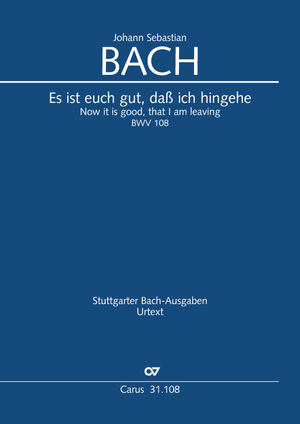
The cantata "Es ist euch gut, dass ich hingehe" [It is well that I go forth] BWV 108 for Cantate Sunday is one of the cantatas composed on texts by the Leipzig poetess Christiane Mariane von Ziegler with which Bach concluded his second annual cycle of cantatas after he had abandoned the annual cycle of chorale cantatas at Easter 1725. The text contains two sayings by Jesus which are taken directly from the Sunday gospel reading (John 16:5-15). The quotation opening the cantata was set by Bach as a bass aria with solo oboe d’amore; it breathes tranquility and assurance. The second quotation, however, is set as an extended choral fugue in three sections; it forms the center of the cantata. The free text surrounding the biblical quotations is divided into two arias in which the emphasis is on melodic lines; there is only one single recitative, the original text of which was substantially abridged by Bach. A four-part chorale concludes the cantata.
Explore

 Additional material
- Purchase additional material as a download product.
-
 Digital text (without sheet music) incl. printing licence, html file, singing text, english translationhtml file, singing text, english translation (Sample)1 Aria (Basso)
Now it is good, that I am leaving,
2 Aria (Tenore)
for if I do not leave you,
then the Spirit is delayed;
but if I do leave now,
the Comforter will come down.My faith no doubts can hinder;
3 Recitativo (Tenore)
to your word I surrender.
I know that if you leave,
your comfort is my shelter;
with all redeemed we enter
your heaven to receive.Your Spirit will divinly rule me,
4 Coro
that I may walk the righteous path;
by your ascension he comes down to me.
Concerned I ask but this:
Is he already here?...
-
Digital text (without sheet music) incl. printing licence, html file, singing text, originalhtml file, singing text, original (Sample)1 Aria (Basso)
Es ist euch gut, dass ich hingehe;
2 Aria (Tenore)
denn so ich nicht hingehe,
so kömmt der Tröster nicht zu euch.
So ich aber gehe, will ich ihn zu euch senden.Mich kann kein Zweifel stören,
3 Recitativo (Tenore)
auf dein Wort, Herr, zu hören.
Ich glaube, gehst du fort,
so kann ich mich getrösten,
dass ich zu den Erlösten
komm an gewünschten Port.Dein Geist wird mich also regieren,
4 Coro
dass ich auf rechter Bahne geh;
durch deinen Hingang kommt er ja zu mir,
ich frage sorgensvoll: Ach, ist er nicht schon hier?Wenn aber jener, der Geist der Wahrheit,
...
Purchase
Additional product information
-
Composer
Johann Sebastian Bach
| 1685-1750Johann Sebastian Bach is one of the most important composers of Western music history. He came from a widely ramified musical dynasty, which produced numerous musicians and organists in the Thuringian-Saxon area.
Bach vocal
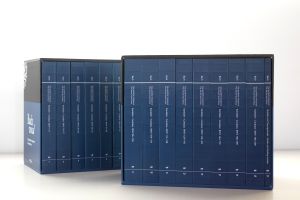
Ever since Carus-Verlag was founded in 1972, publishing the music of Johann Sebastian Bach has been a special focus for us. In the 2017 Reformation anniversary year we completed the Bach vocal project. Bach's complete sacred vocal works are now available in modern Urtext editions, together with performance material. A complete edition of all the full scores is also available in a high quality box set. Personal details
-
Editor
Reinhold Kubik
| 1942-2024
-
Songwriter / Librettist
Christiane Mariane von Ziegler
-
Continuo realization
Paul Horn
| 1922-2016Paul Horn war ein deutscher Kirchenmusiker, Organist, Komponist und Musikwissenschaftler. Er studierte Kirchenmusik und Orgel an der Evangelischen Kirchenmusikschule Esslingen am Neckar bei Hans-Arnold Metzger und Musikwissenschaft, Theologie und Geschichte an der Universität Tübingen. Seine berufliche Laufbahn begann als Kantor an der Evangelischen Michaelskirche in Stuttgart-Degerloch. 1954 wurde er Kantor an der Evangelischen Stadtkirche Ravensburg, eine Position, die er bis zu seiner Pensionierung innehatte. Als Musikwissenschaftler arbeitete Horn bis ins hohe Alter eng mit Carus zusammen. So stammen zahlreiche Carus-Klavierauszüge aus seiner Feder. Personal details
-
Preface writer
Karin Wollschläger
-
Translator
Vernon Wicker
| 1934-2024
Reviews on our website can only be submitted by customers with a registered user account. A check whether the rated products were actually purchased does not take place.
No feedback available for this product.
Frequent questions about this work
 There are no questions and answers available so far or you were unable to find an answer to your specific question about this work? Then click here and send your specific questions to our Customer Services!