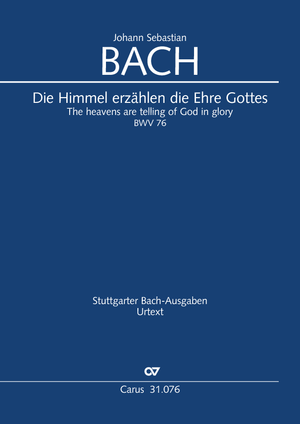
The heavens are telling of God in glory
Cantata for the 2nd Sunday afer Trinity / Reformation Day BWV 76, 1723
The cantata "Die Himmel erzählen die Ehre Gottes" (The heavens are telling of God in glory) BWV 76 by Johann Sebastian Bach was written for the 2nd Sunday after Trinity, which fell on 6 June 1723 in the year it was first performed. This ambitious two-part work was the second cantata which Bach wrote after taking up the position of Kantor of St. Thomas’s in Leipzig. Bach’s aim was evidently to demonstrate a particularly wide range of musical forms in both the arias and the recitatives in this cantata. The opening chorus is based on verses 2 and 4 of Psalm 19, with verse 4 structured as a choral fugue. Both parts of the cantata end with a chorale movement with different verses from the Lutheran hymn "Es woll uns Gott genädig sein". The text refers loosely to the epistle reading from the 1st letter of St John, but deals more with general thoughts about the temptations of the Christian which can be overcome through love. Bach also performed the first part of the cantata later with minor revisions, but evidently no alterations to the text, on Reformation Day in Leipzig.
Explore
 View
View

 Additional material
- Purchase additional material as a download product.
-
 Digital text (without sheet music) incl. printing licence, html file, singing text, english translationhtml file, singing text, english translation (Sample)Prima parte 1 Coro
The heavens are telling of God in glory,
2 Recitativo (Tenore)
and the firmament praises the work his hands have made.
There is not a nation or language,
which would not comprehend their message.By this our God reveals his glory;
3 Aria (Soprano)
his grace and nature do speak to everyone
and all this, God for us has done.
The heavens and the ocean,
like mind and being, are in motion.
The Lord bends down to us in mercy
and calls in many varied ways:
Come, come, take his supper, give him praise!Nations, listen to God’s calling,
come before his throne of grace!
He is alpha and omega;
to the only Son be praise!...
-
Digital text (without sheet music) incl. printing licence, html file, singing text, originalhtml file, singing text, original (Sample)1. Teil 1 Coro
Die Himmel erzählen die Ehre Gottes,
2 Recitativo (Tenore)
und die Feste verkündiget seiner Hände Werk.
Es ist keine Sprache noch Rede,
da man nicht ihre Stimme höre.So lässt sich Gott nicht unbezeuget!
3 Aria (Soprano)
Natur und Gnade redt alle Menschen an:
Dies alles hat ja Gott getan,
dass sich die Himmel regen
und Geist und Körper sich bewegen.
Gott selbst hat sich zu euch geneiget
und ruft durch Boten ohne Zahl:
Auf, kommt zu meinem Liebesmahl!Hört, ihr Völker, Gottes Stimme,
eilt zu seinem Gnadenthron.
Alle Dinge Grund und Ende
ist sein eingeborner Sohn,...
Purchase
Additional product information
-
Composer
Johann Sebastian Bach
| 1685-1750Johann Sebastian Bach is one of the most important composers of Western music history. He came from a widely ramified musical dynasty, which produced numerous musicians and organists in the Thuringian-Saxon area.
Bach vocal
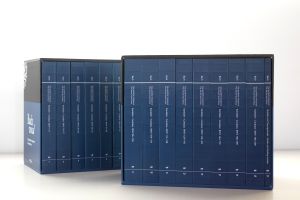
Ever since Carus-Verlag was founded in 1972, publishing the music of Johann Sebastian Bach has been a special focus for us. In the 2017 Reformation anniversary year we completed the Bach vocal project. Bach’s complete sacred vocal works are now available in modern “Urtext” editions, together with performance material. A complete edition of all the full scores is also available in a high quality box set.
Personal details
-
Editor
Ulrich Leisinger
-
Continuo realization
Paul Horn
| 1922-2016Paul Horn war ein deutscher Kirchenmusiker, Organist, Komponist und Musikwissenschaftler. Er studierte Kirchenmusik und Orgel an der Evangelischen Kirchenmusikschule Esslingen am Neckar bei Hans-Arnold Metzger und Musikwissenschaft, Theologie und Geschichte an der Universität Tübingen. Seine berufliche Laufbahn begann als Kantor an der Evangelischen Michaelskirche in Stuttgart-Degerloch. 1954 wurde er Kantor an der Evangelischen Stadtkirche Ravensburg, eine Position, die er bis zu seiner Pensionierung innehatte. Als Musikwissenschaftler arbeitete Horn bis ins hohe Alter eng mit Carus zusammen. So stammen zahlreiche Carus-Klavierauszüge aus seiner Feder. Personal details
-
Translator
Vernon Wicker
| 1934-2024
Reviews on our website can only be submitted by customers with a registered user account. A check whether the rated products were actually purchased does not take place.
No feedback available for this product.
Frequent questions about this work
 There are no questions and answers available so far or you were unable to find an answer to your specific question about this work? Then click here and send your specific questions to our Customer Services!