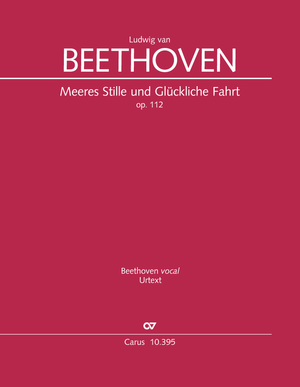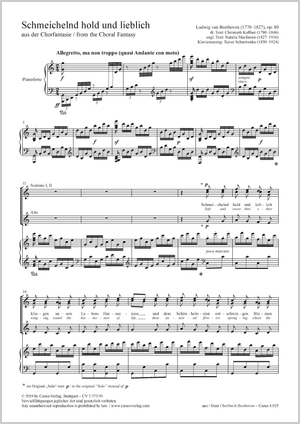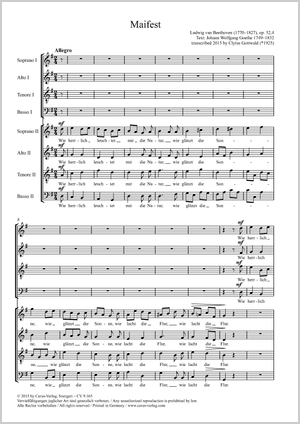
Three Songs based on Words by Goethe. Vocal transcription by Clytus Gottwald
In the last few years, Clytus Gottwald’s sophisticated arrangements have very successfully established themselves in the choral repertoire all over the world. In his choral transcriptions, Gottwald applies the vocal compositional techniques of contemporary music to traditional compositions, using the highly differentiated sound to reveal the structures of these works.
Explore
 View
View

 Listen
(2)
Listen
(2)
- Neue Liebe, neues Leben
- Wonne der Wehmut
Purchase
Additional product information


-
Composer
Ludwig van Beethoven
| 1770-1827Ludwig van Beethoven was without doubt one of the most influential composers in the history of music. His works formed the culmination of many genres – particularly instrumental – of Viennese classicism, and laid the foundation for the following decades. But Beethoven’s vocal works set standards too: the late Missa Solemnis is one of the most impressive choral works of its time; but his earlier Mass in C also opens up new worlds of expression for the liturgical text, and set the benchmark for the further development in the composition of the mass. And with the final chorus of the Ninth Symphony, the setting of Schiller’s Ode to Joy, Beethoven created one of the most frequently-performed and best known choral pieces of all, writing a timeless musical memorial to himself. Personal details
-
Songwriter / Librettist
Johann Wolfgang Goethe
| -1832Johann Wolfgang von Goethe is today a dazzling figure in world literature. He was born in Frankfurt am Main and initially studied law, but then followed his inclination towards poetry. With the drama Götz von Berlechingen and the epistolary novel The Sorrows of Young Werther, he made important contributions to the literary movement of Sturm und Drang.
From 1775 onwards, Goethe was employed at the court of Duke Carl August in Weimar. In addition to his work at court as a minister and director of the Weimar Court Theatre, he wrote his major works here, including the drama Faust, other novels and many poems, which are still a source of inspiration for musical adaptations today. His poems were a source of inspiration for composers, especially in the 19th century, such as Franz Schubert. Schubert alone set 52 of Goethe's works to music, the best known of which are probably the songs Gretchen am Spinnrade and Erlkönig. Goethe also became acquainted with several composers of the time. He was particularly enthusiastic about the young Felix Mendelssohn-Bartholdy, who also set Goethe's lines to music in the ballad Die erste Walpurgisnacht (The First Walpurgis Night). Personal details
-
Arranger
Clytus Gottwald
| 1925-2023The choral conductor, composer and musicologist Clytus Gottwald (1925 - 2023) made significant contributions to contemporary choral music. As editor for New Music at Südfunk Stuttgart and founder and director of the Schola Cantorum Stuttgart, he was in productive exchange with his contemporaries, Pierre Boulez, Mauricio Kagel, György Ligeti, Luigi Nono, Karlheinz Stockhausen and many others. With his Schola Cantorum, a 16-voice chamber vocal ensemble, Gottwald decisively shaped the a cappella choral culture of the highest technical level that is taken for granted today. Clytus Gottwald's transcriptions of piano songs and instrumental pieces for unaccompanied choir are appreciated by choirs all over the world. Modelled on the style of Ligeti, his works set the highest of musical standards. Clytus Gottwald has received several awards for his services, including the Cultural Prize of Baden-Württemberg in 2009, the European Church Music Prize in 2012, and the Cross of Merit of the Federal Republic of Germany in 2014. His importance for the development of contemporary choral music cannot be overestimated. Personal details
Reviews on our website can only be submitted by customers with a registered user account. A check whether the rated products were actually purchased does not take place.
No feedback available for this product.
Frequent questions about this work
 There are no questions and answers available so far or you were unable to find an answer to your specific question about this work? Then click here and send your specific questions to our Customer Services!