Trois Chansons
1914/1915
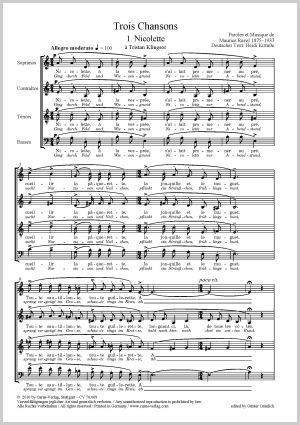
The French chanson of the sixteenth century serves as a musical model for the lightness of the other two songs. In the first piece Ravel also borrows from romantic fairy-tale motifs, when Little Red Riding Hood, aka Nicolette, escapes the wolf, but ultimately allows herself to be seduced by the riches of an old man instead of returning the love of a handsome young man. The third song Ronde (Roundelay) is a tongue-in-cheek recital of the horror stories that older men and women tell the young to scare them away from the forest. With a flourish Ravel reels off a list of all the frightening mythical forest creatures – an impressive collection of French tongue twisters.



 Listen
(3)
Listen
(3)
- Nicolette
- Ronde
- Trois beaux oiseaux du Paradis
Contents


-
Composer
Maurice Ravel
| 1875-1937Maurice Ravel was an important French composer and one of the main representatives of Impressionism in music.
He was born on March 7, 1875 in Ciboure near Saint-Jean-de-Luz and showed musical talent at an early age. He began taking piano lessons at the age of seven. His first works were written during composition lessons with Charles-René. In 1889, he was accepted at the Paris Conservatoire, where he initially pursued a career as a pianist, but later concentrated on composition. The extensive knowledge gained from his pianistic training is later evident in Ravel's piano writing and his understanding of orchestration, e.g. in his arrangement of Mussorgsky's Pictures at an Exhibition.
Ravel's compositional style is characterized by refined timbres, innovative harmonies and masterful orchestration. Despite his importance for the music history of the 20th century, he often remained controversial during his lifetime. Most of his works, with their unusual rhythms and harmonies, were initially met with incomprehension by the general public, but were praised by some critics for their innovative power. Nevertheless, works such as La Valse, Bolero and his two piano concertos became popular during his lifetime. In addition to his instrumental and stage works, Ravel also created vocal music, including the choral piece L'Aurore.
In the last years of his life, a progressive physical decline increasingly prevented him from performing in public and composing new works. He died in Paris on December 28, 1937.
Personal details
-
Editor
Günter Graulich
| 1926The publisher, church musician and teacher Günter Graulich is one of the major personalities in German publishing of the post-war period. With his wife Waltraud he founded Carus-Verlag Stuttgart in 1972, which he built up from a 2-person family firm to a medium-sized business with around 60 employees. A trained church musician and Kantor for many years at the Matthäuskirche Stuttgart, he also directed the Motettenchor Stuttgart for 50 years. With his choir he made LP and CD recordings, and undertook numerous concert tours to other European countries and America. Personal details
-
Translator
Heidi Kirmße
| 1925-2021Heidi Kirmße (1925–2021) studierte Schulmusik in Weimar und lebte dort als freischaffende Schriftstellerin, Herausgeberin und Übersetzerin. Für den Carus-Verlag erstellte sie insbesondere zahlreiche singbare deutsche Nachdichtungen aus unterschiedlichen Sprachen, u.a. für Kompositionen von Marc-Antoine Charpentier, Antonín Dvorák, Gabriel Fauré, Edvard Grieg, Georg Friedrich Händel, Jules Massenet, Sergei Rachmaninow, Max Reger, Gioachino Rossini, Veljo Tormis, Giuseppe Verdi u.a., doch trat sie auch mit eigenen Texten in Erscheinung. Über 500 mittlerweile unveröffentlichte oder mittlerweile vergriffene Texte ihres umfangreichen Schaffens als Dichterin und Übersetzerin sind bei Carus in einer separaten Datenbank erfasst und können bei Interesse erfragt werden. Von ihrem bewussten, hinterfragenden Umgang mit Worten zeugt Heidi Kirmßes Gedicht mit dem gleichlautenden Titel:
Worte
So viele Worte werden viel zu oft gesagt,
so viele Fragen werden nicht genug gefragt.
Wo keine Frage steht, wird niemals eine Antwort sein,
und durch Gewöhnung wird der Sinn der Worte klein.
Und ist das Wort verbraucht, sein Inhalt leer und fad,
so wird es nie mehr Ansporn sein zur Tat.
Wir stehn verwundert, geben auf und fühlen uns beschämt
und merken nicht, dass wir doch selbst die Kraft gelähmt.
Drum wolln wir sorgen, dass Gewohnheit uns nicht trügt,
wir wollen fragen, bis die Antwort uns genügt,
wir wollen jedes Wort genau auf seinen Sinn durchschaun
und nur auf solchem festen Boden sicher baun.Heidi KirmßePersonal details
Reviews on our website can only be submitted by customers with a registered user account. A check whether the rated products were actually purchased does not take place.
Frequent questions about this work
 There are no questions and answers available so far or you were unable to find an answer to your specific question about this work? Then click here and send your specific questions to our Customer Services!