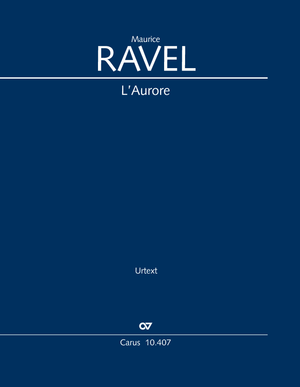
L’Aurore
op. 45, 1905
With his composition L’Aurore (Dawn) of 1905, Maurice Ravel made his fifth and final attempt to win the coveted “Prix de Rome” of Paris’s Académie des Beaux-Arts. The fact that he was once again eliminated in the preliminary round caused something of a stir, with the so-called “Ravel affair” triggering a historic scandal and discussions about the jury’s lack of expertise and impartiality.
Despite the strict requirements of the competition, Ravel created a singular and harmonically rich work on the given text by Édouard Guinand, exploiting the timbral possibilities of the orchestra in striking fashion. No heavy demands are placed on the choir. Carus also offers free pronunciation aids for rehearsal.
This first Urtext edition of the work is based on the composer’s autograph score. A vocal score and performance material are also available.
 View
View

 Practise
-
Pronouncing Aid
- L’Aurore
 Additional material
- Purchase additional material as a download product.
-
 Full score, foreword in German, English and Frenchforeword in German, English and French (Sample)L’Aurore
La terre s’éveille :
L’Aurore vermeille
Dore les coteaux.
Une fraîche haleine
Embaume la plaine
De parfums nouveaux.
Sur l’herbe irisée,
On voit la rosée
Couler en saphirs.
Mille ailes légères,
Quittant les fougères,
Volent aux zéphirs :
On voit la nature,
Dans une hymne pure,
Saluant les cieux.Salut, ô jour levant, à ton berceau superbe !
Salut, soleil fécond, à ton rayon naissant !
Depuis l’homme debout jusqu’à l’humble brin d’herbe,
Tout t’acclame ici-bas d’un coeur reconnaissant.Pour le sillon c’est la richesse,
C’est la sève pour le roseau ;
C’est la chanson pleine d’ivresse
Qu’à son nid roucoule l’oiseau.
Pour la forêt, c’est la lumière,
Le parfum pour les prés en fleurs ;
Pour l’humanité tout entière,
C’est la vie et c’est le bonheur.Salut, ô jour levant, à ton berceau superbe !
Salut, soleil fécond, à ton rayon naissant !...
-
Digital text (without sheet music) incl. printing licence, html file, singing text, originalhtml file, singing text, original (Sample)Das Morgenrot
Die Erde erwacht,
das Morgenrot
vergoldet die Hügel.
Ein frischer Hauch
erfüllt die Ebene
mit neuen Düften.
Auf dem schillernden Gras
sieht man den Tau
wie Saphir fließen.
Tausend leichte Schwingen
erheben sich aus den Farnwedeln
und fliegen zu den Zephiren:
Man sieht die Natur
in einer reinen Hymne
die Himmel grüßend.Sei gegrüßt, o Tagesanbruch, an deiner prächtigen Wiege!
Sei gegrüßt, fruchtbare Sonne, mit deinem jungen Strahl!
Vom aufrecht gehenden Menschen bis zum demütigen Grashalm
bejubelt dich alles hier auf Erden mit dankbarem Herzen.Für die Furche ist es die Fülle,
es ist der Saft für das Schilfrohr;
es ist der Gesang voller Trunkenheit,
den der Vogel in seinem Nest gurrt.
Für den Wald ist es das Licht,
das Parfüm für die blumenbedeckten Wiesen;
für die ganze Menschheit
ist es das Leben und das Glück.Sei gegrüßt, o Tagesanbruch, an deiner prächtigen Wiege!
Sei gegrüßt, fruchtbare Sonne, mit deinem jungen Strahl!
Vom aufrecht gehenden Menschen bis zum demütigen...
-
Digital text (without sheet music) incl. printing licence, html file, singing text, english translationhtml file, singing text, english translation (Sample)Dawn
The earth awakens,
and dawn
gilds the hills.
A breath of fresh air
suffuses the plains
with new fragrances.
On the shimmering grass
we see the dew
flow like sapphire.
A thousand light wings
rise from the fern fronds
and fly to the zephyrs:
We see nature
in a lucid hymn
greeting the heavens.We greet you, O dawn, in your magnificent cradle!
We greet you, fruitful sun, with your youthful rays!
From the human walking erect down to the humble blade of grass
everything here on earth acclaims you with a heart full of gratitude.For the furrow, it is the fullness,
it is the sap for the reed;
it is the song full of intoxication
that the bird coos in its nest.
For the forest, it is the light,
the perfume for the flower-covered meadows;
for all mankind
it is life and happiness.We greet you, O dawn, in your magnificent cradle!
We greet you, fruitful sun, with your youthful rays!
From the human walking erect down to the humble blade of grass
everything here on earth acclaims you with a heart full of gratitude.Édouard Guinand (1838–1909)
Translation: Gudrun and David Kosviner...
-
Composer
Maurice Ravel
| 1875-1937Maurice Ravel was an important French composer and one of the main representatives of Impressionism in music.
He was born on March 7, 1875 in Ciboure near Saint-Jean-de-Luz and showed musical talent at an early age. He began taking piano lessons at the age of seven. His first works were written during composition lessons with Charles-René. In 1889, he was accepted at the Paris Conservatoire, where he initially pursued a career as a pianist, but later concentrated on composition. The extensive knowledge gained from his pianistic training is later evident in Ravel's piano writing and his understanding of orchestration, e.g. in his arrangement of Mussorgsky's Pictures at an Exhibition.
Ravel's compositional style is characterized by refined timbres, innovative harmonies and masterful orchestration. Despite his importance for the music history of the 20th century, he often remained controversial during his lifetime. Most of his works, with their unusual rhythms and harmonies, were initially met with incomprehension by the general public, but were praised by some critics for their innovative power. Nevertheless, works such as La Valse, Bolero and his two piano concertos became popular during his lifetime. In addition to his instrumental and stage works, Ravel also created vocal music, including the choral piece L'Aurore.
In the last years of his life, a progressive physical decline increasingly prevented him from performing in public and composing new works. He died in Paris on December 28, 1937.
Personal details
-
Editor
Marc Rigaudière
Marc Rigaudière is a professor of musicology at the University of Reims Champagne-Ardenne (URCA) and at the Center for Research and Higher Education in Cultural History (CERHiC) there. As early as 1993, Marc Rigaudière was the first prize-winner in the subject of musical analysis at the Paris Conservatoire (CNSMDP). This was followed by a doctorate from the University of Paris Sorbonne in 2002 and a habilitation in 2019. Marc Rigaudière has held teaching positions at various universities, including the conservatory in Metz and the Sorbonne in Paris. His main fields of research are music theory and musical analysis, among other things, he is concerned with Franco-German cultural transfer in the field of music theory. Since 2002, he has devoted himself to the scholarly editing of musical works in collaboration with Carus-Verlag. His complete list of publications can be found here: https://cv.hal.science/marc-rigaudiere Personal details
-
Songwriter / Librettist
Édouard Guinand
| 1838-1909
Reviews on our website can only be submitted by customers with a registered user account. A check whether the rated products were actually purchased does not take place.
Frequent questions about this work
 There are no questions and answers available so far or you were unable to find an answer to your specific question about this work? Then click here and send your specific questions to our Customer Services!