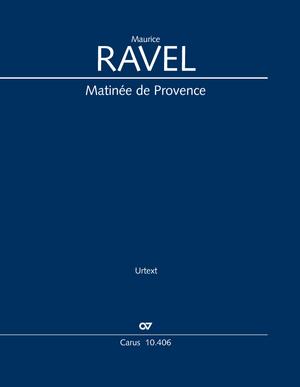
Matinée de Provence
1903
The soft light of the early morning, the song of the cicadas and the beguiling scent of thyme: Matinée de Provence describes a morning in Provence, from the first rays of sunshine to the sweltering midday heat. Ravel captures the imagery of the text with striking melodies, colorful harmonies and brilliant orchestration. The result is a musical mood piece with a captivating atmosphere that exudes sensuality – a true choral gem and an exciting addition to the concert repertoire for mixed choirs.
Matinée de Provence was Maurice Ravel’s submission to the prestigious Prix de Rome in 1903 – already his fourth attempt. The coveted prize bestowed by Paris’s Académie des Beaux-Arts included a bursary for a multi-year study trip to Rome. Although Ravel was once again unsuccessful, his composition did make it through to the final round. Despite the strict conditions imposed by the competition rules, the work is still an impressive demonstration of Ravel’s characteristic tonal language.
This first Urtext edition is based on the composer’s autograph score. Free pronunciation aids are available for rehearsal.

 Practise
-
Pronouncing Aid
- Matinée de Provence
 Additional material
- Purchase additional material as a download product.
-
 Digital text (without sheet music) incl. printing licence, html file, singing text original + german & english translationhtml file, singing text original + german & english translation (Sample)Matinée de Provence
Dans le ciel bleu de la Provence,
Au-dessus des blancs lauriers thym,
Le soleil se lève et s’avance,
Perçant l’or pâle du lointain.Il resplendit ! et les cigales,
Dans les grands pins harmonieux,
Font monter leurs notes égales
Vers l’azur éclatant des cieux.Il resplendit ! et dans l’espace
Où flotte une poussière d’or,
L’hirondelle bondit et passe,
Revient, s’en va, revient encor.De partout la lumière éclate
...
-
Composer
Maurice Ravel
| 1875-1937Maurice Ravel was an important French composer and one of the main representatives of Impressionism in music.
He was born on March 7, 1875 in Ciboure near Saint-Jean-de-Luz and showed musical talent at an early age. He began taking piano lessons at the age of seven. His first works were written during composition lessons with Charles-René. In 1889, he was accepted at the Paris Conservatoire, where he initially pursued a career as a pianist, but later concentrated on composition. The extensive knowledge gained from his pianistic training is later evident in Ravel's piano writing and his understanding of orchestration, e.g. in his arrangement of Mussorgsky's Pictures at an Exhibition.
Ravel's compositional style is characterized by refined timbres, innovative harmonies and masterful orchestration. Despite his importance for the music history of the 20th century, he often remained controversial during his lifetime. Most of his works, with their unusual rhythms and harmonies, were initially met with incomprehension by the general public, but were praised by some critics for their innovative power. Nevertheless, works such as La Valse, Bolero and his two piano concertos became popular during his lifetime. In addition to his instrumental and stage works, Ravel also created vocal music, including the choral piece L'Aurore.
In the last years of his life, a progressive physical decline increasingly prevented him from performing in public and composing new works. He died in Paris on December 28, 1937.
Personal details
-
Editor
Marc Rigaudière
Marc Rigaudière is a professor of musicology at the University of Reims Champagne-Ardenne (URCA) and at the Center for Research and Higher Education in Cultural History (CERHiC) there. As early as 1993, Marc Rigaudière was the first prize-winner in the subject of musical analysis at the Paris Conservatoire (CNSMDP). This was followed by a doctorate from the University of Paris Sorbonne in 2002 and a habilitation in 2019. Marc Rigaudière has held teaching positions at various universities, including the conservatory in Metz and the Sorbonne in Paris. His main fields of research are music theory and musical analysis, among other things, he is concerned with Franco-German cultural transfer in the field of music theory. Since 2002, he has devoted himself to the scholarly editing of musical works in collaboration with Carus-Verlag. His complete list of publications can be found here: https://cv.hal.science/marc-rigaudiere Personal details
-
Songwriter / Librettist
Jean Renouard
Reviews on our website can only be submitted by customers with a registered user account. A check whether the rated products were actually purchased does not take place.
Frequent questions about this work
 There are no questions and answers available so far or you were unable to find an answer to your specific question about this work? Then click here and send your specific questions to our Customer Services!