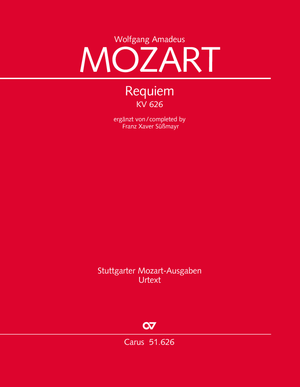
The composition of the Requiem is surrounded by anecdotes and legends. Mozart’s student Franz Xaver Süßmayr completed the unfinished work after Mozart’s death. But in musical terms, the work offers far more than mere anecdotes: Mozart’s choral writing, at the height of his art, presents singers with harmonically challenging passages and thrilling fugues. If you master this, there’s great enjoyment to be had from singing the work, despite its subject matter ...
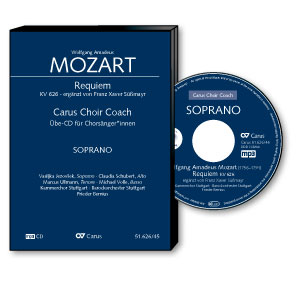
The Carus Choir Coach offers choir singers the unique opportunity to study and learn their own, individual choral parts within the context of the sound of the entire choir and orchestra. For every vocal range a separate Audio CD or MP3 and download containing each choir part is available. The Carus Choir Coach is based on recorded interpretations by renowned artists who have performed the work from carefully prepared Carus Urtext editions. Each choir part is presented in three different versions:
- Original recording
- Coach: each part is accompanied by the piano, with the original recording sounding in the background
- Coach in slow mode: the tempo of the coach slows down to 70% of the original version – through this reduction passages can be learned more effectively.
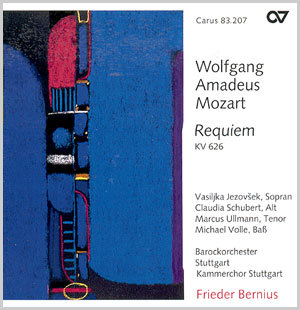
Performers: Vasiljka Jezovsek (soprano), Claudia Schubert (alto), Marcus Ullmann (tenore), Michael Volle (basso) – Kammerchor Stuttgart, Barockorchester Stuttgart – Frieder Bernius.
Also suitable for practicing Howard Arman's version of the Requiem (CV 51.652/00) (except for the Lacrimosa and Fugue).
Explore
 Listen
(13)
Listen
(13)
- Introitus
- Kyrie
- Dies irae
- Rex tremendae
- Confutatis
- Lacrimosa
- Domine Jesu Christe
- Hostias et preces
- Sanctus
- Benedictus
- Agnus Dei
- Lux aeterna
- Cum Sanctis tuis
 Practise
-
 carus music, the Choir Coach
Üben mit carus music
carus music, the Choir Coach
Üben mit carus music
-
Practice aids
-
Practice aids voice part alto
- Introitus (Choir Coach)
- Introitus (Choir Coach, Slow mode)
- Kyrie (Choir Coach)
- Kyrie (Choir Coach, Slow mode)
- Dies irae (Choir Coach)
- Dies irae (Choir Coach, Slow mode)
- Rex tremendae (Choir Coach)
- Rex tremendae (Choir Coach, Slow mode)
- Confutatis (Choir Coach)
- Confutatis (Choir Coach, Slow mode)
- Lacrimosa (Choir Coach)
- Lacrimosa (Choir Coach, Slow mode)
- Domine Jesu Christe (Choir Coach)
- Domine Jesu Christe (Choir Coach, Slow mode)
- Hostias et preces (Choir Coach)
- Hostias et preces (Choir Coach, Slow mode)
- Sanctus (Choir Coach)
- Sanctus (Choir Coach, Slow mode)
- Benedictus (Choir Coach)
- Benedictus (Choir Coach, Slow mode)
- Agnus Dei (Choir Coach)
- Agnus Dei (Choir Coach, Slow mode)
- Lux aeterna (Choir Coach)
- Lux aeterna (Choir Coach, Slow mode)
- Cum Sanctis tuis (Choir Coach)
- Cum Sanctis tuis (Choir Coach, Slow mode)
-
Practice aids voice part tenore
- Introitus (Choir Coach)
- Introitus (Choir Coach, Slow mode)
- Kyrie (Choir Coach)
- Kyrie (Choir Coach, Slow mode)
- Dies irae (Choir Coach)
- Dies irae (Choir Coach, Slow mode)
- Rex tremendae (Choir Coach)
- Rex tremendae (Choir Coach, Slow mode)
- Confutatis (Choir Coach)
- Confutatis (Choir Coach, Slow mode)
- Lacrimosa (Choir Coach)
- Lacrimosa (Choir Coach, Slow mode)
- Domine Jesu Christe (Choir Coach)
- Domine Jesu Christe (Choir Coach, Slow mode)
- Hostias et preces (Choir Coach)
- Hostias et preces (Choir Coach, Slow mode)
- Sanctus (Choir Coach)
- Sanctus (Choir Coach, Slow mode)
- Benedictus (Choir Coach)
- Benedictus (Choir Coach, Slow mode)
- Agnus Dei (Choir Coach)
- Agnus Dei (Choir Coach, Slow mode)
- Lux aeterna (Choir Coach)
- Lux aeterna (Choir Coach, Slow mode)
- Cum Sanctis tuis (Choir Coach)
- Cum Sanctis tuis (Choir Coach, Slow mode)
-
Practice aids voice part basso
- Introitus (Choir Coach)
- Introitus (Choir Coach, Slow mode)
- Kyrie (Choir Coach)
- Kyrie (Choir Coach, Slow mode)
- Dies irae (Choir Coach)
- Dies irae (Choir Coach, Slow mode)
- Rex tremendae (Choir Coach)
- Rex tremendae (Choir Coach, Slow mode)
- Confutatis (Choir Coach)
- Confutatis (Choir Coach, Slow mode)
- Lacrimosa (Choir Coach)
- Lacrimosa (Choir Coach, Slow mode)
- Domine Jesu Christe (Choir Coach)
- Domine Jesu Christe (Choir Coach, Slow mode)
- Hostias et preces (Choir Coach)
- Hostias et preces (Choir Coach, Slow mode)
- Sanctus (Choir Coach)
- Sanctus (Choir Coach, Slow mode)
- Benedictus (Choir Coach)
- Benedictus (Choir Coach, Slow mode)
- Agnus Dei (Choir Coach)
- Agnus Dei (Choir Coach, Slow mode)
- Lux aeterna (Choir Coach)
- Lux aeterna (Choir Coach, Slow mode)
- Cum Sanctis tuis (Choir Coach)
- Cum Sanctis tuis (Choir Coach, Slow mode)
-
Practice aids voice part soprano
- Introitus (Choir Coach)
- Introitus (Choir Coach, Slow mode)
- Kyrie (Choir Coach)
- Kyrie (Choir Coach, Slow mode)
- Dies irae (Choir Coach)
- Dies irae (Choir Coach, Slow mode)
- Rex tremendae (Choir Coach)
- Rex tremendae (Choir Coach, Slow mode)
- Confutatis (Choir Coach)
- Confutatis (Choir Coach, Slow mode)
- Lacrimosa (Choir Coach)
- Lacrimosa (Choir Coach, Slow mode)
- Domine Jesu Christe (Choir Coach)
- Domine Jesu Christe (Choir Coach, Slow mode)
- Hostias et preces (Choir Coach)
- Hostias et preces (Choir Coach, Slow mode)
- Sanctus (Choir Coach)
- Sanctus (Choir Coach, Slow mode)
- Benedictus (Choir Coach)
- Benedictus (Choir Coach, Slow mode)
- Agnus Dei (Choir Coach)
- Agnus Dei (Choir Coach, Slow mode)
- Lux aeterna (Choir Coach)
- Lux aeterna (Choir Coach, Slow mode)
- Cum Sanctis tuis (Choir Coach)
- Cum Sanctis tuis (Choir Coach, Slow mode)
-
 Additional material
- Purchase additional material as a download product.
-
 Digital text (without sheet music) incl. printing licence, html file, singing text, originalhtml file, singing text, original (Sample)Introitus 1 Requiem aeternam (Coro)
Requiem aeternam dona eis, domine!
2 Kyrie (Coro)
Et lux perpetua luceat eis.
Te decet hymnus Deus in Sion,
et tibi reddetur votum in Jerusalem:
Exaudi orationem meam,
ad te omnis caro veniet
Dona eis requiem aeternam
et lux perpetua luceat eis.Kyrie eleison,
Sequenz 3 Dies irae (Coro)
Christe eleison.
Kyrie eleison,Dies irae dies illa,
solvet saeclum in favilla:
teste David cum Sibylla.
Quantus tremor est futurus,...
Purchase
Additional product information
-
Composer
Wolfgang Amadeus Mozart
| 1756-1791As the son of the deputy Kapellmeister to the Salzburg Prince-Archbishop, Mozart was constantly surrounded by church music in his youth. On his travels Mozart became familiar with Italian church music, and later in Vienna he studied the works of Bach and Handel. After moving to Vienna he was faced with the new challenges of composing opera and piano concertos, and significantly the “C Minor Mass” KV 427, the greatest sacred work of the first Vienna years, remained unfinished. The last period of his life again shows a change of direction to church music: Mozart successfully applied to succeed the terminally ill Leopold Hoffmann as Kapellmeister at St Stephen's Cathedral, but he was unable to take up the position as he died before Hoffmann. A gem such as the “Ave verum” KV 618 and the incomplete Requiem KV 626 give us an idea of what Mozart might have achieved as a composer of sacred music if he had taken up this important position. Personal details
-
Arranger
Franz Xaver Süßmayr
| 1766-1803
-
Choir
Kammerchor Stuttgart
The Kammerchor Stuttgart is regarded as one of the best ensembles of its kind. Over its fifty-year existence, Frieder Bernius has developed the choir into an exceptional ensemble acclaimed by audiences and press alike. This has led to invitations for the choir to perform at all the important European festivals. In Germany the chamber choir performs at festivals and in concert halls in repertoire ranging from the 17th to the 21st century. Frieder Bernius and his ensemble have received numerous accolades for their contribution to new music. The Kammerchor Stuttgart has made over 80 CDs and LPs, numerous of which have been awarded international recording prizes (including the Edison award, Diapason d’or, Gramophone Choice, Classical Internet Award, International Classical Music Award, and German Record Critics’ Award prizes). The International Federation for Choral Music has invited the ensemble to sing at the 1st, 4th and 10th World Symposia on Choral Music in Vienna, Sydney and Seoul. Regular tours of North America and Asia since 1988 and a South America tour reflect the Kammerchor Stuttgart’s international reputation. Since 1984 the top ensemble has also been invited to Israel biennially. Personal details
-
Orchestra
Barockorchester Stuttgart
The Barockorchester Stuttgart, which was founded by Bernius in 1985, specializes in 18th century music. The musicians are among the leading representatives of historical performance practice and perform exclusively on original instruments. The ensemble dedicates itself to a large extent to the revival of 18th century operas. It has performed at numerous international festivals, among others in Rome, Dresden and Göttingen. Personal details
-
Conductor
Frieder Bernius
| 1947Frieder Bernius’s work has earned great worldwide recognition. He is in demand internationally as a conductor and as a teacher. His principal artistic collaborators are the ensembles he founded himself, the Kammerchor Stuttgart, the Barockorchester Stuttgart, the Hofkapelle Stuttgart and the Klassische Philharmonie Stuttgart. As a guest conductor, he has collaborated repeatedly with, for example, the SWR Vokalensemble Stuttgart, the Deutsche Kammerphilharmonie Bremen, the Stuttgarter Kammerorchester and the Streicherakademie Bozen. Great stylistic versatility is Frieder Bernius’s hallmark. Whether he conducts vocal works by Monteverdi, Bach, Händel, Mozart, Beethoven, Fauré and Ligeti, stage music by Mendelssohn or symphonies by Haydn, Burgmüller and Schubert, his work always aims for a sound that is at once unmistakably personal and at the same time oriented towards the original period sound ideal. He devotes himself equally to the rediscovery of 18th century operas and to first performances of contemporary compositions. He is particularly interested in the musical history of southwestern Germany. Carus-Verlag has awarded Frieder Bernius a Golden CD for his complete recording of the sacred music of Felix Mendelssohn Bartholdy. The award was presented to him during the German Choir Festival in Stuttgart 2016. The sale of over 250,000 recordings, which has been acclaimed with a number of awards, has made a not insignificant contribution to what today is the obvious presence of Mendelssohn's complete œuvre in the concert repertoire. Personal details
-
Soloist - soprano
Vasiljka Jezovsek
-
Soloist - alto
Claudia Schubert
Claudia Schubert began studying singing in 1986 at the Hochschule für Musik und Darstellende Kunst in Frankfurt with Elsa Cavelti and participated in master classes with Laura Sarti in London. From 1987 to 1991 she held a scholarship from the Studienstiftung des Deutschen Volkes. Since 1987 she has appeared in many important music centers in Europe, in Israel, Japan, Canada and the USA. At renowned festivals for early music she has collaborated with conductors such as Frieder Bernius, Frans Brüggen, Sir John Eliot Gardiner, Reinhard Goebel, Ton Koopman, Herrmann Max, and Jordi Savall. Her activities have been augmented with guest appearances at the opera houses in Frankfurt, Brussels and Salzburg. Personal details
-
Soloist - tenor
Marcus Ullmann
-
Soloist - bass
Michael Volle
Reviews on our website can only be submitted by customers with a registered user account. A check whether the rated products were actually purchased does not take place.
Wolfgang Amadeus Mozart / Franz Xaver Süßmayr (arr.): Requiem (Süßmayr version) Carus Choir Coach (audio only), mp3 CD, practice aids, voice part soprano
I was somewhat surprised to find these so-called practice recordings. And I ask myself the...
Peter writes
I was somewhat surprised to find these so-called practice recordings. And I ask myself the question: Is this kind of thing effective? Doesn't something like this only promote the tiresome "re-singing mentality", where the choir singers sing after a "lead singer"? If someone is unable to work through a work that is still unknown to them on their own, they don't need such recordings, they need ear training and solfége. Has the rich industrialised country of Germany, the land of Goethe and Schiller, Bach, Beethoven and Mendelssohn, given up on counteracting musical anaphylaxis with a thorough education?
As "practice recordings" I would rather expect recordings where the own voice is completely missing! So that the person practising not only sings along, but has to sing himself. Of course, such recordings are more difficult to make, it is not enough to play the voice on the piano to a finished recording. A good example of this would be the Digital Academy courses from Voces8. They offer exactly that, the complete recording, where the voice to be practised is missing. Of course, this assumes that you have a certain level of aural motor skills and can make the connections between the music and the sound yourself. But this is essential for making music anyway. Just like reading text. Just imagine someone wants to put on an amateur theatre production and none of the actors can read or write. They all have to learn their lines by heart from audio recordings. Unimaginable, isn't it?
In my opinion, a proper rehearsal recording should include the following elements:
- preparatory exercises for difficult passages, mnemonic bridges to hit an initial note, rhythm exercises.
- a tempo adapted to the level of difficulty
- Singing complex passages (not with piano!)
- only for difficult passages, a recording where your own voice is emphasised (as a singing voice, not with piano)
- a final recording where your own voice is missing. The aim of the exercise is to be able to sing your own voice with this recording.
Is it all too much, too expensive, nobody pays for it? Maybe. Then it's no longer the land of Bach, Beethoven and Mendelssohn.
As "practice recordings" I would rather expect recordings where the own voice is completely missing! So that the person practising not only sings along, but has to sing himself. Of course, such recordings are more difficult to make, it is not enough to play the voice on the piano to a finished recording. A good example of this would be the Digital Academy courses from Voces8. They offer exactly that, the complete recording, where the voice to be practised is missing. Of course, this assumes that you have a certain level of aural motor skills and can make the connections between the music and the sound yourself. But this is essential for making music anyway. Just like reading text. Just imagine someone wants to put on an amateur theatre production and none of the actors can read or write. They all have to learn their lines by heart from audio recordings. Unimaginable, isn't it?
In my opinion, a proper rehearsal recording should include the following elements:
- preparatory exercises for difficult passages, mnemonic bridges to hit an initial note, rhythm exercises.
- a tempo adapted to the level of difficulty
- Singing complex passages (not with piano!)
- only for difficult passages, a recording where your own voice is emphasised (as a singing voice, not with piano)
- a final recording where your own voice is missing. The aim of the exercise is to be able to sing your own voice with this recording.
Is it all too much, too expensive, nobody pays for it? Maybe. Then it's no longer the land of Bach, Beethoven and Mendelssohn.
*This review was submitted in another language and has been translated for you.
Frequent questions about this work
 There are no questions and answers available so far or you were unable to find an answer to your specific question about this work? Then click here and send your specific questions to our Customer Services!