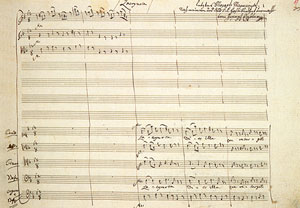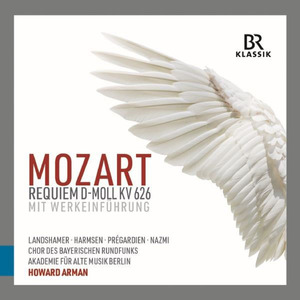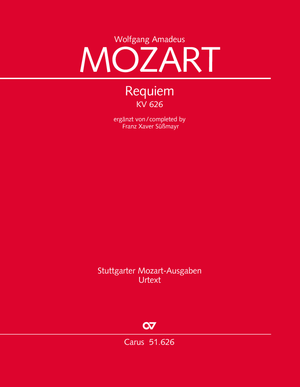
The history of the genesis of the Requiem is entwined with legends and anecdotes. The burdens of the composition and performance of La Clemenza di Tito and Die Zauberflöte, and an acute infection led to the collapse and death of the composer following a short illness.
When he died on December 5th, 1791, the composer left behind a fragment for a requiem composition, where the various sections were at different stages of completion. Mozart’s wife Constanze therefore turned to Mozart’s friends, asking them to complete the fragment. After two failed attempts, the task passed to Mozart’s pupil Franz Xaver Süßmayr, who completed the Requiem in the form known today, using working materials that are no longer extant, and perhaps verbal instructions from the composer. Today the Süßmayr version is still the most well known, and it is doubtless the one with the closest historical ties to Mozart.
Explore


 Listen
(13)
Listen
(13)
- Introitus
- Kyrie
- Dies irae
- Rex tremendae
- Confutatis
- Lacrimosa
- Domine Jesu Christe
- Hostias et preces
- Sanctus
- Benedictus
- Agnus Dei
- Lux aeterna
- Cum Sanctis tuis
 Practise
-
 carus music, the Choir Coach
Üben mit carus music
carus music, the Choir Coach
Üben mit carus music
-
Practice aids
-
Practice aids voice part soprano
- Introitus (Choir Coach)
- Introitus (Choir Coach, Slow mode)
- Kyrie (Choir Coach)
- Kyrie (Choir Coach, Slow mode)
- Dies irae (Choir Coach)
- Dies irae (Choir Coach, Slow mode)
- Rex tremendae (Choir Coach)
- Rex tremendae (Choir Coach, Slow mode)
- Confutatis (Choir Coach)
- Confutatis (Choir Coach, Slow mode)
- Lacrimosa (Choir Coach)
- Lacrimosa (Choir Coach, Slow mode)
- Domine Jesu Christe (Choir Coach)
- Domine Jesu Christe (Choir Coach, Slow mode)
- Hostias et preces (Choir Coach)
- Hostias et preces (Choir Coach, Slow mode)
- Sanctus (Choir Coach)
- Sanctus (Choir Coach, Slow mode)
- Benedictus (Choir Coach)
- Benedictus (Choir Coach, Slow mode)
- Agnus Dei (Choir Coach)
- Agnus Dei (Choir Coach, Slow mode)
- Lux aeterna (Choir Coach)
- Lux aeterna (Choir Coach, Slow mode)
- Cum Sanctis tuis (Choir Coach)
- Cum Sanctis tuis (Choir Coach, Slow mode)
-
Practice aids voice part alto
- Introitus (Choir Coach)
- Introitus (Choir Coach, Slow mode)
- Kyrie (Choir Coach)
- Kyrie (Choir Coach, Slow mode)
- Dies irae (Choir Coach)
- Dies irae (Choir Coach, Slow mode)
- Rex tremendae (Choir Coach)
- Rex tremendae (Choir Coach, Slow mode)
- Confutatis (Choir Coach)
- Confutatis (Choir Coach, Slow mode)
- Lacrimosa (Choir Coach)
- Lacrimosa (Choir Coach, Slow mode)
- Domine Jesu Christe (Choir Coach)
- Domine Jesu Christe (Choir Coach, Slow mode)
- Hostias et preces (Choir Coach)
- Hostias et preces (Choir Coach, Slow mode)
- Sanctus (Choir Coach)
- Sanctus (Choir Coach, Slow mode)
- Benedictus (Choir Coach)
- Benedictus (Choir Coach, Slow mode)
- Agnus Dei (Choir Coach)
- Agnus Dei (Choir Coach, Slow mode)
- Lux aeterna (Choir Coach)
- Lux aeterna (Choir Coach, Slow mode)
- Cum Sanctis tuis (Choir Coach)
- Cum Sanctis tuis (Choir Coach, Slow mode)
-
Practice aids voice part tenore
- Introitus (Choir Coach)
- Introitus (Choir Coach, Slow mode)
- Kyrie (Choir Coach)
- Kyrie (Choir Coach, Slow mode)
- Dies irae (Choir Coach)
- Dies irae (Choir Coach, Slow mode)
- Rex tremendae (Choir Coach)
- Rex tremendae (Choir Coach, Slow mode)
- Confutatis (Choir Coach)
- Confutatis (Choir Coach, Slow mode)
- Lacrimosa (Choir Coach)
- Lacrimosa (Choir Coach, Slow mode)
- Domine Jesu Christe (Choir Coach)
- Domine Jesu Christe (Choir Coach, Slow mode)
- Hostias et preces (Choir Coach)
- Hostias et preces (Choir Coach, Slow mode)
- Sanctus (Choir Coach)
- Sanctus (Choir Coach, Slow mode)
- Benedictus (Choir Coach)
- Benedictus (Choir Coach, Slow mode)
- Agnus Dei (Choir Coach)
- Agnus Dei (Choir Coach, Slow mode)
- Lux aeterna (Choir Coach)
- Lux aeterna (Choir Coach, Slow mode)
- Cum Sanctis tuis (Choir Coach)
- Cum Sanctis tuis (Choir Coach, Slow mode)
-
Practice aids voice part basso
- Introitus (Choir Coach)
- Introitus (Choir Coach, Slow mode)
- Kyrie (Choir Coach)
- Kyrie (Choir Coach, Slow mode)
- Dies irae (Choir Coach)
- Dies irae (Choir Coach, Slow mode)
- Rex tremendae (Choir Coach)
- Rex tremendae (Choir Coach, Slow mode)
- Confutatis (Choir Coach)
- Confutatis (Choir Coach, Slow mode)
- Lacrimosa (Choir Coach)
- Lacrimosa (Choir Coach, Slow mode)
- Domine Jesu Christe (Choir Coach)
- Domine Jesu Christe (Choir Coach, Slow mode)
- Hostias et preces (Choir Coach)
- Hostias et preces (Choir Coach, Slow mode)
- Sanctus (Choir Coach)
- Sanctus (Choir Coach, Slow mode)
- Benedictus (Choir Coach)
- Benedictus (Choir Coach, Slow mode)
- Agnus Dei (Choir Coach)
- Agnus Dei (Choir Coach, Slow mode)
- Lux aeterna (Choir Coach)
- Lux aeterna (Choir Coach, Slow mode)
- Cum Sanctis tuis (Choir Coach)
- Cum Sanctis tuis (Choir Coach, Slow mode)
-
 Additional material
- Purchase additional material as a download product.
-
 Digital text (without sheet music) incl. printing licence, html file, singing text, originalhtml file, singing text, original (Sample)Introitus 1 Requiem aeternam (Coro)
Requiem aeternam dona eis, domine!
2 Kyrie (Coro)
Et lux perpetua luceat eis.
Te decet hymnus Deus in Sion,
et tibi reddetur votum in Jerusalem:
Exaudi orationem meam,
ad te omnis caro veniet
Dona eis requiem aeternam
et lux perpetua luceat eis.Kyrie eleison,
Sequenz 3 Dies irae (Coro)
Christe eleison.
Kyrie eleison,Dies irae dies illa,
solvet saeclum in favilla:
teste David cum Sibylla.
Quantus tremor est futurus,...
Purchase
Additional product information
-
Composer
Wolfgang Amadeus Mozart
| 1756-1791As the son of the deputy Kapellmeister to the Salzburg Prince-Archbishop, Mozart was constantly surrounded by church music in his youth. On his travels Mozart became familiar with Italian church music, and later in Vienna he studied the works of Bach and Handel. After moving to Vienna he was faced with the new challenges of composing opera and piano concertos, and significantly the “C Minor Mass” KV 427, the greatest sacred work of the first Vienna years, remained unfinished. The last period of his life again shows a change of direction to church music: Mozart successfully applied to succeed the terminally ill Leopold Hoffmann as Kapellmeister at St Stephen's Cathedral, but he was unable to take up the position as he died before Hoffmann. A gem such as the “Ave verum” KV 618 and the incomplete Requiem KV 626 give us an idea of what Mozart might have achieved as a composer of sacred music if he had taken up this important position. Personal details
-
Editor
Ulrich Leisinger
-
Vocal score arranger
Paul Horn
| 1922-2016Paul Horn war ein deutscher Kirchenmusiker, Organist, Komponist und Musikwissenschaftler. Er studierte Kirchenmusik und Orgel an der Evangelischen Kirchenmusikschule Esslingen am Neckar bei Hans-Arnold Metzger und Musikwissenschaft, Theologie und Geschichte an der Universität Tübingen. Seine berufliche Laufbahn begann als Kantor an der Evangelischen Michaelskirche in Stuttgart-Degerloch. 1954 wurde er Kantor an der Evangelischen Stadtkirche Ravensburg, eine Position, die er bis zu seiner Pensionierung innehatte. Als Musikwissenschaftler arbeitete Horn bis ins hohe Alter eng mit Carus zusammen. So stammen zahlreiche Carus-Klavierauszüge aus seiner Feder. Personal details
-
Arranger
Franz Xaver Süßmayr
| 1766-1803
Reviews
[...] Nach zwei gescheiterten Versuchen kam die Aufgabe an Mozarts Schüler Franz Xaver Süßmayr, der das Requiem in der heute bekannten Form abschloss. Dabei standen ihm heute verlorenes Werkstattmaterial, vielleicht auch mündliche Anweisungen Mozarts zur Verfügung. Diese Version ist heute noch am bekanntesten, sie steht Mozart zweifellos historisch am nächsten. In einer Neuausgabe wird Süßmayrs Fassung getreu nach den Originalquellen wiedergegeben. Dankenswerterweise legt Carus eine neue, hervorragend gemachte Urtext-Ausgabe der Süßmayrschen Ergänzung von Mozarts letztem Werk vor. [...]
Quelle: Singende Kirche 3/07
[...] Die Carus-Ausgabe überzeugt durch das ausführliche Vorwort und einen besonders ausführlichen kritischen Bericht.
Musik&Liturgie, 2/09
Reviews on our website can only be submitted by customers with a registered user account. A check whether the rated products were actually purchased does not take place.
No feedback available for this product.
Frequent questions about this work
To which version of the Mozart Requiem do the recorded practice aids Carus Choir Coach and App fit?
The practice aids have been recorded with the Süßmayer version of the Mozart Requiem.
 There are no questions and answers available so far or you were unable to find an answer to your specific question about this work? Then click here and send your specific questions to our Customer Services!