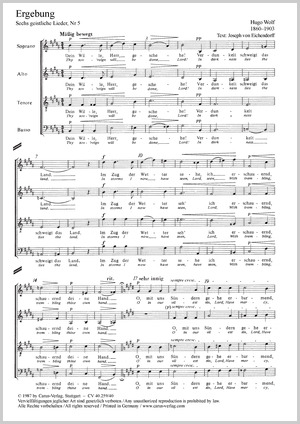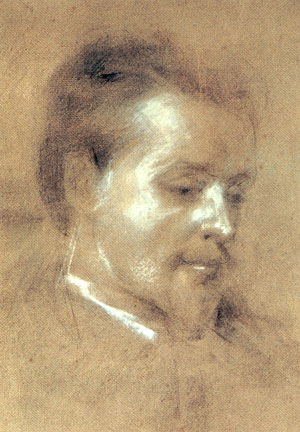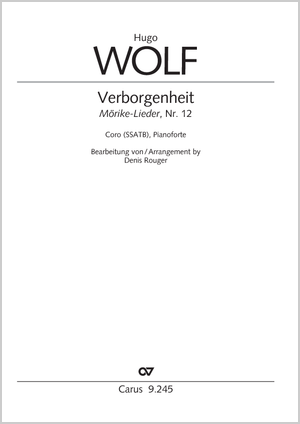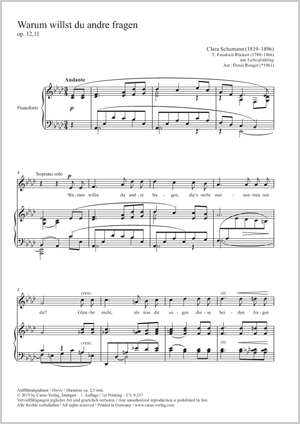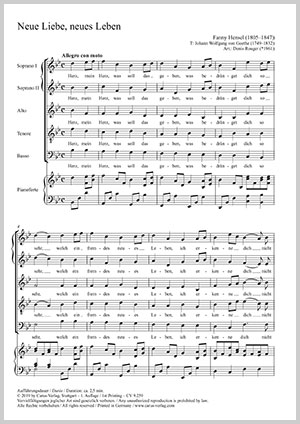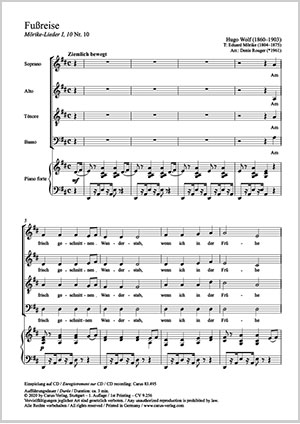
Hugo Wolf set a total of 53 songs by Eduard Mörike, all in the year 1888. The composer wrote in a letter: “Once you have heard this song, it can only inspire one wish – to die.” In the artistic-metaphysical milieu of the late 19th century this was regarded as the highest ideal, especially for Hugo Wolf, who believed in the body as a “wretched piano case” from which the soul can only break free like harmonies dying away.
And yet Fußreise (Journey on Foot) begins as a simple, happy, elated song of travel, revolving around the key of D major over an ostinato piano rhythm. “Old Adam” believes he senses the “bliss of paradise” in this, but he continues to be caught in the tension between earthly suffering and eternal longing, as the rest of Hugo Wolf's setting clearly shows: it remains a pious hope that a whole life “would be such a morning journey bathed in gentle perspiration”.
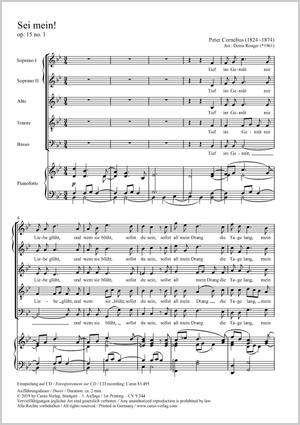
These art songs were originally composed not for chamber choir, but for solo voice and piano. Denis Rouger has carefully adapted them to suit the requirements and expressive possibilities offered by a larger ensemble, without losing the any of the qualities of the original in the process. Each part in the choir has a melodic line drawn from the harmonic and rhythmic framework. In the process, the variety and refinement of the choral language combines with an enormous flexibility in form and expression, as French melodies or German art song demand from a soloist and pianist.
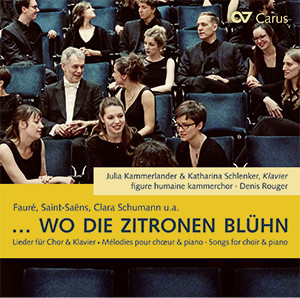
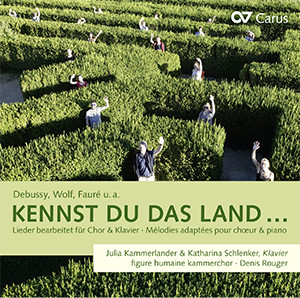
The songs have been recorded by the figure humaine chamber choir on the CD Kennst du das Land... (Carus 83.495).
Explore
 View
View
 Listen
(1)
Listen
(1)
- Fußreise
 Additional material
- Purchase additional material as a download product.
-
 Digital text (without sheet music) incl. printing licence, html file, singing text, originalhtml file, singing text, original (Sample)
Am frisch geschnittnen Wanderstab,
Wenn ich in der Frühe
So durch Wälder ziehe,
Hügel auf und ab:
Dann, wie’s Vöglein im Laube
Singet und sich rührt,
Oder wie die goldne Traube
Wonnegeister spürt
In der ersten Morgensonne:
So fühlt auch mein alter, lieber
Adam Herbst- und Frühlingsfieber,
Gottbeherzte,
nie verscherzte
Erstlings-Paradieseswonne.Also bist du nicht so schlimm,o alter
Adam, wie die strengen Lehrer sagen;
Liebst und lobst du immer doch,
Singst und preisest immer noch,
Wie an ewig neuen Schöpfungstagen,
Deinen lieben Schöpfer und Erhalter....
-
Digital text (without sheet music) incl. printing licence, html file, singing text, french translationhtml file, singing text, french translation (Sample)
Avec un bâton de promenade fraîchement coupé,
Lorsque de bon matin
Je marche à travers forêts
Et collines :
Alors, comme les oiseaux chantent
Et bougent dans les feuillages,
Ou comme le raisin doré
Ressent les esprits de la joie
Dans le premier soleil du matin :
Ainsi mon vieil Adam bien-aimé ressent
La fièvre de l’automne et du printemps,
Les premières
Joies du Paradis
Jamais gâchées, embrassées par Dieu.Donc tu n’es pas si terrible, ô vieil
Adam, comme le disent les professeurs sévères ;
Tu aimes et loues toujours,
Chantes et acclames encore, comme dans
Les nouveaux jours de la Création éternelle,
Ton créateur bien-aimé et ton soutien....
Purchase
Additional product information
-
Composer
Hugo Wolf
| 1860-1903
-
Songwriter / Librettist
Eduard Mörike
| 1804-1875Eduard Mörike was a German poet and writer of the Schwäbische Dichterschule. He studied theology at Tübingen Abbey and then worked as a vicar and parish administrator in various parishes. In 1834, Mörike was appointed pastor of Cleversulzbach until he took early retirement in 1843. From then on, he devoted his time entirely to his literary work and also began teaching literature at the Katharinenstift in Stuttgart in 1851. He lived and worked in Stuttgart until his death in 1875.
Eduard Mörike is considered one of the most important poets between Romanticism and Realism. His best-known works include the novel Maler Nolten, the novella Mozart auf der Reise nach Prag and numerous poems, including the popular Er ist's. His lyrical works deal with personal experiences and observations of nature, but his subjects also include mythological and religious motifs. His texts are characterized by a deep emotionality and musical quality, which has led to many musical settings of Mörike's poems. Josef G. Rheinberger, Robert Schumann, Max Bruch, Max Reger, Hugo Wolf, Peter Schindler and many others have used Mörike's texts for their compositions. Personal details
-
Arranger
Denis Rouger
| 1961Denis Rouger gained his initial musical experience as the son of a Parisian family of musicians and during his studies at the Conservatoire National Supérieur de Musique de Paris, where he received first prizes in harmony, fugue and counterpoint.
He was a lecturer and choirmaster at the University of Paris-Sorbonne for 20 years and choirmaster at Notre-Dame de Paris Cathedral for 10 years. He is honorary conductor of the Parisian church La Madeleine. He also collaborates with numerous ensembles in Germany. He has been invited as a guest conductor by radio choirs, the Balthasar-Neumann-Chor, the Baden-Württemberg State Youth Choir and the Stuttgart Philharmonic Orchestra, among others. Concerts have taken him to Italy, the Netherlands, Canada, Russia, the United Arab Emirates and Switzerland (Lucerne Festival).
He gives master classes in Sweden, Bulgaria, France, Germany, as well as in Switzerland.
Denis Rouger has been Professor of Choral Conducting at the Stuttgart State University of Music and Performing Arts since 2011. The chamber choir he founded at the university in the fall of 2011 won first prize at the International Choir Competition in Mosbach (Germany) in 2014.
In addition to his work as a choirmaster, he composes and arranges French and German songs for choir. His arrangements on the CDs Kennst Du das Land ... and ... wo die Zitronen blühn (Carus) were well received by the press and radio. In collaboration with Carus-Verlag, he has edited the choir book Französische Chormusik, which received the German Music Edition Award “Best Edition” in 2019.
In 2016, Denis Rouger founded the figure humaine kammerchor (www.figurehumaine.de), with which he regularly gives concerts at renowned festivals.
Personal details
Reviews on our website can only be submitted by customers with a registered user account. A check whether the rated products were actually purchased does not take place.
No feedback available for this product.
Frequent questions about this work
 There are no questions and answers available so far or you were unable to find an answer to your specific question about this work? Then click here and send your specific questions to our Customer Services!