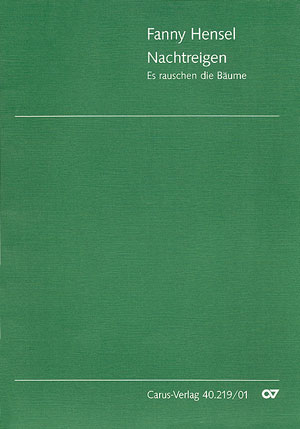
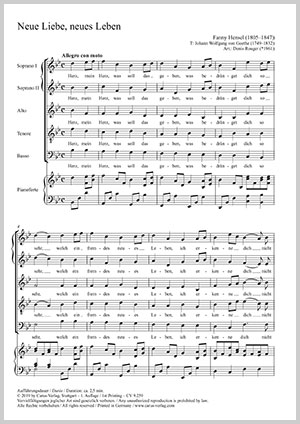
Neue Liebe, neues Leben comes from Johann Wolfgang von Goethe’s “Lili-Lyrik” of 1775, which reflects the experiences of his conflicted love for Anna Elisabeth “Lili” Schönemann. The text inspired many composers: as well as Beethoven, Reichardt, Spohr, and Zelter, Fanny Hensel, née Mendelssohn, also immersed herself in this poetry and set it to music. In her composition we feel both the elation of being in love as well as the inner turmoil and the sighs of the lover.
This art song was originally composed not for chamber choir, but for solo voice and piano. Denis Rouger has carefully adapted it to suit the requirements and expressive possibilities offered by a larger ensemble, without losing any of the qualities of the original in the process. Each part in the choir has a melodic line drawn from the harmonic and rhythmic framework. In the process, the variety and refinement of the choral language combines with an enormous flexibility in form and expression, as French melodies or German art song demand from a soloist and pianist.
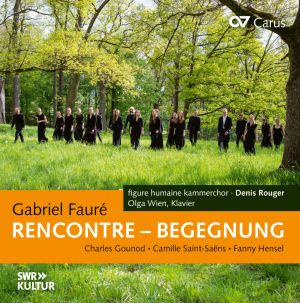
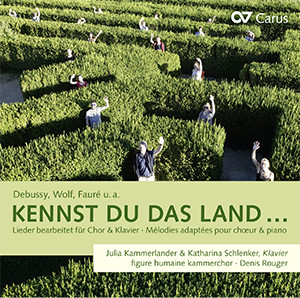
The songs have been recorded by the figure humaine chamber choir on the CD Kennst du das Land... (Carus 83.495).
Explore
 View
View

 Listen
(1)
Listen
(1)
- Neue Liebe, neues Leben
 Additional material
- Purchase additional material as a download product.
-
 Digital text (without sheet music) incl. printing licence, html file, singing text, originalhtml file, singing text, original (Sample)
Herz, mein Herz, was soll das geben?
Was bedränget dich so sehr?
Welch ein fremdes neues Leben
Ich erkenne dich nicht mehr.Weg ist alles, was du liebtest,
Weg, warum du dich betrübtest,
Weg dein Fleiß und deine Ruh,
Ach, wie kamst du nur dazu?Fesselt dich die Jugendblüte,
Diese liebliche Gestalt,
Dieser Blick voll Treu und Güte,
Mit unendlicher Gewalt?Will ich rasch mich ihr entziehen,
Mich ermannen, ihr entfliehen,
Führet mich im Augenblick,
Ach, mein Weg zu ihr zurück.Und an diesem zarten Fädchen,
Das sich nicht zerreißen lässt,
Hält das liebe, lose Mädchen
Mich so wider Willen fest;...
-
Digital text (without sheet music) incl. printing licence, html file, singing text, french translationhtml file, singing text, french translation (Sample)
Cœur, mon cœur, que se passe-t-il ?
Qu’est-ce qui t’opresse tant ?
Quelle est donc cette nouvelle vie étrange,
Je ne te reconnais plus.Tout ce que tu aimais est parti,
Ce qui te troublait est parti,
Ton zèle comme ton repos,
Ô comment est-ce donc possible ?Est-ce ce jeune sang qui te ligote,
Ce personnage bien-aimé,
Ce regard plein de fidélité et de bonté
Qui te ligote avec une force infinie ?Au moment où je veux m’éloigner d’elle,
M’encourager à la fuir,
Ô, à ce moment-même mon chemin
Me ramène-t-il à elle.Et à ce petit lien si tendre,
Qui ne se laisse point rompre,
La chère jeune fille légère
Tient ma volonté fermement....
Purchase
Additional product information
-
Composer
Fanny Hensel
| 1805-1847Fanny Hensel (1805-1847), born Mendelssohn, was one of the most talented female composers of the Romantic period and an important representative of 19th century German musical life. As the sister of Felix Mendelssohn-Bartholdy, she grew up in an artistic environment that encouraged her musical development from an early age, but also confronted her with social restrictions due to her gender. In the 1830s and 1840s in particular, Fanny Hensel composed a large number of songs, piano and choral works and - despite the reservations of her father and brother - ultimately decided to gradually publish her music. In her family home in Berlin, a centre for musicians and intellectuals, she performed many of these works, which combine romantic emotionality with tonal sophistication, as part of the so-called Sunday music. On 14 May 1847, she suffered a stroke during rehearsals for one of her popular Sunday concerts and died just a few hours later. Her impressive œuvre, which comprises more than 460 compositions, is today regarded as a significant contribution to Romantic musical culture and is attracting increasing attention in concerts and academic studies.
Personal details
-
Songwriter / Librettist
Johann Wolfgang Goethe
| -1832Johann Wolfgang von Goethe is today a dazzling figure in world literature. He was born in Frankfurt am Main and initially studied law, but then followed his inclination towards poetry. With the drama Götz von Berlechingen and the epistolary novel The Sorrows of Young Werther, he made important contributions to the literary movement of Sturm und Drang.
From 1775 onwards, Goethe was employed at the court of Duke Carl August in Weimar. In addition to his work at court as a minister and director of the Weimar Court Theatre, he wrote his major works here, including the drama Faust, other novels and many poems, which are still a source of inspiration for musical adaptations today. His poems were a source of inspiration for composers, especially in the 19th century, such as Franz Schubert. Schubert alone set 52 of Goethe's works to music, the best known of which are probably the songs Gretchen am Spinnrade and Erlkönig. Goethe also became acquainted with several composers of the time. He was particularly enthusiastic about the young Felix Mendelssohn-Bartholdy, who also set Goethe's lines to music in the ballad Die erste Walpurgisnacht (The First Walpurgis Night). Personal details
-
Arranger
Denis Rouger
| 1961Denis Rouger gained his initial musical experience as the son of a Parisian family of musicians and during his studies at the Conservatoire National Supérieur de Musique de Paris, where he received first prizes in harmony, fugue and counterpoint.
He was a lecturer and choirmaster at the University of Paris-Sorbonne for 20 years and choirmaster at Notre-Dame de Paris Cathedral for 10 years. He is honorary conductor of the Parisian church La Madeleine. He also collaborates with numerous ensembles in Germany. He has been invited as a guest conductor by radio choirs, the Balthasar-Neumann-Chor, the Baden-Württemberg State Youth Choir and the Stuttgart Philharmonic Orchestra, among others. Concerts have taken him to Italy, the Netherlands, Canada, Russia, the United Arab Emirates and Switzerland (Lucerne Festival).
He gives master classes in Sweden, Bulgaria, France, Germany, as well as in Switzerland.
Denis Rouger has been Professor of Choral Conducting at the Stuttgart State University of Music and Performing Arts since 2011. The chamber choir he founded at the university in the fall of 2011 won first prize at the International Choir Competition in Mosbach (Germany) in 2014.
In addition to his work as a choirmaster, he composes and arranges French and German songs for choir. His arrangements on the CDs Kennst Du das Land ... and ... wo die Zitronen blühn (Carus) were well received by the press and radio. In collaboration with Carus-Verlag, he has edited the choir book Französische Chormusik, which received the German Music Edition Award “Best Edition” in 2019.
In 2016, Denis Rouger founded the figure humaine kammerchor (www.figurehumaine.de), with which he regularly gives concerts at renowned festivals.
Personal details
Reviews on our website can only be submitted by customers with a registered user account. A check whether the rated products were actually purchased does not take place.
No feedback available for this product.
Frequent questions about this work
 There are no questions and answers available so far or you were unable to find an answer to your specific question about this work? Then click here and send your specific questions to our Customer Services!