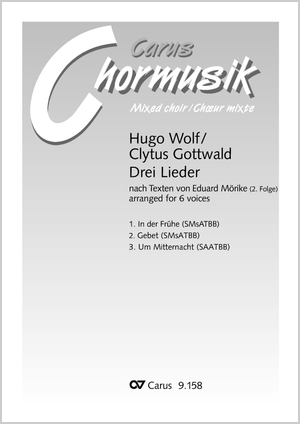
Drei Lieder
Vocal transcriptions after Clytus Gottwald
In the last few years, Clytus Gottwald’s sophisticated arrangements have very successfully established themselves in the choral repertoire all over the world. In his choral transcriptions, Gottwald applies the vocal compositional techniques of contemporary music to traditional compositions, using the highly differentiated sound to reveal the structures of these works.
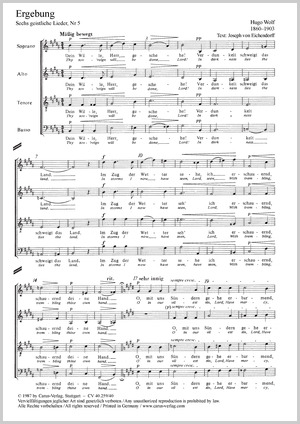
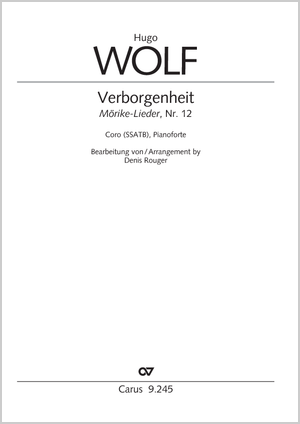
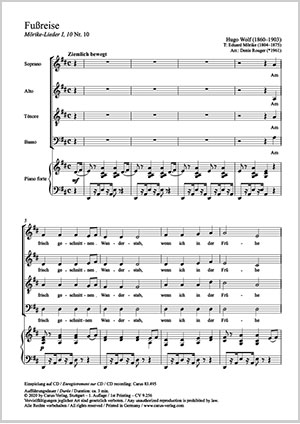
Hugo Wolf's 53 Lieder on poems by Eduard Mörike were composed during the years 1888–1890, almost simultaneously with the Lieder cycles on poems by Goethe and Eichendorff. In 2013, Clytus Gottwald transcribed three of the “Mörike Lieder” for vocal ensemble. In “In der Frühe” (At Dawn), the disturbing opening lines lead into chords depicting the comforting ringing of the morning bells. Gottwald's transcription aims at dramatizing this by making use of sonorities derived from the spectra of bell sounds. The famous “Gebet” (Prayer) is modeled after a chorale, but Wolf contradicts the “holdes Bescheiden” (beautiful humility) for which Mörike prays by means of a – not at all humble – reminiscence of “Isolde's Liebestod” (Isolde’s love death). In the third Lied,“"Um Mitternacht” (At Midnight), Wolf paints a somber world with gently blurred dissonances.
 View
View
 Additional material
- Purchase additional material as a download product.
-
 Digital text (without sheet music) incl. printing licence, html file, singing text, originalhtml file, singing text, original (Sample)Unbenanntes Dokument In der Frühe
Kein Schlaf noch kühlt das Auge mir,
Gebet
dort gehet schon der Tag herfür
an meinem Kammerfenster.
Es wühlet mein verstörter Sinn
noch zwischen Zweifeln her und hin
und schaffet Nachtgespenster. –
Ängste, quäle
dich nicht länger, meine Seele!
Freu’ dich! schon sind da und dorten
Morgenglocken wach geworden.Herr! schicke, was du willt,
...
-
Digital text (without sheet music) incl. printing licence, html file, singing text, english translationhtml file, singing text, english translation (Sample)Unbenanntes Dokument Early Morning
No sleep still cools my eyes,
Prayer
the day already steals upon us
outside my bedroom window.
My troubled mind still rummages
back and forth between my doubts,
and conjures ghosts of the night. –
Frighten, torment yourself no more,
my soul!
Be happy! Already morning bells
are waking here and there.Lord, send what you will,
...
-
Digital text (without sheet music) incl. printing licence, html file, singing text, french translationhtml file, singing text, french translation (Sample)Unbenanntes Dokument Au matin
Aucun sommeil ne vient apaiser ma paupière,
Prière
et le jour perce déjà
à ma fenêtre.
Mon esprit troublé est encore
tout agité de doutes peuplés
de spectres et de fantômes.
Cesse de t’angoisser et
de te torturer, mon âme !
Réjouis-toi ! Les matines s’éveillent
déjà ici et là.Seigneur ! Envoie ce que tu veux,
...
Contents
-
Composer
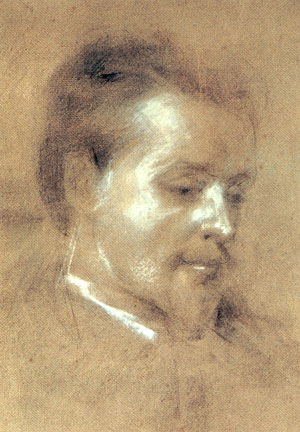
Hugo Wolf
| 1860-1903
-
Arranger
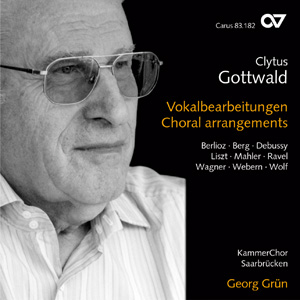
Clytus Gottwald
| 1925-2023The choral conductor, composer and musicologist Clytus Gottwald (1925 - 2023) made significant contributions to contemporary choral music. As editor for New Music at Südfunk Stuttgart and founder and director of the Schola Cantorum Stuttgart, he was in productive exchange with his contemporaries, Pierre Boulez, Mauricio Kagel, György Ligeti, Luigi Nono, Karlheinz Stockhausen and many others. With his Schola Cantorum, a 16-voice chamber vocal ensemble, Gottwald decisively shaped the a cappella choral culture of the highest technical level that is taken for granted today. Clytus Gottwald's transcriptions of piano songs and instrumental pieces for unaccompanied choir are appreciated by choirs all over the world. Modelled on the style of Ligeti, his works set the highest of musical standards. Clytus Gottwald has received several awards for his services, including the Cultural Prize of Baden-Württemberg in 2009, the European Church Music Prize in 2012, and the Cross of Merit of the Federal Republic of Germany in 2014. His importance for the development of contemporary choral music cannot be overestimated. Personal details
Reviews on our website can only be submitted by customers with a registered user account. A check whether the rated products were actually purchased does not take place.
Frequent questions about this work
 There are no questions and answers available so far or you were unable to find an answer to your specific question about this work? Then click here and send your specific questions to our Customer Services!