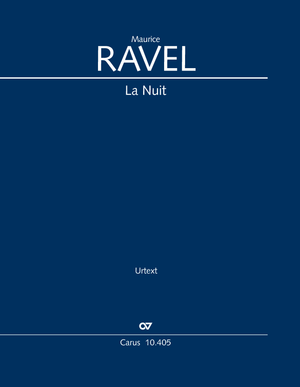
La Nuit
1902
The composition assignment for the prestigious Prix de Rome in 1902 was, as so often, to set nature poetry to music, in this case “La Nuit” by Auguste Lacaussade. The imagery of the soothing night softly covering all “earthly pain” with dreams inspired the candidate, Maurice Ravel, to create a main theme featuring a fluid, almost dance-like rhythm. At the same time, he chose very gentle, at times ethereal orchestral textures: muted strings paired with harp arpeggios and carefully balanced wind timbres. In contrast, Ravel strongly expressed the world's agony in his vocal writing for the solo soprano and choir.
Although the work was written to comply with the strict rules of the Prix de Rome, it still impressively showcases Ravel’s characteristic tonal language.
This first Urtext edition of the composition is based on Ravel’s autograph score. Free pronunciation aids are available to help practice the text.

 Practise
-
Pronouncing Aid
- La Nuit
 Additional material
- Purchase additional material as a download product.
-
 Digital text (without sheet music) incl. printing licence, html file, singing text, originalhtml file, singing text, original (Sample)La Nuit
(Chœur)
Nuit bienfaisante ! Ô Nuit ! mère des molles trêves,
Sur nos fronts épuisés de peine et de labeurs
Verse, avec le sommeil, les brises et les rêves,
Verse l’oubli sacré des terrestres douleurs !De la plage, en mourant, l’onde argente les sables.
Doucement balancés au lent roulis des flots,
Les navires du port, ondulant sur leurs câbles,
Se bercent endormis comme des (de grands) oiseaux.Tout repose, partout l’ombre épaissit ses voiles.
(Solo)
Seule, aux feux dont le ciel emplit ses bleus déserts,
La blanche Rêverie, amante des étoiles,
Médite et veille, assise au bord des flots amers.(Chœur)
Nuit bienfaisante, ô mère des molles trêves,
Ah ! sur nos fronts épuisés / pâlis de peine et de labeurs
Verse, avec le sommeil, les brises et les rêves,
Verse(-nous) l’oubli des terrestres douleurs !
Ô douce Nuit ! Ô Nuit bienfaisante !Auguste Lacaussade (1815–1897)
...
-
Digital text (without sheet music) incl. printing licence, html file, singing text, german translationhtml file, singing text, german translation (Sample)Die Nacht
(Chor)
Wohltuende Nacht! O Nacht! Mutter sanfter Ruhe,
über unsere von Kummer und Mühsal erschöpften Stirnen
gieße du, zusammen mit dem Schlaf, Brisen und Träume aus,
gieße das heilige Vergessen der irdischen Schmerzen!Die Wellen versilbern beim Zurückziehen den Sand des Meeresufers.
Sanft schaukelnd im langsamen Auf und Ab der Fluten,
wiegen sich die Schiffe im Hafen, an ihren Tauen schwankend,
schlafend wie (große) Vögel.Alles ruht, überall verdichtet der Schatten seine Schleier.
(Solo)
Allein, bei den Lichtern, mit denen der Himmel seine blauen Weiten erfüllt,
sinnt und wacht die weiße Träumerei, die Geliebte der Sterne,
am Ufer der bitteren Wogen sitzend.(Chor)
Wohltuende Nacht, o Mutter sanfter Ruhe,
ach, über unsere von Kummer und Mühsal erschöpften / erblassten Stirnen,
gieße du, zusammen mit dem Schlaf, Brisen und Träume aus,
gieße (uns) das Vergessen der irdischen Schmerzen!
O sanfte Nacht! O wohltuende Nacht!Auguste Lacaussade (1815–1897)
Übersetzung: Barbara Grossmann...
-
Digital text (without sheet music) incl. printing licence, html file, singing text, english translationhtml file, singing text, english translation (Sample)The Night
(Chorus)
Beneficent night! Oh Night! Mother of gentle repose,
upon our brows, weary from sorrow and toil,
pour, along with sleep, breezes and dreams,
pour the sacred oblivion of earthly sorrows!As they recede, the waves turn the sand on the seashore silvery.
Gently rocking in the slow ebb and flow of the tides,
the ships in the harbor sway, swinging on their moorings,
lulled to sleep like (great) birds.All is still; everywhere, the shadow thickens its veils.
(Solo)
Alone, amidst the lights with which the sky fills its blue expanse,
the white reverie, the beloved of the stars,
ponders and watches, seated at the edge of the bitter waves.(Chorus)
Beneficent night, Oh mother of gentle repose,
ah, upon our weary brows / pale with sorrow and toil,
pour, along with sleep, breezes and dreams,
pour (upon us) the oblivion of earthly sorrows!
O gentle night! O beneficent night!Auguste Lacaussade (1815–1897)
Translation: Gudrun and David Kosviner...
-
Composer
Maurice Ravel
| 1875-1937Maurice Ravel was an important French composer and one of the main representatives of Impressionism in music.
He was born on March 7, 1875 in Ciboure near Saint-Jean-de-Luz and showed musical talent at an early age. He began taking piano lessons at the age of seven. His first works were written during composition lessons with Charles-René. In 1889, he was accepted at the Paris Conservatoire, where he initially pursued a career as a pianist, but later concentrated on composition. The extensive knowledge gained from his pianistic training is later evident in Ravel's piano writing and his understanding of orchestration, e.g. in his arrangement of Mussorgsky's Pictures at an Exhibition.
Ravel's compositional style is characterized by refined timbres, innovative harmonies and masterful orchestration. Despite his importance for the music history of the 20th century, he often remained controversial during his lifetime. Most of his works, with their unusual rhythms and harmonies, were initially met with incomprehension by the general public, but were praised by some critics for their innovative power. Nevertheless, works such as La Valse, Bolero and his two piano concertos became popular during his lifetime. In addition to his instrumental and stage works, Ravel also created vocal music, including the choral piece L'Aurore.
In the last years of his life, a progressive physical decline increasingly prevented him from performing in public and composing new works. He died in Paris on December 28, 1937.
Personal details
-
Editor
Marc Rigaudière
Marc Rigaudière is a professor of musicology at the University of Reims Champagne-Ardenne (URCA) and at the Center for Research and Higher Education in Cultural History (CERHiC) there. As early as 1993, Marc Rigaudière was the first prize-winner in the subject of musical analysis at the Paris Conservatoire (CNSMDP). This was followed by a doctorate from the University of Paris Sorbonne in 2002 and a habilitation in 2019. Marc Rigaudière has held teaching positions at various universities, including the conservatory in Metz and the Sorbonne in Paris. His main fields of research are music theory and musical analysis, among other things, he is concerned with Franco-German cultural transfer in the field of music theory. Since 2002, he has devoted himself to the scholarly editing of musical works in collaboration with Carus-Verlag. His complete list of publications can be found here: https://cv.hal.science/marc-rigaudiere Personal details
-
Songwriter / Librettist
Auguste Lacaussade
| 1815-1897
Reviews on our website can only be submitted by customers with a registered user account. A check whether the rated products were actually purchased does not take place.
Frequent questions about this work
 There are no questions and answers available so far or you were unable to find an answer to your specific question about this work? Then click here and send your specific questions to our Customer Services!