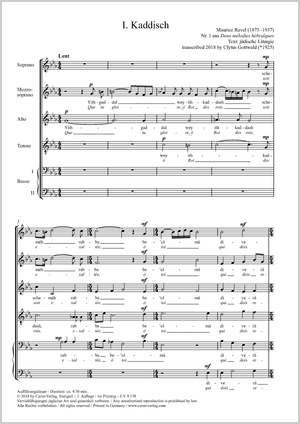
Deux mélodies hebraïques. Vocal transcriptions von Clytus Gottwald
 View
View
 Additional material
- Purchase additional material as a download product.
-
 Digital text (without sheet music) incl. printing licence, html file, singing text, german translationhtml file, singing text, german translation (Sample)Unbenanntes Dokument Kaddisch
Verherrlicht und geheiligt werde sein großer Name
in der Welt, die er nach seinem Willen erschaffen hat.
Er möge sein Reich fest begründen
in eurem Leben und in euren Tagen und im Leben des ganzen Hauses Israel,
bald und in naher Zeit, sprecht: Amen!
[Es sei sein großer Name gebenedeit von Ewigkeit zu Ewigkeit! – von Ravel nicht vertont]
Gebenedeit und gepriesen, gerühmt und erhoben
erhöhet und verherrlicht,
geweiht und hochgelobt sei der Name des Heiligen.
Gelobt sei er, hoch über jedem Lob und Gesang,
jeder Verherrlichung und Trostverheißung, die je in der Welt gesprochen wurde, sprecht: Amen!ursprüngliches Kaddisch („Halbes Kaddisch“)
...
-
Digital text (without sheet music) incl. printing licence, html file, singing text, english translationhtml file, singing text, english translation (Sample)Unbenanntes Dokument Kaddisch
Exalted and sanctified be God’s great name
throughout the world He has created according
to his will.
May He establish his kingdom
during your lifetime
and within the lifetime of all the House of Israel,
speedily and soon;
and say, Amen.
[Blessed be God’s great name
forever and to all eternity. – not composed by Ravel]
Blessed and praised, glorified, exalted, extolled, adored
and lauded...
Contents
-
Composer
Maurice Ravel
| 1875-1937Maurice Ravel was an important French composer and one of the main representatives of Impressionism in music.
He was born on March 7, 1875 in Ciboure near Saint-Jean-de-Luz and showed musical talent at an early age. He began taking piano lessons at the age of seven. His first works were written during composition lessons with Charles-René. In 1889, he was accepted at the Paris Conservatoire, where he initially pursued a career as a pianist, but later concentrated on composition. The extensive knowledge gained from his pianistic training is later evident in Ravel's piano writing and his understanding of orchestration, e.g. in his arrangement of Mussorgsky's Pictures at an Exhibition.
Ravel's compositional style is characterized by refined timbres, innovative harmonies and masterful orchestration. Despite his importance for the music history of the 20th century, he often remained controversial during his lifetime. Most of his works, with their unusual rhythms and harmonies, were initially met with incomprehension by the general public, but were praised by some critics for their innovative power. Nevertheless, works such as La Valse, Bolero and his two piano concertos became popular during his lifetime. In addition to his instrumental and stage works, Ravel also created vocal music, including the choral piece L'Aurore.
In the last years of his life, a progressive physical decline increasingly prevented him from performing in public and composing new works. He died in Paris on December 28, 1937.
Personal details
-
Arranger
Clytus Gottwald
| 1925-2023The choral conductor, composer and musicologist Clytus Gottwald (1925 - 2023) made significant contributions to contemporary choral music. As editor for New Music at Südfunk Stuttgart and founder and director of the Schola Cantorum Stuttgart, he was in productive exchange with his contemporaries, Pierre Boulez, Mauricio Kagel, György Ligeti, Luigi Nono, Karlheinz Stockhausen and many others. With his Schola Cantorum, a 16-voice chamber vocal ensemble, Gottwald decisively shaped the a cappella choral culture of the highest technical level that is taken for granted today. Clytus Gottwald's transcriptions of piano songs and instrumental pieces for unaccompanied choir are appreciated by choirs all over the world. Modelled on the style of Ligeti, his works set the highest of musical standards. Clytus Gottwald has received several awards for his services, including the Cultural Prize of Baden-Württemberg in 2009, the European Church Music Prize in 2012, and the Cross of Merit of the Federal Republic of Germany in 2014. His importance for the development of contemporary choral music cannot be overestimated. Personal details
Reviews on our website can only be submitted by customers with a registered user account. A check whether the rated products were actually purchased does not take place.
Frequent questions about this work
 There are no questions and answers available so far or you were unable to find an answer to your specific question about this work? Then click here and send your specific questions to our Customer Services!