Explore



 Listen
(1)
Listen
(1)
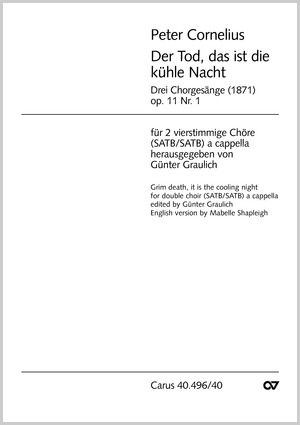
- Grim death, it is the cooling night
Purchase
Additional product information
-
Composer
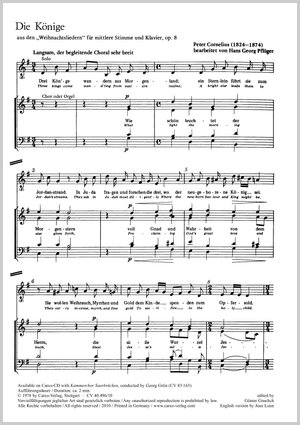
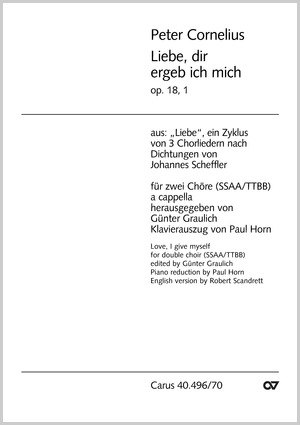
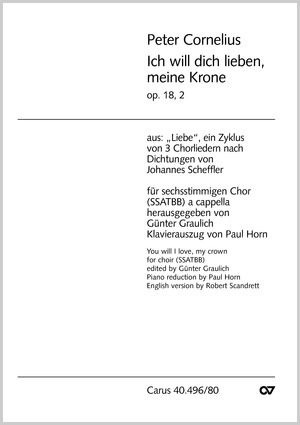
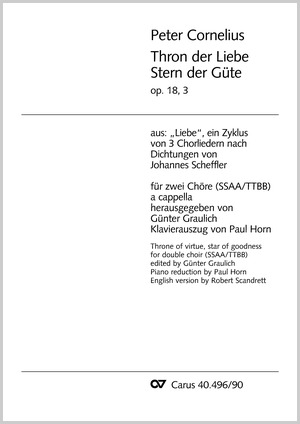
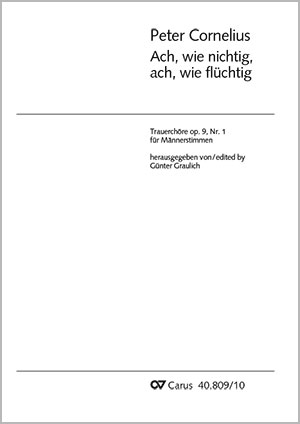
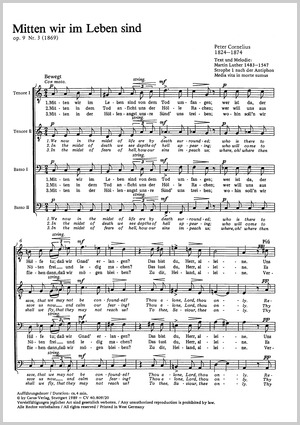
Peter Cornelius
| 1824-1874Peter Cornelius, born in Mainz in 1824, died there in 1874. Son of an actors' couple. Initially also took up this profession, but then studied counterpoint with S. Dehn in Berlin from 1844 to 1846. His church music dates mainly from this period and from the years after 1852, when he went to Liszt in Weimar, who encouraged his work as a church composer. Cornelius became one of the most important pioneers of the New German School. He followed Wagner to Munich in 1865, where he worked as a composition teacher at the newly founded Royal School of Music from 1867 on. Today, his opera ‘Der Babier von Bagdad’ (1858) and his ‘Weihnachtslieder’ op. 8 are particularly well known. Personal details
-
Songwriter / Librettist
Heinrich Heine
| 1797-1856Heinrich Heine (1797–1856) is regarded as one of the most important German poets of the 19th century. He was born in Düsseldorf and is best known for his lyric poetry, which combines Romanticism with sharp social criticism. Many of his works deal with love, nature and freedom. Because of his political views, Heine lived in exile in Paris for many years.
He also occupies a prominent place in the history of music. His lyrical texts were set to music by numerous composers and had a particularly profound influence on the Romantic art song. Robert Schumann, Franz Schubert, Felix Mendelssohn Bartholdy and Hugo Wolf, in particular, created musical works of enduring significance based on Heine’s poems. The poetic combination of linguistic simplicity, emotional depth and often ironic ambiguity offered composers a wide range of possibilities for musical interpretation. As a result, Heine’s poetry became a central part of the Romantic art-song repertoire and continues to influence vocal music to this day.
Personal details
Reviews
Peter Cornelius: Der Tod, das ist die kühle Nacht
Peter Cornelius: Der Tod, das ist die kühle Nacht
Ein fantastisches Stück Chormusik liefert Herausgeber G. Graulich mit diesem 1871 entstandenem Doppelchor von Peter Cornelius (1824 -1896) nach einem Text von Heinrich Heine. Der Komponist versteht es brillant, die Bilder des Gedichtes in musikalische Farben umzusetzen. Allerdings ist der Schwierigkeitsgrad des Werkes recht hoch anzusiedeln, der achtstimmige, oft imitatorisch gesetzte Notentext fließt über voller harmonischer Einfälle, ungewohnter Wendungen und intonationsproblematischer Akkorde.
Quelle: Musica Sacra 6/99, S. 486
Reviews on our website can only be submitted by customers with a registered user account. A check whether the rated products were actually purchased does not take place.
No feedback available for this product.
Frequent questions about this work
 There are no questions and answers available so far or you were unable to find an answer to your specific question about this work? Then click here and send your specific questions to our Customer Services!