Explore



 Listen
(1)
Listen
(1)
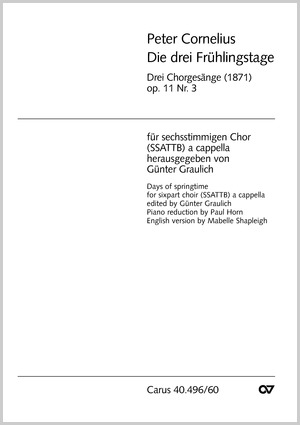
- Days of springtime
Purchase
Additional product information
-
Composer
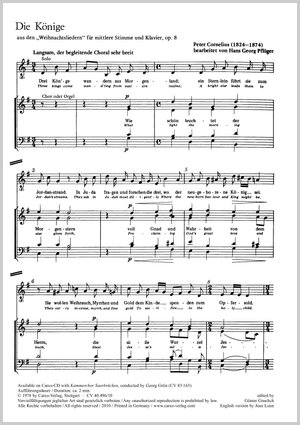
Peter Cornelius
| 1824-1874Peter Cornelius, born in Mainz in 1824, died there in 1874. Son of an actors' couple. Initially also took up this profession, but then studied counterpoint with S. Dehn in Berlin from 1844 to 1846. His church music dates mainly from this period and from the years after 1852, when he went to Liszt in Weimar, who encouraged his work as a church composer. Cornelius became one of the most important pioneers of the New German School. He followed Wagner to Munich in 1865, where he worked as a composition teacher at the newly founded Royal School of Music from 1867 on. Today, his opera ‘Der Babier von Bagdad’ (1858) and his ‘Weihnachtslieder’ op. 8 are particularly well known. Personal details
-
Songwriter / Librettist
Friedrich Rückert
| 1788-1866Friedrich Rückert, born 1788 in Schweinfurt, died 1866 near Coburg. Poet and translator. Professor of oriental philology in Erlangen. Personal details
Reviews
Cornelius, Peter: Die drei Frühlingstage
Cornelius, Peter: Die drei Frühlingstage
Dass nicht nur Brahms in der Mitte des 19. Jahrhunderts tolle, sechsstimmige Chorsätze schreiben konnte, belegt diese rhythmisch mitreißende (6/8-Takt inklusive Schluss-Stretta) und harmonisch interessante Vertonung des Rückert-Gedichtes „Jugend, Rausch und liebe sind gleich drei schönen Frühlingstagen”. Wer solcher Sinnlichkeit Ohr und Stimmen widmen mag, nur zu! Hier kann ein (guter) Chor das pralle Leben erfahren.
Konrad Kiek
Quelle: Württembergische Blätter für Kirchenmusik 4/99, S. 30
„Jugend. Rausch und Liebe sind gleich drei schönen Frühlingstagen” (Friedrich Rückert), die es hemmungslos zu genießen gilt. Tatsächlich scheinen sich die Ausführenden in einen Rausch steigern zu müssen, wie es die Tempovorschriften verlangen: „Bewegt - Ein wenig belebter - schneller - Immer schneller - Sehr schnell”. Dieser melodienselige muntere Reigen ist jedenfalls allen Freunden weltlicher Chormusik dringend zu empfehlen.
Quelle: Musica Sacra 6/99, S. 486
Reviews on our website can only be submitted by customers with a registered user account. A check whether the rated products were actually purchased does not take place.
No feedback available for this product.
Frequent questions about this work
 There are no questions and answers available so far or you were unable to find an answer to your specific question about this work? Then click here and send your specific questions to our Customer Services!