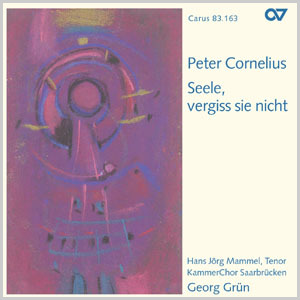
Seele, vergiss sie nicht (Grün)
 Listen
(16)
Listen
(16)
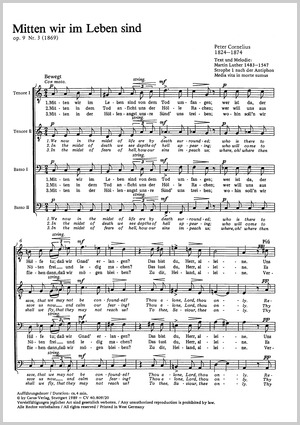
- Mitten wir im Leben sind
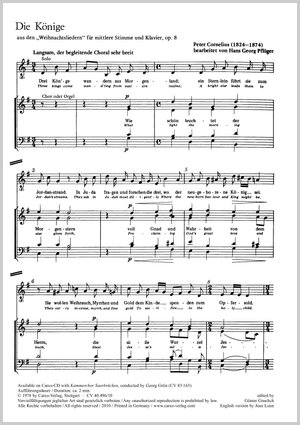
- Drei Könige wandern
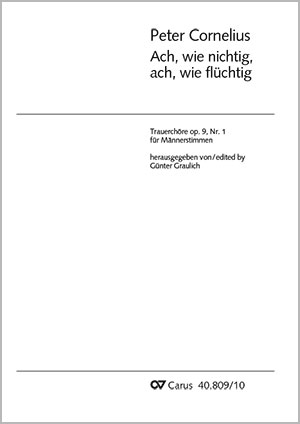
- Ach wie nichtig, ach wie flüchtig
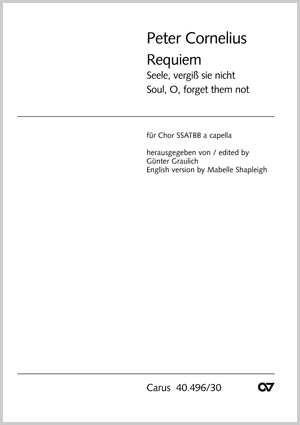
- Requiem
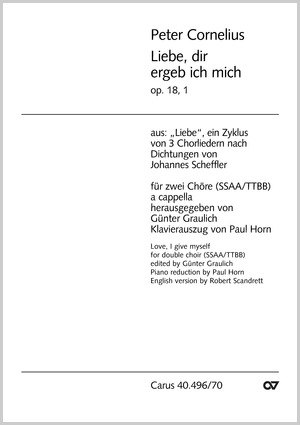
- Love, I give myself
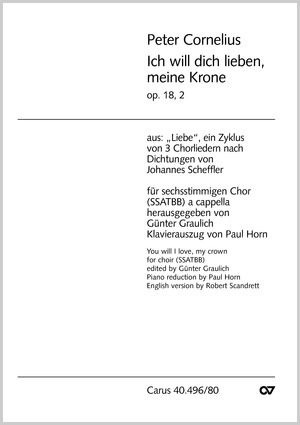
- You will I love, my crown
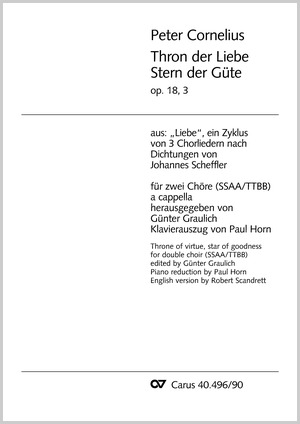
- Throne of virtue
- Nicht die Träne kann es sagen
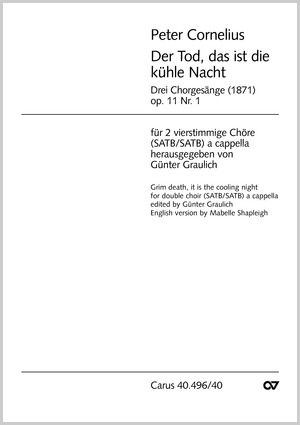
- Grim death, it is the cooling night
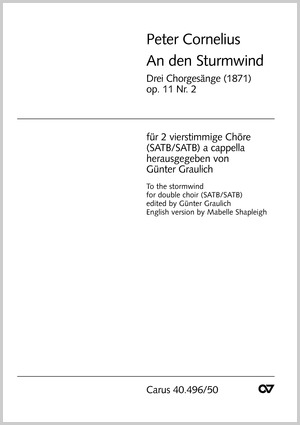
- To the stormwind
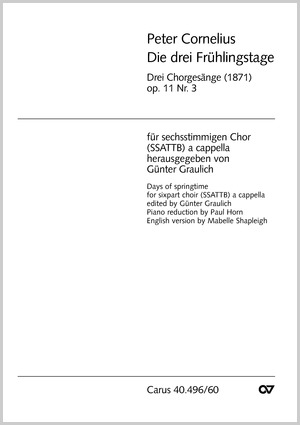
- Days of springtime
- Absolve Domine
- Bußlied
- An Babels Wasserflüssen
- Heil und Freude ward mir verheißen
- So weich und warm
 Additional material
-
 Digital text (without sheet music) incl. printing licence, html file, singing text, originalhtml file, singing text, original (Sample)Unbenanntes Dokument Seele, vergiss sie nicht, vergiss nicht die Toten!
Sieh’, sie umschweben dich, schaudernd, verlassen,
und in den heiligen Gluten,
die den Armen die Liebe schürt,
atmen sie auf und erwarmen und genießen
zum letzten Mal ihr verglimmendes Leben.
Und wenn du dich ihnen verschließest,
so erstarren sie bis hinein in das Tiefste.
Dann ergreift sie der Sturm der Nacht,
dem sie zusammengekrampft in sich,
trotzten im Schoß der Liebe.
Und er jagt sie mit Ungestüm
durch die endlose Wüste hin,
...
-
Digital text (without sheet music) incl. printing licence, html file, singing text, english translationhtml file, singing text, english translation (Sample)Unbenanntes Dokument Soul, O, forget them not, never forget the departed!
See they are hovering near to the living,
and in the heavenly radiance,
that the glow of our love imparts,
breathe they again and rewarm them and enjoy
for a final time their low flickering being
And when thou forgettest to heed them,
then they shrink benumbed to their innermost being.
They are caught in the storm of night,
which they together resist
with the strength of the love we give them.
It pursues them with violence through the endless and
darkened waste,
...
Contents


-
Composer
Peter Cornelius
| 1824-1874Peter Cornelius, born in Mainz in 1824, died there in 1874. Son of an actors' couple. Initially also took up this profession, but then studied counterpoint with S. Dehn in Berlin from 1844 to 1846. His church music dates mainly from this period and from the years after 1852, when he went to Liszt in Weimar, who encouraged his work as a church composer. Cornelius became one of the most important pioneers of the New German School. He followed Wagner to Munich in 1865, where he worked as a composition teacher at the newly founded Royal School of Music from 1867 on. Today, his opera ‘Der Babier von Bagdad’ (1858) and his ‘Weihnachtslieder’ op. 8 are particularly well known. Personal details
-
Preface writer
Georg Grün
Georg Grün studied church music, school music, Catholic theology, musicology, and conducting, and he taught music and courses on the Catholic religion for several years at a lycée for the arts. In 2000 he was appointed Professor of choral conducting at the Staatliche Hochschule für Musik und Darstellende Kunst Mannheim. He has also been very success ful as a conductor of the chamber choir at this school (it has won prizes at the choral competitions of Cork and Maribor). Grün is active both at home and abroad as a guest conductor, juror and lecturer. In October 2012 Georg Grün was appointed Professor for Choral Conducting at the Hochschule für Musik Saar. Personal details
-
Ensemble
KammerChor Saarbrücken
The KammerChor Saarbrücken, founded in 1990 by its conductor Georg Grün, quickly developed into one of the best choirs in Germany and likewise enjoys an outstanding international reputation. This has been confirmed through countless appear ances in Germany, in many European countries, the USA and Russia, CDs which have received critical acclaim, numerous radio record ings, and last, but not least, by the many prizes which the choir has won at international choral competitions and at the German choral competition in Regensburg in 1998. The choir performs works from all historical eras. In the field of early music it collaborates with professional ensembles and soloists who are dedicated to historical performance practice. Additional themes in its repertoire include the performance of romantic choral music, as well as an increasing number of world premiere performances of works written by composers exclusively for the ensemble. Personal details
-
Conductor
Georg Grün
Georg Grün studied church music, school music, Catholic theology, musicology, and conducting, and he taught music and courses on the Catholic religion for several years at a lycée for the arts. In 2000 he was appointed Professor of choral conducting at the Staatliche Hochschule für Musik und Darstellende Kunst Mannheim. He has also been very success ful as a conductor of the chamber choir at this school (it has won prizes at the choral competitions of Cork and Maribor). Grün is active both at home and abroad as a guest conductor, juror and lecturer. In October 2012 Georg Grün was appointed Professor for Choral Conducting at the Hochschule für Musik Saar. Personal details
-
Soloist - tenor
Hans Jörg Mammel
Reviews
Peter Cornelius: Seele, vergiss sie nicht
Peter Cornelius: Seele, vergiss sie nicht
Die Chorwerke von Peter Cornelius (1824-1874) gehörten lange Zeit zu den nahezu vergessenen Werkschätzen des 19. Jahrhunderts. „Seele, vergiss sie nicht” heißt daher der programmatische Gesamttitel zur Rückgewinnung der hier versammelten a-cappella-Kostbarkeiten für den Konzertsaal. In mustergültigen Darbietungen des Kammerchores Saarbrücken wurden sie von seinem Leiter Georg Grün ausgewählt, einstudiert und im Beiheft samt Abdruck sämtlicher gesungenen Texte von ihm sachkundig kommentiert. Entstanden ist eine Art „Gesamtkunstwerk”, wie es für die damaligen Fortschrittler der sogenannten „Neudeutschen” in der Anhängerschaft Richard Wagners - zu der Cornelius gehörte - durchaus zeitgemäß war. (...) Auch der professionelle Niederländische Kammerchor unter Uwe Gronostay erkannte den besonderen Wert des sechsstimmigen Satzes Seele, vergiss sie nicht - einer Versdichtung von Friedrich Hebbel unter dem Titel Requiem -, wie er jetzt mit gesteigerter Intensität von dem 1980 gegründeten Saarbrücker Ensemble zu hören ist. Insgesamt beweisen sämtliche Beiträge, welche Klangschätze mit ihrem faszinierenden modulatorischen Reichtum der Gegenwart allzu lange fremd geblieben sind. Sieht man von einigen sprachlichen Glättungen zugunsten des stimmlichen Wohlklanges auf Kosten der Textverständlichkeit ab, so stellt sich das rund 30 Mitglieder zählende Saarbrücker Ensemble mit seinem Beitrag hier überzeugend in die vorderste Reihe aller vergleichbaren Chorgruppierungen.
Gerhard Pätzig
Quelle: Klassik heute, 11.03.04
Peter Cornelius: Seele, vergiss sie nicht
Cornelius was an unquestioned master of harmony, his use of chromaticism imaginative and unfailingly artful, his sense of text and its musical expression both intelligent and creative. The Requiem is the most substantial work here, and it’s remarkable both for its economy (just short of nine minutes) and for the sophistication of its text-setting, which is an emotionally charged, rich-textured explication of a poem by Friedrich Hebbel. This kind of deeply affecting writing characterizes all of Cornelius’ vocal music, from his most popular song--Die Könige--to his final choral composition, So weich und warm, a short piece for mixed choir that extols the virtue and honor of motherhood. Along the way we’re treated to the composer’s ingeniously conceived psalms set to keyboard pieces by Bach and to his beautiful, Brahmsian Op. 18 cycle Liebe, for six-to-eight-part choir. The performances here can’t be faulted, nor can the open, vibrant, realistic sound that gives us an ideal seat in an acoustically complementary hall. No question, this is--and will remain--one of the year’s best.
David Vernier
Quelle: Classics today
Peter CORNELIUS (1824-1874) Seele, vergiss sie nicht
[...] Georg Grün, director of the performances here, contends (booklet translation p.8) that the ‚Requiem’ (tr. 1) is the most mature of Cornelius’s choral works. It was written in 1863 in the response to the death of his friend, the poet and writer Friedrich Hebbel, and is a setting of the latter’s poem ‚Seele, vergiss sie nicht’. In this work, six-part writing for a tenor, alto and two sopranos and baritones, predominates. Each vocal register doubles for the cycle ‚Lieb’ of 1872 (trs. 2-4) whilst in ‚Trauerchöre’ (1869, trs. 5-7) the choral backing is two tenors and baritones. It is perhaps in this latter piece, with its lack of female voices, that we can best appreciate the consummate skill of these performers. The blending of harmony and pinpoint articulation are the hallmarks of much practise under a choral director of experience and excellence. The exclusion of the female voices in the previous comment should not be taken as a criticism or failing on the distaff side. Rather the very resonant acoustic does take away the sharpness of the words particularly when the sopranos are above the stave. However, the overall result allows appreciation of the structures and compositional complexities within the various pieces. Perhaps the most interesting work, after the ‚Requiem’, is Cornelius’s Op. 13 (trs. 12-14). These three vocal psalms were written in 1872, Cornelius arranging movements from keyboard suites by Bach as four-part chorales with the soprano line carrying the melody. He uses his own words based on the passages in the psalms and succeeds in preserving the musical substance of Bach’s originals. The booklet has a brief essay by Georg Grün and all the words with English translation. The disc should appeal to all lovers of this genre and is strongly recommended.
Robert J. Farr
Quelle: Classical Music on the Web
Elegische Klänge und Sphärenharmonien
Empfohlen von klassik.com!
Peter Cornelius – ein wenn nicht unbeschriebenes, dann doch fast leeres Blatt. Fast leer, denn man kennt ja zumindest ‚Die Könige’ eines der Lieder, die in jedem in gymnasialen Musiksälen herumliegenden Kunstliederbuch zu finden sind. Aber Cornelius hat weit mehr an Chormusik komponiert, wofür die vorliegende Aufnahme Zeugnis ablegt. Und was für ein Zeugnis! [...]
Was dieser Aufnahme – neben ihrer differenzierten, kontrastreichen Interpretation – Lorbeeren verleiht, ist die klangliche Realisierung. Vom wie gehaucht wirkenden piano bis zum auftrumpfenden forte gibt es alle möglichen Abstufungen zu hören. Wirklich kleinste dynamische Ereignisse, sowie auch größte Kontraste werden von der Aufnahmetechnik in vorbildlicher Manier auf diesen Tonträger gebannt. Dazu kommt noch eine vollkommen natürliche Akustik, die dem Klang Luft und Raum verleiht, um sich bestmöglich entfalten zu können. Die Maria Königin-Kirche in Saarbrücken scheint hierfür der geeignete Raum zu sein. Fazit: Diese CD muss man – als Liebhaber romantischer Chormusik – haben. Denn die Interpretation kann als absolut hervorragend bezeichnet werden. Hier stimmt einfach alles: Dynamik, Agogik, feinste Phrasierungen, weit spannende Melodiebögen, rhythmische Klarheit, beste Intonationsreinheit. Eine Referenzaufnahme.
Tobias Pfleger
Quelle: Klassik.com, 21.04.2004
SWR2 CD-Tipp
[...] Georg Grün setzt in seiner Interpretation auf Textverständlichkeit und Intonation - er wählt ein langsames Grundtempo mit chorischem Rubato und riskiert dabei viel: nämlich den Zusammenhalt der Phrasen. Der Gefahr des Pathos begegnet er durch starke Zäsuren, die er wie Pflöcke zwischen die Abschnitte setzt. Eine Tour de Force für den Kammerchor Saarbrücken, die dieser bewundernswert meistert. ... Wunderbar ... gehen liedhaftere Sätze auf wie zum Beispiel „Ich will die lieben, meine Krone aus dem Zyklus „Liebe” op. 18, in dem die Klangkultur dieses jungen Ensembles zum Blühen kommt. [...] Fast 70 Minuten a-cappella-Chöre von Peter Cornelius bietet diese CD, darunter vieles, das wenig bekannt ist.
Dorothea Bossert
Quelle: SWR2 CD-Tipp, 3. Juni 2004, 17.50 Uhr
Peter Cornelius: Seele, vergiss sie nicht
Eingespielt wurden die Chorwerke vom KammerChor Saarbrücken, der, 1990 gegründet, mit vielen nationalen und internationalen Preisen bedacht wurde. Der Chor singt in einer mittelgroßen Besetzung von etwa 40 Personen unter der Leitung seines Gründers Georg Grün. Er wählt moderate, zuweilen ausgesprochen langsame Tempi, wie ein Vergleich mit der Aufnahme des Ensemble „Polyphony” unter der Leitung von Stephen Layton aus dem Jahr 2000 zeigt. Die Wahl der Tempi ist jedoch wohl überlegt, sie steigert den emotionalen Ausdruck und dient dem Text. Intonation und Textverständlichkeit des Chores sind gut.
Michael Fischer
Quelle: Musik und Kirche 4/04
Peter Cornelius: Seele, vergiss sie nicht
The composer and writer Peter Cornelius was born in Mainz in 1824 and died there fifty years later. After he failed at an acting career he studied music and became a friend of Liszt and Wagner. I mainly know his music from his opera ‚Der Barbier von Baghdad’ (1858). This was first produced in Weimar by Liszt who had become Kapellmeister there in 1848 and where he promoted the works of Wagner and Berlioz. However, Liszt’s support of Cornelius’s opera on top of his promotion of the Liszt-Wagner ‚New Music’, provoked local opposition. As a consequence Liszt resigned his position. Despite these early difficulties this delightful work has maintained its position in the repertoire, particularly in Germany. A recording featuring Fritz Wunderlich has had circulation. However, it is not by that opera, or his two later works in the genre that Cornelius is known. Rather it is his vocal and the choral works, particularly the latter. It is these that feature on the present disc.
Georg Grün, director of the performances here, contends (booklet translation p.8) that the ‚Requiem’ (tr. 1) is the most mature of Cornelius’s choral works. It was written in 1863 in the response to the death of his friend, the poet and writer Friedrich Hebbel, and is a setting of the latter’s poem ‚Seele, vergiss sie nicht’. In this work, six-part writing for a tenor, alto and two sopranos and baritones, predominates. Each vocal register doubles for the cycle ‚Lieb’ of 1872 (trs. 2-4) whilst in ‚Trauerchöre’ (1869, trs. 5-7) the choral backing is two tenors and baritones. It is perhaps in this latter piece, with its lack of female voices, that we can best appreciate the consummate skill of these performers. The blending of harmony and pinpoint articulation are the hallmarks of much practise under a choral director of experience and excellence. The exclusion of the female voices in the previous comment should not be taken as a criticism or failing on the distaff side. Rather the very resonant acoustic does take away the sharpness of the words particularly when the sopranos are above the stave. However, the overall result allows appreciation of the structures and compositional complexities within the various pieces. Perhaps the most interesting work, after the ‚Requiem’, is Cornelius’s Op. 13 (trs. 12-14). These three vocal psalms were written in 1872, Cornelius arranging movements from keyboard suites by Bach as four-part chorales with the soprano line carrying the melody. He uses his own words based on the passages in the psalms and succeeds in preserving the musical substance of Bach’s originals.
The booklet has a brief essay by Georg Grün and all the words with English translation. The disc should appeal to all lovers of this genre and is strongly recommended. It should also be appropriate listening for those who enjoy earlier choral pieces such as those by Hildegard of Bingen and others of that period.
Robert J Farr
Quelle: http://www.musicweb.uk.net
[...] Die Balance innerhalb des Chores kann nur verblüffen, [...] , ausgeglichener kann man sich einen romantischen Chorklang nicht wünschen. [...] Fazit: Diese CD muss man - als Liebhaber romantischer Chormusik - haben. Denn die Interpretation kann als absolut hervorragend bezeichnet werden. Hier stimmt einfach alles: Dynamik, Agogik, feinste Phrasierungen, weit spannende Melodiebögen, rhythmische Klarheit, beste Intonationsreinheit. Eine Referenzaufnahme.
Tobias Pfleger
klassik.com, 21.04.2004
Reviews on our website can only be submitted by customers with a registered user account. A check whether the rated products were actually purchased does not take place.
Frequent questions about this work
 There are no questions and answers available so far or you were unable to find an answer to your specific question about this work? Then click here and send your specific questions to our Customer Services!