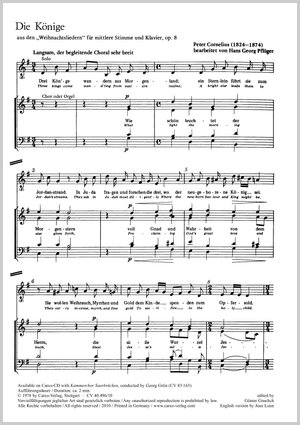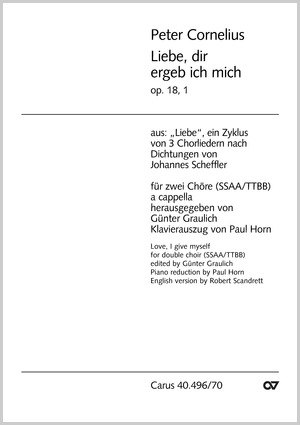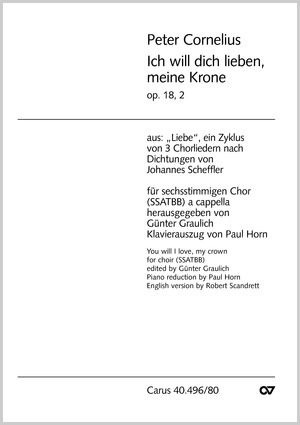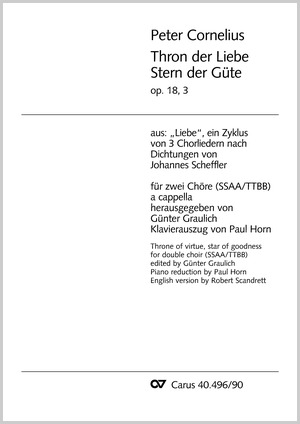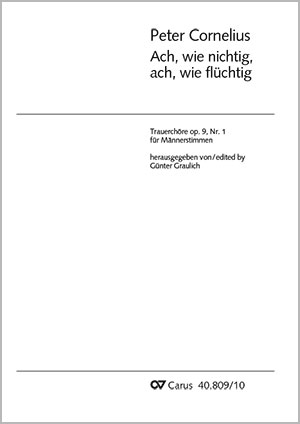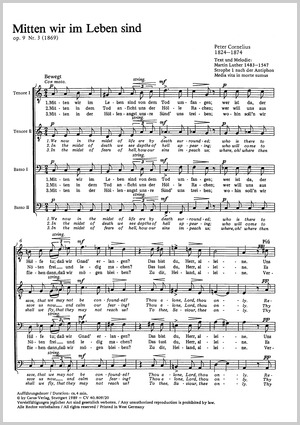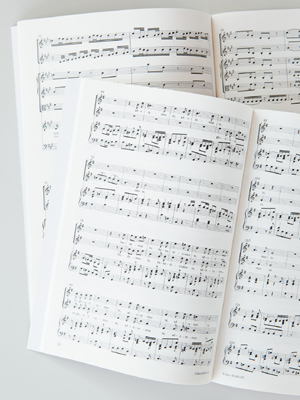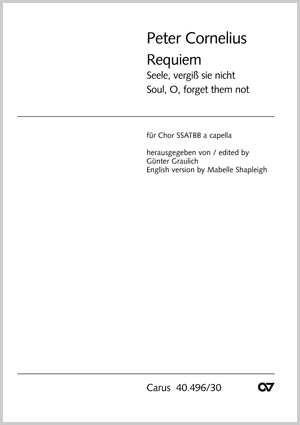
Cornelius ist einer der führenden Vertreter romantischer Chormusik. Die ausgefeilte harmonische Gestaltung, der Wechsel zwischen verschiedenen Satztechniken, eine differenzierte Dynamik machen dies deutlich. Dies erfordert aber auch einen Chor, der diesen Anforderungen gewachsen ist.
Explore


 Listen
(1)
Listen
(1)
- Requiem
 Additional material
- Purchase additional material as a download product.
-
 Digital text (without sheet music) incl. printing licence, html file, singing text, originalhtml file, singing text, original (Sample)Unbenanntes Dokument Seele, vergiss sie nicht, vergiss nicht die Toten!
Sieh’, sie umschweben dich, schaudernd, verlassen,
und in den heiligen Gluten,
die den Armen die Liebe schürt,
atmen sie auf und erwarmen und genießen
zum letzten Mal ihr verglimmendes Leben.
Und wenn du dich ihnen verschließest,
so erstarren sie bis hinein in das Tiefste.
Dann ergreift sie der Sturm der Nacht,
dem sie zusammengekrampft in sich,
trotzten im Schoß der Liebe.
Und er jagt sie mit Ungestüm
durch die endlose Wüste hin,
...
-
Digital text (without sheet music) incl. printing licence, html file, singing text, english translationhtml file, singing text, english translation (Sample)Unbenanntes Dokument Soul, O, forget them not, never forget the departed!
See they are hovering near to the living,
and in the heavenly radiance,
that the glow of our love imparts,
breathe they again and rewarm them and enjoy
for a final time their low flickering being
And when thou forgettest to heed them,
then they shrink benumbed to their innermost being.
They are caught in the storm of night,
which they together resist
with the strength of the love we give them.
It pursues them with violence through the endless and
darkened waste,
...
Purchase
Additional product information
-
Composer
Peter Cornelius
| 1824-1874Peter Cornelius, born in Mainz in 1824, died there in 1874. Son of an actors' couple. Initially also took up this profession, but then studied counterpoint with S. Dehn in Berlin from 1844 to 1846. His church music dates mainly from this period and from the years after 1852, when he went to Liszt in Weimar, who encouraged his work as a church composer. Cornelius became one of the most important pioneers of the New German School. He followed Wagner to Munich in 1865, where he worked as a composition teacher at the newly founded Royal School of Music from 1867 on. Today, his opera ‘Der Babier von Bagdad’ (1858) and his ‘Weihnachtslieder’ op. 8 are particularly well known. Personal details
-
Songwriter / Librettist
Friedrich Hebbel
| 1813-1863Christian Friedrich Hebbel was a German playwright, poet and storyteller. Hebbel's work is classified as Vormär, and later also as Realism. His best-known works include the drama Die Nibelungen and the tragedies Agnes Bernauer and Maria Magdalena. Personal details
Reviews
Peter Cornelius
Peter Cornelius: REQUIEM
Der Name Peter Cornelius ist schon fast eine Garantie für musikalische Qualität. Bei der vorliegenden Motette scheint ihm der ausdrucksstarke, bildreiche Text von Friedrich Hebbel noch einen zusätzlichen Inspirationsschub gegeben zu haben. Diese sechsstimmige Motette (SSATBB) gehört für mich in die vorderste Reihe der romantischen Chorliteratur. Interessante packende Harmonik, verschiedene Satztechniken, wechselnde Tempi und Dynamik sind die aufzählbaren Parameter einer Komposition, die bei leistungsfähigen Chören am Besten aufgehoben ist.
Thomas Gabriel
Quelle: Kirchenmusik im Bistum Limburg 1/92, S. 52
Peter Cornelius: Requiem (Seele, vergiss sie nicht)
Written between 1863 and 1872, this lament on a text by Friedrick Hebbel reflects the influences of Wagner and Liszt on Cornelius. A lovely, brooding, intense work that utilizes the highly chromatic harmonies of the nineteenth-century, this six-arid-one-half minute work would be an excellent choice for mature choirs. Due to its complex harmonic vocabulary, achieving accurate intonation will no doubt be a challenge for even the best choirs. Finding the ”melos” will require very intelligent, harmonically attuned singers. The edition provides a usable English singing translation as well as the preferred German text. No piano reduction of the five voice parts is provided.
Jerry McCoy
Quelle: Choral Journal, September 1993
Reviews on our website can only be submitted by customers with a registered user account. A check whether the rated products were actually purchased does not take place.
No feedback available for this product.
Frequent questions about this work
 There are no questions and answers available so far or you were unable to find an answer to your specific question about this work? Then click here and send your specific questions to our Customer Services!