Messe en ré majeur
 Consulter

-
Compositeur
Johann Georg Albrechtsberger
| 1736-1809geboren 1736 in Klosterneuburg (Niederösterreich), gestorben 1809 in Wien. Chorknabe am Stiftsgymnasium Melk, ab 1755 Organistenämter in Raab (Ungarn), Maria Taferl (Niederösterreich) und Melk, ab 1768 Organist und Orgelbauer in Wien. Sein umfangreiches kompositorisches OEuvre umfasst Kirchenkompositionen, Orchester- und Kammermusik sowie Werke für Tasteninstrumente. Er trat auch als Verfasser musiktheoretischer Schriften hervor. Zu seinen zahlreichen Schülern gehörten Ludwig van Beethoven, Carl Czerny und Johann Nepomuk Hummel. Plus d'information sur la personne
Critiques
Johann Georg Albrechtsberger
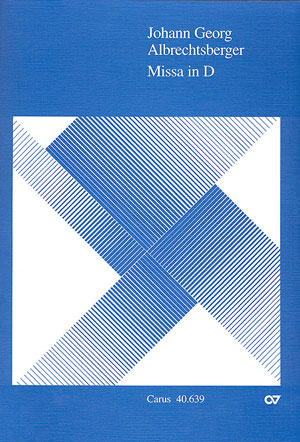
Johann Georg Albrechtsberger: MISSA IN D
In der vom Carus-Verlag gewohnten Gründlichkeit und Sorgfalt wird hier als Erstdruck eine empfehlenswerte lateinische Messe des bekannten Wiener Kontrapunktiker und Lehrer Beethovens, Johann Georg Albrechtsberger, vorgelegt. Sie ist ohne selbständige Instrumentalstimmen komponiert, vom Herausgeber Paul Horn mit ausgesetztem Generalbass versehen. Allerdings war es zu der Zeit, in der die Messe entstanden ist, üblich, die Singstimmen durch Instrumente zu stützen (Streicher, Oboe, Fagott, engmensurierte Posaunen). Anders als der um die „Missa solemnis” ringende Beethoven bringt Albrechtsberger seine „naive”, zeitlebens ungebrochene Frömmigkeit zum Ausdruck. Gleichwohl zeigt er sich als souveräner Meister seines Metiers. Seine Musik ist abwechslungsreich und voller überraschender harmonischer Wendungen. Der Schwierigkeitsgrad liegt im mittleren Bereich, nur das Sanctus wirft möglicherweise rhythmische Probleme auf.
Wolfgang Nickel
Quelle: Kirchenmusik im Bistum Limburg 1/89
Albrechtsberger is remembered as a theorist and pedagogue (teacher of Beethoven), but he deserves more attention as the composer of same 30 Masses as weIl as a large quantity of organ music. (In fact, an Albrechtsberger Society was formed recently by a group of Austrian scholars to promote the publication of his works.) The ”Mass in D” (1783), scored for SATB chorus and organ, contains an interesting variety of textures and vigorous choral writing. Especially notable is Albrechtsberger’s contrapuntal technique seen here in the Kyrie (a double fugue), Benedictus (a lovely fugal setting in triple meter), and dona nobis. The music lies within the capability of a good parish choir, the edition is based on ideal sources: the composer’s autograph score and a set of performance parts closely associated with the score. The original performance materials include parts for strings and trombones. These document the 18th-century practice of using instruments to support the voices even in the so-called a cappella style, or in scores that do not specifically indicate instrumental doubling.
Jane Schatkin Hettrick
Quelle: The American Organist 3/93, S. 74-75
Les évaluations sur notre site web ne peuvent être effectuées que par des clients disposant d'un compte d'utilisateur enregistré. Il n'est pas vérifié si les produits évalués ont été effectivement achetés.
Questions fréquentes sur l'œuvre
 Il n'y a pas encore de questions et réponses concernant cette œuvre ou vous n'avez pas trouvé la réponse à votre question sur l'œuvre ? Cliquez ici et envoyez votre question spécifique à notre service clients.