

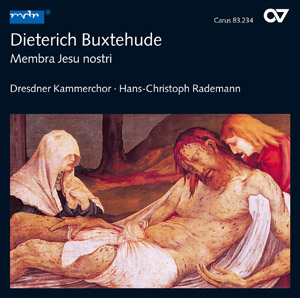
Membra Jesu nostri (Rademann)
Pour le temps de la Passion de 1680, Dieterich Buxtehude composa son plus grand oratorio, le cycle de cantates “Membra Jesu nostri” et le dédia à son ami Gustav Düben, maitre de chapelle suédois. Dans les sept cantates indépendantes, qui suivent en principe toutes le schéma „introduction instrumentale – choeur sur un texte de la Bible –solo vocal (Aria) sur un poème médiéval sacré – reprise du choeur", les pieds, genoux, mains, côtes, la poitrine, le coeur, et le visage de Jésus crucifié sont représentés allégoriquement. L'ensemble de solistes et le choeur de chambre de Dresde sous la direction de Hans-Christoph Rademann sont entièrement dédiés à traduire le gestus du texte. Le programme est complété par deux autres enregistrements de cantates de Buxtehude.
Récompensé par le Pizzicato Supersonic Award
 Ecouter
(27)
Ecouter
(27)
- I. Ad pedes: Tutti
- I. Ad pedes: Aria
- I. Ad pedes: Tutti
- I. Ad pedes: Tutti
- II. Ad genua: Sonata in tremulo
- II. Ad genua: Tutti
- II. Ad genua: Aria
- II. Ad genua: Tutti
- III. Ad manus: Sonata
- III. Ad manus: Tutti
- III. Ad manus: Aria
- III. Ad manus: Tutti
- IV. Ad latus: Tutti
- IV. Ad latus: Aria
- IV. Ad latus: Tutti
- V. Ad pectus: Voci
- V. Ad pectus: Aria
- V. Ad pectus: Voci
- VI. Ad Cor: Sonata
- VI. Ad Cor: Voci
- VI. Ad Cor: Aria
- VI. Ad Cor: Voci
- VII. Ad faciem: Tutti
- VII. Ad faciem: Aria
- VII. Ad faciem: Voci
- Wär Gott nicht mit uns diese Zeit
- Walts Gott, mein Werk ich lasse
 Compléments
- Acheter des compléments au format téléchargement.
-
 Texte numérique (sans notes), licence d'impression incluse, fichier html, paroles, traduction en anglaisfichier html, paroles, traduction en anglais (Extrait)
I. To the Feet 1. Sonata 2. Tutti (Coro SSATB) Behold, over the mountains come the feet
3. Aria a) Soprano I Greetings, salvation of the world!
of the bringer of good tidings and herald of peace.
Nahum 2:1
Greetings, dear Jesus!
Upon your Cross I truly desire
to hang! You know the reason,
give me your strength!
b) Soprano II The nails in your feet, the hard blows
and the so severe injuries
I embrace with emotion.
Shuddering at the sight of you,
I think of your wounds. c) Basso...
-
Texte numérique (sans notes), licence d'impression incluse, fichier html, paroles, traduction allemandefichier html, paroles, traduction allemande (Extrait)
I. An die Füße 1. Sonata 2. Tutti (Coro SSATB) Siehe, über die Berge kommen die Füße
3. Aria a) Soprano I Sei gegrüßt, Heil der Welt!
des Freudenboten und Verkünders des Friedens.
Nahum 2,1
Sei gegrüßt, teurer Jesus!
An dein Kreuz will ich wahrhaftig
mich hängen! Du weißt warum,
gib mir deine Kraft!
b) Soprano II Die Nägel in deinen Füßen, die harten Schläge
und die derart schweren Blessuren
umfasse ich mit Ergriffenheit.
Bei deinem Anblick erschauernd,
gedenke ich deiner Wunden.
c) Basso...
-
Texte numérique (sans notes), licence d'impression incluse, fichier html, paroles, originalfichier html, paroles, original (Extrait)
I. Ad pedes 1. Sonata 2. Tutti (Coro SSATB) Ecce super montes pedes
3. Aria a) Soprano I Salve mundi salutare,
evangelizantis et annunciantis pacem.
Nahum 2,1
salve, salve Jesu care!
Cruci tuae me aptare
vellem vere, tu scis quare,
da mihi tui copiam.
b) Soprano II Clavos pedum, plagas duras,
et tam graves impressuras
circumplector cum affectu,
tuo pavens in aspectu,
tuorum memor vulnerum.
c) Basso Dulcis Jesu, pie Deus,
...
-
Texte numérique (sans notes), licence d'impression incluse, fichier html, Texte introductif, françaisfichier html, Texte introductif, français (Extrait)Texte abrégé du livret du CD Carus 83.234
Michael Wersin
Traduction (abrégée): Sylvie CoquillatLongtemps fut attribué à saint Bernard (vers 1090–1153), l’un des représentants majeurs du culte de la Passion du Moyen-Age, un poème en latin connu sous le titre de Rhytmica Oratio, qui est une méditation sur les membres du Crucifié en sept hymnes : pieds, genoux, mains, côté, poitrine, cœur et visage font l’objet de considérations remplies d’amour fervent et de compassion. En fait, le texte, comme on le suppose aujourd’hui, est plutôt l’œuvre de l’abbé cistercien Arnulf von Löwen (vers 1200–1250) et fut plus tard agrandi à plusieurs reprises.
Dieterich Buxtehude prit sans doute connaissance de la Rhytmica Oratio latine dans une gravure de l’an 1633 parue à Hambourg. Il choisit trois strophes de chacun des sept hymnes consacrés à un membre du corps (membrum) et les place au
...
-
Texte numérique (sans notes), licence d'impression incluse, fichier html, Texte introductif, en anglaisfichier html, Texte introductif, en anglais (Extrait)Abridged text from the CD Carus 83.234
Michael Wersin
Translation: Peter PalmerSt. Bernard of Clairvaux (ca. 1090–1153) is regarded as one of the chief representatives of the pietism of the Cross in the Middle Ages. For a long time he was thought to be the author of a Latin poem which became known as Rhytmica Oratio. Its seven hymns constitute meditations on the limbs of the crucified Christ. Full of devoted love and ready sympathy, they are addressed to the feet, knees, hands, side, chest, heart, and face. In fact, however, the poem is now believed to traceable to the Cistercian abbot Arnulf von Löwen (ca. 1200–1250). It was later extended several times.
Dieterich Buxtehude probably encountered the Latin Rhytmica Oratio in a printing of 1633 which came out in Hamburg. He selected three verses from each of the seven hymns devoted to
...
-
Texte numérique (sans notes), licence d'impression incluse, fichier html, Texte introductif, en allemandfichier html, Texte introductif, en allemand (Extrait)Gekürzter Booklet-Text der CD Carus 83.234
Michael Wersin
Die Meditation über die Wundmale des Heilands Jesus Christus zählt zu den zentralen Elementen spätmittelalterlicher Frömmigkeitspraxis. Der Betende initiiert und kräftigt auf dem Wege der commemoratio seine Bereitschaft zu Buße und Reue, indem er des Leidens Christi am Kreuz gedenkt. Mittels der compassio, des Mit-Erleidens von Folterung und Kreuzigung, entwickelt er ein enges Liebesverhältnis zu Christus, das durchaus auch erotische Züge tragen kann. Durch das Sich-Versenken in Schmerzen und Schmach des Erlösers vergegenwärtigt er sich dessen freiwilligen Opfertod zur Rettung der gefallenen Menschheit und strebt nach conformitas, nach Gleich-Förmigkeit mit Jesus. In Einzelfällen kann es dabei zur unio mystica, zum raptus-artigen Erlebnis des mystischen Einswerdens mit dem Angebeteten, ja sogar zur Ausbildung von Stigmata (so etwa beim
...
-
Texte numérique (sans notes), licence d'impression incluse, fichier html, paroles, traduction en anglaisfichier html, paroles, traduction en anglais (Extrait)
If God were not on our side this day,
Israel should say,
if God were not on our side this day,
we would have had to resign,
being such a poor little band,
despised by so many sons of man,
all at war with us.
So great is their wrath against us,
that if God had allowed it,
they would have swallowed us up
life and limb entirely;
we would have been engulfed
and overwhelmed by the tide
and drowned with violence.
Praise and thank God, who did not let
us be caught in their chasm.
As a bird evades the snare,
our soul has escaped.
...
-
Texte numérique (sans notes), licence d'impression incluse, fichier html, paroles, originalfichier html, paroles, original (Extrait)
Wär Gott nicht mit uns diese Zeit,
so sollt Israel sagen,
wär Gott nicht mit uns diese Zeit,
wir hätten müssn verzagen,
die so ein armes Häuflein sind,
veracht’ von so viel Menschenkind,
die an uns setzen alle.
Auf uns ist so zornig ihr Sinn,
wo Gott das hätt zugeben,
verschlungen hätten sie uns hin
mit ganzem Leib und Leben;
wir wärn als die ein Flut ersäuft
und über die groß Wasser läuft
und mit Gewalt verschwemmet.
Gott Lob und Dank, der nicht zugab,
dass ihr Schlund uns möcht fangen.
Wie ein Vogel des Stricks kommt ab,
ist unser Seel entgangen.
...
-
Texte numérique (sans notes), licence d'impression incluse, fichier html, paroles, traduction en anglaisfichier html, paroles, traduction en anglais (Extrait)
If God grants it, I cease to work,
the sun prepares to rest.
It has completed its journey,
and slips back under its canopy.
So may my affairs also
pause for a time.
I want to take my rest
with a debt of gratitude.
My eyes and heart and hands,
O Jesus, Son of God,
I now turn towards you
for my daily wage,
for you yourself have come
into my workplace
and helped with my labors,
directing my mind and spirit.
You have strengthened my head,
put vigor in my fingers.
...
-
Texte numérique (sans notes), licence d'impression incluse, fichier html, paroles, originalfichier html, paroles, original (Extrait)
Walts Gott, mein Werk ich lasse,
die Sonn Feirabend meldt.
Sie hat vollendt ihr Straße,
schleicht wieder in ihr Zelt.
So mögen auch mein Sachen
anstehen diese Zeit.
Ich will Feirabend machen
mit schuldger Dankbarkeit.
Mein Augen, Herz und Hände,
o Jesu, Gottes Sohn,
zu dir ich nunmehr wende
zum schuldgen Tagelohn,
denn du bist selbst getreten
an meine Werkstatt gut,
hast helfen mir arbeiten,
regiert mein’ Sinn und Mut.
Mein Haupt hast du gestärket,
mein’ Fingern geben Kraft.
...
-
Texte numérique (sans notes), licence d'impression incluse, fichier html, Texte introductif, en allemandfichier html, Texte introductif, en allemand (Extrait)Gekürztes Vorwort der Edition Carus 36.018
Thomas Schlage
Dieterich Buxtehude wurde um das Jahr 1637 wahrscheinlich in Helsingborg, das damals zu Dänemark gehörte, geboren. Dort wirkte sein Vater Johannes Buxtehude als Organist an der Mariekirke. Im Jahr 1641 oder 1642 übernahm Johannes Buxtehude die Organistenstelle an der St.-Olai-Kirke in Helsingør. Nach der Ausbildung zum Organisten, wohl bei seinem Vater, wurde Dieterich Buxtehude 1657 oder 1658 Organist an der Mariekirke in Helsingborg. 1660 ging er zurück nach Helsingør an die deutschsprachige Marienkirche. Acht Jahre später wurde er zum Werkmeister (Verwaltungsbeamter der Kirche mit vielfältigen Aufgaben) und Organist an St. Marien in der Hansestadt Lübeck gewählt. Bis zu seinem Tod im Jahre 1707 blieb Buxtehude in diesem Amt und führte die Tradition der bedeutenden Organisten an St. Marien sowie die als Abendmusiken bezeichneten Konzertveranstaltungen fort, die sein Vorgänger Franz Tunder (1614–1667) in Lübeck begründet hatte.
Die Choralkantate Walts Gott, mein Werk ich lasse ist in einer Abschrift Gustav Dübens überliefert und vermutlich im Frühjahr 1687 komponiert worden.
...
Sommaire

-
Compositeur
Dieterich Buxtehude
| 1637-1707There are few documents concerning Buxtehude’s life. From a contemporary article in Nova literaria Maris Balthici, published soon after his death, we know that he regarded “Denmark as his homeland, from where he came to our region.”Dieterich Buxtehude, to use the spelling of his forename which he used when signing letters, was born about 1637 in Helsingborg, so he was a subject of the King of Denmark. His father, Johannes Buxtehude, was an organist, and taught his son sufficiently for him to become, in 1657 or 1658, an organist in Helsingborg and later in Helsingør. On the 11 April 1668 he was chosen to succeed Franz Tunder as organist at St. Marien in Lübeck, and until his death on 9 May 1707 Buxtehude remained in that position, one of the most important in northern Germany. After his death in 1707 musical experts praised Dieterich Buxtehude particularly for his keyboard music. For example, Johann Mattheson referred to him as a “highly regarded, former Lübeck organist.” That appreciation was based not on printed works, but on manuscript copies of his keyboard compositions, and on his reputation as a virtuoso which he enjoyed throughout Germany. Thus in 1703 Georg Friedrich Händel and Johann Mattheson were in Lübeck, and during the winter of 1705–06 Johann Sebastian Bach also went to Lübeck to study under Buxtehude so as to perfect his technique in composition and organ playing. Together with vocal music and music for keyboard instruments, two publications of his trio sonatas are extant. We know of the “Abendmusiken” in Lübeck from libretti printed for those occasions, but unfortunately the music is lost. That tradition of events similar to concerts was taken over by Buxtehude from his predecessor Franz Tunder. Plus d'information sur la personne
-
L'auteur de l'avant-propos
Michael Wersin
-
Chœur
Dresdner Kammerchor
Le Dresdner Kammerchor (Chœur de chambre de Dresde) – l’un des meilleurs chœurs d’Allemagne – est bien connu pour sa sonorité unique, faite d’une grande intensité et clarté. Rayonnement dynamique, homogénéité et transparence sonores souvent cités en exemple sont les points forts de cet ensemble demandé au niveau international. Le chœur a été créé en 1985 par Hans-Christoph Rademann et des étudiants du Conservatoire de musique « Carl Maria von Weber » de Dresde. De nombreuses tournées de concerts ont établi la notoriété de l’ensemble également hors d’Europe. En ont résulté des invitations régulières à d’importants festivals internationaux. Le répertoire du chœur va de la musique de la Renaissance à des compositions du 21ème siècle. Des interprétations de la musique chorale romantique et contemporaine ont été récompensées de prix spéciaux lors de concours internationaux, ainsi que du prix d’encouragement de la fondation Ernst von Siemens. En dehors de la pratique a cappella, le chœur de chambre se consacre intensément à la coopération avec le Dresdner Barockorchester et l’ensemble « Alte Musik Dresden », donnant des impulsions importantes à la pratique de la musique ancienne en Saxe. Une foule d’enregistrements pour la radio et pour le CD, ainsi que la coopération avec des orchestres allemands et étrangers viennent renforcer la renommée du Chœur de chambre de Dresde. Le CD paru aux Editions Carus de Stuttgart, avec le premier enregistrement mondial du Requiem en mi bémol majeur de Johann Adolf Hasse s’est vu décerner le prix de la Critique allemand du disque. Plus d'information sur la personne
-
Chef d'orchestre
Hans-Christoph Rademann
| 1965Conductor Hans-Christoph Rademann is an immensely versatile artist with a broad repertoire who devotes himself with equal passion and expertise both to the performance and rediscovery of early music and to the first performances and cultivation of Contemporary Music. Born in Dresden and raised in the Erzgebirge mountains, he was influenced at an early age by the great Central German kantorial and musical tradition. He was a student at the traditional Kreuzgymnasium, a member of the famous Kreuzchor, and studied choral and orchestral conducting at the Carl Maria von Weber University of Music in Dresden. During his studies, he founded the Dresdner Kammerchor and formed it into a top international choir which is still under his direction today. Since 2013, Hans-Christoph Rademann has been the academy director of the International Bach Academy Stuttgart. He regularly collaborates with leading choirs and ensembles of the international music scene. From 1999 to 2004 he was chief conductor of the NDR Choir and from 2007 to 2015 chief conductor of the RIAS Chamber Choir. Guest conducting engagements have led and continue to lead him to the Nederlandse Bachvereniging, the Collegium Vocale Gent, the Akademie für Alte Musik, the Freiburger Barockorchester, the Deutsche Radiophilharmonie Saarbrücken Kaiserslautern, the Sinfonieorchester Basel, the Orchestre Philharmonique de Luxembourg, among others. Hans-Christoph Rademann has been awarded prizes and honors for his artistic work, including the Johann Walter Plaque of the Saxon Music Council (2014), the Saxon Constitutional Medal (2008), the Sponsorship Prize as well as the Art Prize of the state capital Dresden (1994 and 2014 respectively). He received the Preis der Deutschen Schallplattenkritik several times for his numerous CD recordings (most recently in 2016), as well as the Grand Prix du Disque (2002), the Diapason d’Or (2006 & 2011), the CHOC de l’année 2011 and the Best Baroque Vocal Award 2014. In 2016 he was awarded the European Church Music Prize of the city of Schwäbisch Gmünd. His exemplary interpretation and recording of the complete works of Heinrich Schütz with the Dresdner Kammerchor in the Stuttgart Carus-Verlag, which was completed in 2019, was awarded the newly endowed Heinrich Schütz Prize as well as the OPUS KLASSIK 2020 in the same year. Hans-Christoph Rademann is professor of choral conducting at the Carl Maria von Weber University of Music in Dresden. He is also artistic director of the Musikfest Erzgebirge, ambassador of the Erzgebirge and patron of the Christian Hospice Service Dresden. Plus d'information sur la personne
-
Solist - soprano
Christina Kaiser
-
Solist - soprano
Astrid Werner
-
Solist - soprano
Anja Zügner
Soprano Anja Zügner received her first singing lessons at the age of 17. She completed her vocal studies at the Hochschule für Musik “Carl Maria von Weber” in Dresden in 2010. She has continued her studies, attending master classes with Kammersänger Peter Schreier, Ruth Ziesak, Gerold Huber and Ludger Rémy. As a lieder and oratorio singer, she has performed with Konrad Junghänel, Wolfgang Katschner and Hans-Christoph Rademann. Anja Zügner is a scholarship holder of the German Academic Exchange Service (DAAD), the Forum Tiberius and the Carl Maria von Weber Scholarship. Plus d'information sur la personne
-
Solist - alto
Alexander Schneider
Alexander Schneider (altus) was a member of the Dresdner Kreuzchor from 1987 until 1996. From 1997 he studied under Peter Herrmann at the Hochschule für Musik “Hanns Eisler” in Berlin, obtaining his singing diploma in 2004. He has sung with numerous renowned conductors and ensembles including the Collegium Vocale of Ghent and the Akademie für Alte Musik Berlin, as well as the Dresdner Kreuzchor. He made a successful opera debut in 1999 at the Neukölln Opera, Berlin, in Johann Adolf Hasse’s Commedia per musica La Sorella amante. His work is documented on many CD and radio recordings. Plus d'information sur la personne
-
Solist - ténor
Tobias Hunger
-
Solist - basse
Matthias Lutze
Bass-baritone Matthias Lutze received his first musical training in the Dresdner Kreuzchor and Windsbacher Knabenchor. He studied singing in Dresden with Christiane Junghanns and Olaf Bär. He has also been considerably influenced by Charlotte Lehmann, Norman Shetler and Peter Kooij. He performs with leading ensembles such as the Collegium Vocale Gent, RIAS Kammerchor, Lauttencompagney Berlin and is a frequent guest at major music festivals including the Handel Festival in Halle, the Festival de Saintes, Dresden Music Festival and Prague Spring Festival. Matthias Lutze sings with conductors such as Philippe Herreweghe, Hans-Christoph Rademann, Daniel Reuss, Marcus Creed, Iván Fischer and Helmuth Rilling, and has performed in highly-acclaimed CD and radio recordings. Plus d'information sur la personne
-
Solist - basse
Marek Rzepka
-
Solist - contrebasse
Matthias Müller
Matthias Müller works as a freelance musician in Freiburg im Breisgau. Since completing his studies he has pursued a busy international concert career, including performing on numerous CDs. The range of instruments he plays encompasses all of the gamba family, including various types of violone, and the lyra da gamba. Since 2000 he has been a permanent member of the ensemble Cantus Cölln, and also works together with various other leading ensembles and conductors. Plus d'information sur la personne
-
solist - luth
Michael Dücker
-
Solist - orgue
Michaela Hasselt
-
Solist - violon
Daniel Deuter
-
Solist - violon
Margret Baumgartl
Margret Baumgartl studied violin in Dresden with Günter Friedrich and in Munich with Urs Stiehler. During her time as a student she specialized in authentic performance practice on historic instruments, working with conductors such as René Jacobs, Frieder Bernius, Jos van Immerseel, and Hans-Christoph Rademann. Her most important teacher and chamber music partner in the area of early music was Reinhard Goebel. She was a member of Musica Antiqua Köln from 2002 to 2006, performing in concerts throughout Europe, the USA and Canada, and appearing in a TV film on Bach’s The Art of Fugue. Margret Baumgartl became the concertmaster of the Dresdner Barockorchester in 2004. Plus d'information sur la personne
-
Solist - violoncelle
Juliane Laake
-
Solist - violoncelle
Benjamin Dreßler
-
Solist - violoncelle
Katharina Schlegel
-
Solist - violoncelle
Renate Pank
Critiques

(BC) [...] The solo and tutti singing is excellent (as one expects from the choir concerned!), and the playing equally stylish. [...] The two works that fill the disc are based on chorales and, rather than using the melodies as the basis of contrapuntal expositions, Buxtehude opts to contrast four-part hymn singing with virtuose violin writing. Although I have more versions of Membra Jesu nostri on disc now than perhaps any other Buxtehude work, I'm sure this perfbrmance will establish itself as one of my favourites.
Quelle: Early Music Review, June 2007
Les évaluations sur notre site web ne peuvent être effectuées que par des clients disposant d'un compte d'utilisateur enregistré. Il n'est pas vérifié si les produits évalués ont été effectivement achetés.
Questions fréquentes sur l'œuvre
 Il n'y a pas encore de questions et réponses concernant cette œuvre ou vous n'avez pas trouvé la réponse à votre question sur l'œuvre ? Cliquez ici et envoyez votre question spécifique à notre service clients.