


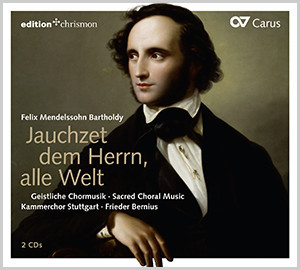

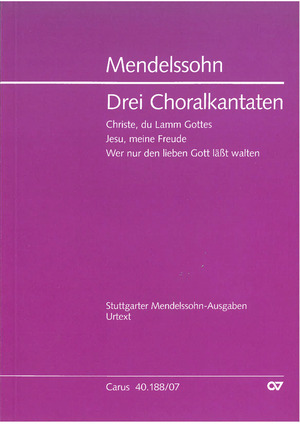
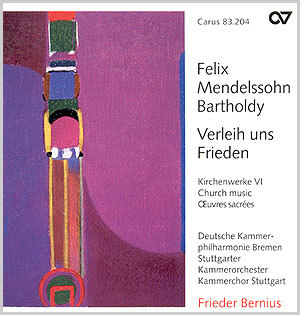
Le travail intensif de Mendelssohn sur l’œuvre de Bach l’a amené à composer quelques cantates basées sur des chorals. Dans la cantate "Wer nur den lieben Gott lässt walten", c’est surtout le deuxième mouvement qui présente des difficultés pour le chœur : le cantus firmus se trouve à la basse, le socle habituel fait donc défaut par endroits et les autres voix doivent être d’autant plus sûres d’elles. En outre, le mouvement est morcelé et requiert souplesse d’esprit et anticipation pour chanter – assurance et bonne maîtrise de sa partie sont donc indispensables.
Il suffit de s'exercer. Partout. A tout moment.
Que ce soit à la maison sur votre tablette ou votre PC ou en déplacement sur votre smartphone : avec carus music, the Choir Coach, vous avez toujours vos œuvres chorales avec vous pour vous entraîner ! Avec l'application chorale de carus music, vous pouvez écouter votre partition ainsi qu'un enregistrement de première qualité sur n'importe quel appareil et vous entraîner facilement à votre propre partie de chœur avec un coach. Avec carus music, la préparation de vos concerts est facile, efficace et amusante à maîtriser !
Interprètes: Sabine Ritterbusch (soprano) – Kammerchor Stuttgart, Stuttgarter Kammerorchester – Frieder Bernius
Découvrir
 Ecouter
(4)
Ecouter
(4)
- Choral: Mein Gott, du weißt am allerbesten
- Choral: Wer nur den lieben Gott lässt walten
- Aria: Er kennt die rechten Freudenstunden
- Choral: Sing, bet und geh auf Gottes Wegen
 Compléments
- Acheter des compléments au format téléchargement.
-
 Texte numérique (sans notes), licence d'impression incluse, fichier html, paroles, traduction en anglaisfichier html, paroles, traduction en anglais (Extrait)1. Choral
My God, whose wisdom ever guides me,
2. Choral
in paths of truth and service free,
I seek above all earthly striving,
thy dwelling place eternally.
Thou, only God, my hope I see;
in thee alone my trust will be.
Translation: Robert ScandrettIf thou but suffer God to guide thee,
3. Aria (Soprano)
and hope in him through all thy ways,
he’ll give thee strength, what e’er betide thee,
and bear thee through the evil days.
Who trusts in God’s unchanging love,
builds on the rock that naught can move.He knows the time for joy, and truly,
will send it when he sees it meet;
when he has tried and purged thee duly,
and finds thee free from all deceit.
...
-
Texte numérique (sans notes), licence d'impression incluse, fichier html, paroles, originalfichier html, paroles, original (Extrait)1. Choral
Mein Gott, du weißt am allerbesten
2. Choral
das, was mir gut und nützlich sei.
Hinweg mit allem Menschenwesen,
weg mit dem eigenen Gebäu,
Gib, Herr, dass ich auf dich nur bau
und dir alleine ganz vertrau.Wer nur den lieben Gott lässt walten
3. Arie (Sopran)
und hoffet auf ihn allezeit,
den wird er wunderbar erhalten
in allem Kreuz und Traurigkeit.
Wer Gott, dem Allerhöchsten, traut,
der hat auf keinen Sand gebaut.Er kennt die rechten Freudenstunden,
er weiß wohl, wann es nützlich sei;
wenn er uns nur hat treu erfunden
und merket keine Heuchelei.
So kommt Gott, eh wir’s uns versehn,
...
-
Texte numérique (sans notes), licence d'impression incluse, fichier html, Texte introductif, françaisfichier html, Texte introductif, français (Extrait)Texte du livret du CD Carus 83.204
Barbara Mohn
Traduction (abrégée) : Jean Paul Ménière« [...] Si quelque ressemblance existe avec Seb. Bach, je n’y suis à nouveau pour rien, car j’ai écrit comme je me sentais, et si je me suis senti une fois, mot pour mot, comme le vieux Bach, il n’en est que mieux pour moi [...]. » C’est ce qu’écrivit Felix Mendelssohn Bartholdy le 15 juillet 1831 à son ami intime, le chanteur Eduard Devrient. Ce dernier, un peu soucieux de l’évolution de son talentueux ami en tant que compositeur, avait remarqué que Mendelssohn, à la fin des années 20, s’orientait de plus en plus vers la musique d’église en se laissant inspirer pour cela par les œuvres du grand Cantor de Saint-Thomas. A une époque décisive de son processus créateur, Mendelssohn n’écrivait pas des opéras ou de grandes œuvres orchestrales grâce auxquelles il eût pu se faire un nom, mais, simplement parce qu’il « se sentait ainsi », des motets et des psaumes, ainsi qu’un ensemble d’œuvres que – comme le disait sa mère
...
-
Texte numérique (sans notes), licence d'impression incluse, fichier html, Texte introductif, en anglaisfichier html, Texte introductif, en anglais (Extrait)Text from the CD Carus 83.204
Barbara Mohn
Translation (abridged): Alan Pope“[...] If it resembles Seb. Bach, I cannot do anything about it, since I have written it according to how I feel and, if I am inspired by the words as Bach was, then it should be all the better for me [...]” wrote Felix Mendelssohn Bartholdy on 15th July 1831 to his close friend, the singer Eduard Devrient. Devrient was observing with some trace of anxiety about the compositional development of his gifted friend that at the end of the 1820s Mendelssohn was devoting himself increasingly to church music and in the process was being inspired by the great Cantor of St. Thomas’ Church Leipzig. In a crucial phase of his creativity, Mendelssohn did not compose operas or great instrumental works, but in accordance with his “feelings” he simply wrote motets and psalms as well as a group of works, which, as his mother complained, “no one would get to hear” – eight cantatas
...
-
Texte numérique (sans notes), licence d'impression incluse, fichier html, Texte introductif, en allemandfichier html, Texte introductif, en allemand (Extrait)Booklet-Text der CD Carus 83.204
Barbara Mohn
„[...] Hat es Ähnlichkeit mit Seb. Bach, so kann ich wieder nichts dafür, denn ich habe es so geschrieben, wie mir zu Muthe war, und wenn mir einmal bei den Worten so zu Muthe geworden ist, wie dem alten Bach, so soll es mir nur umso lieber sein [...]“, schrieb Felix Mendelssohn Bartholdy am 15. Juli 1831 an seinen engen Freund, den Sänger Eduard Devrient. Mit einem Anflug von Sorge um die kompositorische Fortentwicklung seines begabten Freundes hatte dieser beobachtet, was wohl keinem verborgen bleiben konnte: dass sich Mendelssohn Ende der 1820er Jahre zunehmend der Kirchenmusik zuwandte und sich dabei vom Werk des großen Thomaskantors inspirieren ließ. In einer entscheidenden Phase seines Schaffens, in den Jahren 1827 bis 1832, komponierte Mendelssohn nicht Opern oder große Instrumentalwerke, mit denen er sich einen Namen hätte machen können, sondern, einfach
...
Acheter
Informations complémentaires sur l'œuvre
Sommaire

-
Compositeur
Felix Mendelssohn Bartholdy
| 1809-1847Felix Mendelssohn Bartholdy (1809-1847) compte parmi les compositeurs les plus importants du romantisme musical. Son œuvre allie la clarté formelle du classicisme viennois à la puissance expressive propre au XIXe siècle. Son étude de la musique de Jean-Sébastien Bach a eu une influence particulièrement marquante ; il a d’ailleurs largement contribué à la redécouverte de cette œuvre en organisant l’exécution de la Passion selon saint Matthieu en 1829.
Parmi ses compositions vocales les plus célèbres figurent ses deux oratorios, Paul et Élie, ainsi que sa cantate chorale « Verleih uns Frieden gnädiglich ». Par ailleurs, Mendelssohn a exercé les fonctions de chef d’orchestre, de pianiste et de pédagogue musical, et a contribué de manière significative à la professionnalisation du monde des concerts ainsi qu’au développement du Conservatoire de Leipzig. Son œuvre occupe une place centrale dans l’histoire de la musique du XIXe siècle et allie le respect de la tradition à l’esthétique sonore romantique.
Plus d'information sur la personne
-
Parolier/Librettiste
Johann Georg Neumark
| 1621-1681
-
Chœur
Kammerchor Stuttgart
The Kammerchor Stuttgart is regarded as one of the best ensembles of its kind. Over its fifty-year existence, Frieder Bernius has developed the choir into an exceptional ensemble acclaimed by audiences and press alike. This has led to invitations for the choir to perform at all the important European festivals. In Germany the chamber choir performs at festivals and in concert halls in repertoire ranging from the 17th to the 21st century. Frieder Bernius and his ensemble have received numerous accolades for their contribution to new music. The Kammerchor Stuttgart has made over 80 CDs and LPs, numerous of which have been awarded international recording prizes (including the Edison award, Diapason d’or, Gramophone Choice, Classical Internet Award, International Classical Music Award, and German Record Critics’ Award prizes). The International Federation for Choral Music has invited the ensemble to sing at the 1st, 4th and 10th World Symposia on Choral Music in Vienna, Sydney and Seoul. Regular tours of North America and Asia since 1988 and a South America tour reflect the Kammerchor Stuttgart’s international reputation. Since 1984 the top ensemble has also been invited to Israel biennially. Plus d'information sur la personne
-
Ensemble
Stuttgarter Kammerorchester
Founded in 1945, the Stuttgarter Kammerorchester is the oldest and most renowned ensemble of its kind and for over 65 years it has occupied an outstanding position in international orchestra culture. Michael Hofstetter has been the conductor of this ensemble since September 2006. The orchestra had already earned its excellent reputation under its founder and long-time director, Karl Münchinger. Through a completely new and exemplary style of interpretation of the works of Johann Sebastian Bach the Stuttgarter Kammerorchester became a pathfinder in the field of historical performance practice. Dennis Russell Davies, its principal conductor, from 1995 to 2006, expanded the repertoire of the orchestral, especially with works from 20th century. In 2008 the orchestra was awarded the European Chamber Music Award by the European Foundation for Culture. Plus d'information sur la personne
-
Chef d'orchestre
Frieder Bernius
| 1947Le travail de Frieder Bernius jouit d’une grande reconnaissance à l’échelle mondiale. Il est très sollicité à l’international, tant comme chef d’orchestre que comme professeur. Ses partenaires artistiques sont principalement le Chœur de chambre de Stuttgart, l’Orchestre baroque de Stuttgart, la Hofkapelle de Stuttgart et la Philharmonie classique de Stuttgart. C’est en 1968, avec la création du Chœur de chambre de Stuttgart, qu’il a posé les bases de sa carrière exceptionnelle, qu’il a rapidement fait de cet ensemble l’un des plus éminents de son genre. Qu’il s’agisse d’œuvres vocales de Monteverdi, Bach, Haendel, Mozart, Beethoven, Fauré et Ligeti, de musiques de théâtre de Mendelssohn ou de symphonies de Haydn, Burgmüller et Schubert, le travail de Frieder Bernius vise toujours un son à la fois fidèle à l’idéal sonore original et d’une personnalité incomparable. Il se consacre aussi bien à la redécouverte d’opéras du XVIIIe siècle qu’aux créations de compositions contemporaines. Il porte un intérêt particulier à l’histoire de la musique du sud-ouest de l’Allemagne. Le travail de Frieder Bernius est largement documenté sur disques et CD sous le label Carus. De nombreux enregistrements ont été récompensés par des prix internationaux. Dans le cadre du Festival choral allemand de Stuttgart, Frieder Bernius s’est vu décerner un CD d’or par les éditions Carus pour son intégrale de la musique vocale sacrée de Felix Mendelssohn Bartholdy. Plus d'information sur la personne
-
Solist - soprano
Sabine Ritterbusch
Les évaluations sur notre site web ne peuvent être effectuées que par des clients disposant d'un compte d'utilisateur enregistré. Il n'est pas vérifié si les produits évalués ont été effectivement achetés.
Aucune évaluation disponible pour ce produit.
Questions fréquentes sur l'œuvre
 Il n'y a pas encore de questions et réponses concernant cette œuvre ou vous n'avez pas trouvé la réponse à votre question sur l'œuvre ? Cliquez ici et envoyez votre question spécifique à notre service clients.