

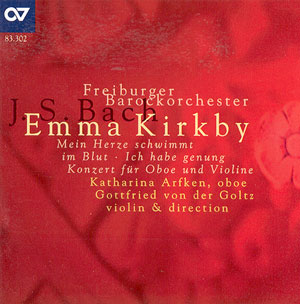
Solo Cantatas and Concerto for Oboe
"... quelles couleurs et quelle implication émotionnelle de la part de Emma Kirkby ! L'Orchestre baroque de Freiburg y participe par son interprétation fine et sensible." Fono Forum 3/00
Récompensé par le Gramophone - Editor's Choice
 Ecouter
(10)
Ecouter
(10)
- Aria: Stumme Seufzer, stille Klagen
- Aria: Tief gebückt und voller Reue
- Choral: Ich, dein betrübtes Kind
- Aria: Wie freudig ist mein Herz
- Allegro
- Adagio
- Allegro
- Aria
- Aria: Schlummert ein, ihr matten Augen
- Aria: Ich freue mich auf meinen Tod
Sommaire


-
Compositeur
Johann Sebastian Bach
| 1685-1750Jean-Sébastien Bach compte parmi les compositeurs les plus importants de l'histoire de la musique occidentale. Il était issu d'une dynastie de musiciens très ramifiée, qui a donné naissance à de nombreux musiciens municipaux et organistes dans la région de Thuringe et de Saxe.
Bach vocal
Depuis la création des éditions Carus, l’édition des œuvres de Jean-Sébastien Bach constitue pour nous une priorité particulière. À l’occasion de l’année commémorative de la Réforme, nous avons achevé le projet « Bach vocal ». La musique vocale sacrée de Bach est désormais disponible dans son intégralité sous forme d’éditions modernes « Urtext », accompagnées du matériel d’exécution. Une édition complète de toutes les partitions, présentée dans un coffret de grande qualité, est également disponible. Traduit avec DeepL.com (version gratuite)
Plus d'information sur la personne
-
L'auteur de l'avant-propos
Peter Wollny
| 1961
-
Ensemble
Freiburger Barockorchester
Orchestre de l'année 2007 (Opernwelt) Plus d'information sur la personne
-
Chef d'orchestre
Gottfried von der Goltz
Gottfried von der Goltz has made a respected international name for himself as a Baroque violinist and Artistic Director of the Freiburger Barockorchester. As was common during the 18th century, he leads the FBO from the platform of the concertmaster. He also occasionally swaps the violin for the baton as, for example, in the Freiburger Barockorchester’s Beethoven Series which stretched over a period of many years. Gottfried von der Goltz made the specialist world sit up and take notice with successful CD recordings of the regrettably long-forgotten music of the Dresden Baroque and Bach’s sons. Nevertheless, he does not want to restrict himself to being a specialist in a particular repertoire. His diverse discography, ranging from the 17th century to the modern, shows instead that he is a tremendously versatile and flexible musician. In addition to his multi-layered chamber music engagements, Gottfried von der Goltz is Artistic Director of the Norsk Barokkorkesters. As a Professor, he is also a sought after teacher of Baroque and modern violin at the Hochschule für Musik in Freiburg. Plus d'information sur la personne
-
Solist - soprano
Emma Kirkby
| 1949
-
Solist - flûte
Karl Kaiser
Karl Kaiser studied flute, transverse flute and musicology at the music conservatories in Cologne and Münster. He has gone on to perform as a soloist, chamber, and orchestral musician in the field of historically-informed performance practice, and has established himself as an outstanding teacher. He has made numerous CDs. Kaiser has been a member and soloist of the Freiburg Baroque Orchestra for many years, and has been flutist of Camerata Köln for 30 years. Karl Kaiser is a founding member of the orchestra La Stagione Frankfurt, and flutist in the Ardinghello Ensemble for romantic chamber music. He is Professor of Transverse Flute at Frankfurt University of Music and Performing Arts and the Freiburg Musikhochschule. 2010 saw the publication of his book “Basiswissen Barockmusik”, followed by his “Principes de la flûte” on Jacques Hotteterre’s theories at the beginning of 2014. Plus d'information sur la personne
-
Solist - hautbois
Katharina Arfken
Critiques
Two of Bach’s most beautiful cantatas prove ideal for Emma Kirkby’s artistry

Two of Bach’s most beautiful cantatas prove ideal for Emma Kirkby’s artistry
One of the world’s brightest Baroque ensembles performing with one of the world’s most admired Baroque sopranos sounds an enticing proposition, and so it should. What is more, the solo cantatas on otter here are two of Bach’s most moving: ”Ich habe genug”, that serene contemplation of the afterlife; and ”Mein Herze schwimmt im Blut”, a relatively early work with a text which moves from the wallowing self-pity of the sinner to joyful relief in God’s mercy. Each contains music of great humanity and beauty, and each, too, contains an aria of aching breadth and nobility – the justly celebrated ”Schlummert ein” in the case of ”Ich habe genug”, and in ”Mein Herze” the humble but assured supplication of ”Tief gebückt”. This aria alone ought to make the cantata a more familiar one, but there is plenty more to recommend it, including a grief-laden first aria with obbligato oboe, a dignified chorale with obbligato cello, and recitatives whose expressiveness is enhanced by stoical string accompaniment. Both could have been written for Emma Kirkby, who, thrillingly virtuosic though she can be, is perhaps at her best in this kind of long-breathed, melodically sublime music in which sheer beauty of vocal sound counts for so much. Not that technique does not come into it, and Kirkby’s allows her to share vibrato-less long notes and phrases with utter security and, ravishing vocal quality, with only the occasional high note sounding slightly pinched. Above all, however, her intelligence and unfailing attention to text are a lesson to all; in ”Schlummrt ein”, the way her voice subsides almost to nothing, retreating into the orchestral texture at ”fallet sanft” (fall asleep), is entrancing. The support of the Freiburg Baroque Orchestra is total, combining tightness of ensemble with such flexibility and sensitivity to the job of accompaniment that you really feel they ‚playing the words’. The obbligato contributions of flautist Karl Kaiser and oboist Katharina Arfken, furthermore, are outstandingly musical. And if that were not enough, the Freiburgers also give one of the most satisfyingly thoroughbred accounts of the Violin and Oboe Concerto that I have heard. Add a recorded sound which perfectly combines bloom, clarity and internal balance, and you have a CD to treasure.
Lindsay Kemp
Quelle: Gramophone November 2001, S. 4
Johann Sebastian Bach, Kantaten
Mit dieser außerordentlich schönen Einspielung präsentieren die brillante Emma Kirkby und das ihr in nichts nachstehende Freiburger Barockorchester unter Gottfried von der Goltz eine selten gespielte Kantate (BWV 199, entstanden 1713), mit der Bach in seiner Weimarer Zeit musikalisches Neuland betreten hat: Gesteigerte Expressivität und großzügig ausschweifende Melodiephrasen kennzeichnen einen neuartigen Kantatenstil. Die Kantate BWV 82 (1727) wird in dieser Aufnahme erstmals in ihrer späteren Fassung (1731) für Traversflöte und Sopran vorgestellt. Das Concerto BWV 1060 ist lediglich in einer Fassung für zwei Cembali und Orchester überliefert, doch offensichtlich handelt es sich hierbei um eine Bearbeitung eines verschollenen Doppelkonzertes für Oboe und Violine. In jedem Fall lohnt sich die Begegnung mit diesen hörenswerten Meisterwerken.
Quelle: Musica Sacra 5/2000, S. 43
Les évaluations sur notre site web ne peuvent être effectuées que par des clients disposant d'un compte d'utilisateur enregistré. Il n'est pas vérifié si les produits évalués ont été effectivement achetés.
Questions fréquentes sur l'œuvre
 Il n'y a pas encore de questions et réponses concernant cette œuvre ou vous n'avez pas trouvé la réponse à votre question sur l'œuvre ? Cliquez ici et envoyez votre question spécifique à notre service clients.