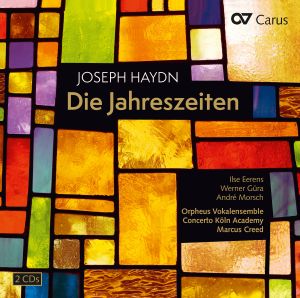


 Ecouter
(40)
Ecouter
(40)
- Einleitung Frühling. Recitativo (STB): Seht, wie der strenge Winter flieht
- Coro: Komm, holder Lenz
- Recitativo (B): Vom Widder strahlet jetzt
- Aria (B): Schon eilet froh der Ackermann
- Recitativo (T): Der Landmann hat sein Werk vollbracht
- Coro: Sei nun gnädig, milder Himmel
- Recitativo (S): Erhört ist unser Flehn
- Coro (STB, Coro): O, wie lieblich ist der Anblick
- Einleitung Sommer. Recitativo (TB): In grauem Schleier rückt heran
- Aria. Recitativo (SB): Der muntre Hirt versammelt nun
- Coro (STB, Coro): Sie steigt herauf, die Sonne
- Recitativo (B): Nun regt und bewegt sich alles umher
- Recitativo (T): Die Mittagssonne brennet jetzt
- Cavatina (T): Dem Druck erlieget die Natur
- Recitativo (S): Willkommen jetzt, o dunkler Hain
- Aria (S): Welche Labung für die Sinne
- Recitativo (STB): O seht! Er steiget in der schwülen Luft
- Coro: Ach! Das Ungewitter naht
- Terzetto con Coro (STB, Coro): Die düstren Wolken trennen sich
- Einleitung Herbst. Recitativo (S): Was durch seine Blüte
- Recitativo (T): Den reichen Vorrat führt er nun
- Terzetto con Coro (STB, Coro): So lohnet die Natur den Fleiß
- Recitativo (STB): Seht, wie zum Haselbusche dort
- Duetto (ST): Ihr Schönen aus der Stadt, kommt her
- Recitativo (B): Nun zeiget das entblößte Feld
- Aria (B): Seht auf die breiten Wiesen hin
- Recitativo (T): Hier treibt ein dichter Kreis
- Coro: Hört, hört das laute Getön
- Recitativo (STB): Am Rebenstocke blinket jetzt
- Coro: Juchhe! Juchhe! Der Wein ist da
- Einleitung Winter. Recitativo. Cavatina (SB): Nun senket sich das blasse Jahr
- Recitativo (T): Gefesselt steht der breite See
- Aria (T): Hier steht der Wandrer nun
- Recitativo (STB): So wie er naht
- Coro (S, Coro): Knurre, schnurre, knurre
- Recitativo (T): Abgesponnen ist der Flachs
- Coro (S, Coro): Ein Mädchen, das auf Ehre hielt
- Recitativo (B): Vom dürren Oste dringt
- Aria (B): Erblicke hier, betörter Mensch
- Coro (STB; Coro): Dann bricht der große Morgen an
 Compléments
-
 Texte numérique (sans notes), licence d'impression incluse, fichier html, Texte introductif, en anglaisfichier html, Texte introductif, en anglais (Extrait)Abridged foreword of the Edition Carus 51.980
Ernst Herttrich
Translation: Gudrun and David KosvinerThe premiere of The Creation on 30 April 1798 at the Palais Schwarzenberg in Vienna was the greatest success Haydn had ever experienced, so it was only natural that he and his librettist Gottfried van Swieten embarked on a new, similar project soon afterwards. When the first public performance of The Creation took place on 19 March 1799, causing a veritable storm of enthusiasm among the so-called “general public,” Haydn was already working on “a new great work after Thomson’s Seasons, which the worthy Privy Councillor Freyherr van Swieten had arranged metrically, and of which he had already completed the first section, Spring.” At any event, this was the announcement in the Allgemeine Musikalische Zeitung (AMZ) published by Breitkopf & Härtel a few days after said performance (24 March 1799). Breitkopf probably received the corresponding information from Georg August Griesinger, who acted as the Viennese liaison between Haydn and the publishing house.
By this time – if one may believe a letter from the Countess Charlotta of Schleswig-Holstein-Gottorf dated 17 March
...
-
Texte numérique (sans notes), licence d'impression incluse, fichier html, Texte introductif, en allemandfichier html, Texte introductif, en allemand (Extrait)Gekürztes Vorwort der Ausgabe Carus 51.980
Ernst Herttrich
Die Uraufführung der Schöpfung am 30. April 1798 im Palais Schwarzenberg in Wien war der größte Erfolg, den Haydn bis dahin erlebt hatte. Es war also nur natürlich, dass er und sein Textdichter Gottfried van Swieten danach rasch ein neues, ähnlich geartetes Projekt in Angriff nahmen. Als am 19. März 1799 die erste öffentliche Aufführung der Schöpfung stattfand und beim sogenannten „großen Publikum“ regelrechte Begeisterungsstürme auslöste, saß Haydn bereits an der Arbeit an „ein[em] neuen grossen Werk, welches der würdige Herr Geheimrath Freyherr van Swieten nach Thomsons Jahreszeiten metrisch bearbeitet, und wovon er bereits die erste Abtheilung, den Frühling, fertig hat“. Das ließ zumindest die bei Breitkopf & Härtel erscheinende Allgemeine Musikalische Zeitung (AMZ) wenige Tage nach besagter Aufführung, am 24. März 1799, verlauten. Den entsprechenden Hinweis dürfte Breitkopf von Georg August Griesinger erhalten haben, der als Wiener Verbindungsmann zwischen Haydn und dem Verlag fungierte.
Wenn man einem Brief der
...
-
Texte numérique (sans notes), licence d'impression incluse, fichier html, paroles, originalfichier html, paroles, original (Extrait)THE SEASONS The Spring 1. Overture · Recitativo
The Overture paints the passage from the winter to the spring.
Simon
Behold where surly winter flies!
Far to the north he passes off.
He calls his ruffian blast,
they soon the forest, hill and vale,
with dreadful roarings quit.Lukas
Behold, from craggy rocks the snows
in livid torrents melted run!Hanne
2. Coro
Forth fly the tepid airs,
and from the southern shores allure
the messenger of spring.Chorus of country people
Come, gentle spring, ethereal mildness, come!
And from her wintry grave bid drowsy nature rise.Women and girls
See, gentle spring delightful comes!
Her soft and balmy breath we feel,
the joy of renovated life.The men
As yet the year is unconfirm’d,
and oft, and oft returning winter’s blast,
or black envenom’d fog the bud
and bloom destroys, the bud and bloom destroys.All
Come, gentle spring, ethereal mildness, come!
And smiling on our plains descend;
O come, gentle spring, o come while music wakes around,
O come, and smiling...
-
Texte numérique (sans notes), licence d'impression incluse, fichier html, paroles, traduction en anglaisfichier html, paroles, traduction en anglais (Extrait)DIE JAHRESZEITEN Der Frühling 1. Einleitung · Recitativo
Die Einleitung stellt den Übergang vom Winter zum Frühling vor
Simon
Seht, wie der strenge Winter flieht!
Zum fernen Pole zieht er hin.
Ihm folgt, auf seinen Ruf,
der wilden Stürme brausend Heer
mit grässlichem Geheul.Lukas
Seht, wie vom schroffen Fels der Schnee
in trüben Strömen sich ergießt!Hanne
2. Coro
Seht, wie vom Süden her,
durch laue Winde sanft gelockt,
der Frühlingsbote streicht!Chor des Landvolks
Komm, holder Lenz!
Des Himmels Gabe, komm!
Aus ihrem Todesschlaf
erwecke die Natur.Weiber und Mädchen
Er nahet sich, der holde Lenz.
Schon fühlen wir den linden Hauch;
bald lebet alles wieder auf.Die Männer
Frohlocket ja nicht allzufrüh!
Oft schleicht in Nebel eingehüllt,
der Winter noch zurück und streut
auf Blüt und Keim sein starres Gift.Alle
Komm, holder Lenz!
Des Himmels Gabe, komm!
Auf unsre Fluren senke dich!
Komm, holder Lenz, o komm,...
-
Compositeur
Joseph Haydn
| 1732-1809En tant que maître de chapelle du prince Esterházy, Haydn a créé, outre de nombreuses musiques instrumentales et divers opéras, d'importantes contributions à la musique sacrée, entre autres les quatorze messes en latin, dont seules douze sont authentiques ou achevées, des motets et des offertoires, deux importantes mises en musique du Te Deum, deux Salve Regina, un Stabat Mater ainsi que les différentes versions des Sept Paroles du Sauveur sur la croix. A l'exception des années 1783-1795, les messes ont été composées de manière continue entre 1749 et 1802 et constituent ainsi le genre auquel Haydn s'est consacré le plus longtemps. Les six messes (authentiques ou complètes) composées jusqu'en 1782 sont de styles très différents ; à côté de courtes Missae breves, on trouve également des messes étendues avec un riche effectif orchestral ; en revanche, les six messes dites tardives, composées à partir de 1796, forment un groupe relativement homogène d'œuvres à grand effectif et de grande envergure. Avec ses deux grands oratorios La Création (1798) et Les Saisons (1801), Haydn fonde la tradition de l'oratorio bourgeois allemand. Plus d'information sur la personne
-
Chœur
Orpheus Vokalensemble
L'Orpheus Vokalensemble a été créé en 2005 comme chœur de chambre professionnel de l'Académie musicale du land de Bade-Wurtemberg. Il est de distribution internationale et exige les plus hautes compétences vocales de la part de ses membres. Des chefs de chœur de renommée internationale sont invités pour les phrases de travail. Ils marquent durablement de leur empreinte la qualité artistique de l'ensemble. Le modèle est ici le légendaire Orpheus Chamber Orchestra (New York), qui a donné son nom à l'ensemble. Le but du travail artistique est, lors de l'étude et de la représentation d'œuvres musicales, de reporter les principes de la musique de chambre – engagement personnel et respect mutuel – sur le travail d'ensemble avec des voix. De plus, les membres ont un droit de décision dans le choix du répertoire, des solistes et des chefs ainsi que des programmes de concert. Plusieurs compositeurs ont déjà écrit des œuvres pour l'Orpheus Vokalensemble, parmi eux Bo Hansson, Knut Nystedt, Gregor Hübner et Jürgen Essl. En 2006, l'ensemble a été invité à participer au Festival international du lac de Constance. D'autres invitations à des festivals célèbres ont été faites. Plus d'information sur la personne
-
Orchestre
Concerto Köln
Soon after it was founded in 1985, Concerto Köln won a firm place in the top rank of orchestras specializing in historical performance practice. From early on, its trade mark was to present musicologically- based interpretations in concerts with a new vitality. And so, Concerto Köln quickly found its way into the leading concert halls and to the major music festivals. Numerous tours have taken the group to North and South America, Southeast Asia, Japan, Israel and most European countries. Concerto Köln has made many recordings for various leading labels and now has a discography of ca. fifty CDs, many of which have won prestigious prizes. The size of the group varies according to program and repertoire. As the ensemble is committed to historical performance practice, it prefers to perform without a conductor. For large-scale productions such as operas and oratorios, Concerto Köln performs with conductors such as René Jacobs, Marcus Creed, Ivor Bolton, David Stern, Daniel Reuss, Pierre Cao and Emmanuelle Haïm. Other artistic partners include notable soloists such as Cecilia Bartoli, Waltraud Meier, Magdalena Kožená, Véronique Gens, Andreas Scholl and Christoph Prégardien, and the actors Bruno Ganz and Ulrich Tukur. Plus d'information sur la personne
-
Chef d'orchestre
Marcus Creed
The conductor Marcus Creed was born and grew up on the south coast of England. He began his studies at King’s College in Cambridge, where he had the opportunity to sing in the famous King’s College Choir. Further studies took him to Christ Church in Oxford and the Guildhall School in London. Marcus Creed moved to Berlin in 1977. Stations in his professional career have been the Deutsche Oper Berlin and the Hochschule der Künste, as well as the Gruppe Neue Musik and the Scharoun Ensemble. From 1987 to 2001, Marcus Creed was artistic director of the RIAS-Kammerchor. In 1998, he accepted a professorship for conducting at the Musikhochschule in Cologne. Marcus Creed has been artistic director of the SWR Vokalensemble Stuttgart since 2003. His particular objective with this ensemble has been to make renewed performances of outstanding compositions from the recent past, including, for example, works by Luigi Nono, György Kurtág, Wolfgang Rihm or Heinz Holliger. Marcus Creed is regularly invited to international festivals for both early music and new music and he regularly collaborates with the Akademie für Alte Musik Berlin, the Freiburger Barockorchester and Concerto Köln. His CD releases have won international awards for their stylistically sure and acoustically sensitive interpretations. Among others, he has been awarded the German Record Critics’ Award, the Edison Award, the Diapason D’Or, the Cannes Classical Award, and the Echo Classic Prize. Plus d'information sur la personne
-
Solist - soprano
Ilse Eerens
-
Solist - ténor
Werner Güra
Werner Güra accomplit ses études au Mozarteum de Salzbourg. Il poursuit sa formation vocale auprès de Kurt Widmer à Bâle et Margreet Honig à Amsterdam. Il a été invité à se produire aux opéras de Francfort, Bâle, Dresde, Paris et Bruxelles. On peut l’entendre régulièrement au Staatsoper de Berlin depuis 1999. En qualité d’interprète de concert et d’oratorio, Werner Güra travaille souvent avec des orchestres et des chefs de renom. Des tournées l’ont conduit plusieurs fois au Japon. Werner Güra est aussi un interprète de lied reconnu, ce qu’attestent des prestations pour des organisateurs de concerts internationaux, ainsi que de nombreux enregistrements récompensés de prix aussi prestigieux que le « Diapason d’or ». Plus d'information sur la personne
-
Solist - basse
André Morsch
Les évaluations sur notre site web ne peuvent être effectuées que par des clients disposant d'un compte d'utilisateur enregistré. Il n'est pas vérifié si les produits évalués ont été effectivement achetés.
Questions fréquentes sur l'œuvre
 Il n'y a pas encore de questions et réponses concernant cette œuvre ou vous n'avez pas trouvé la réponse à votre question sur l'œuvre ? Cliquez ici et envoyez votre question spécifique à notre service clients.