
Homo natus de muliere
nach 1790
"Man that is born of woman hath but a short time to live" is one of the central biblical texts dealing with the transitoriness of human existence. Leopold Hofmann, Kapellmeister at St. Stephen’s Cathedral in Vienna from 1772 to 1793, where W. A. Mozart was his church music assistant, also set this strongly expressive text. Hofmann's setting, in C minor, offers an austere harmony, characterized by suspensions in a homophonic, through-composed four-part vocal setting (soloists or SATB choir), reinforced only by two trombones and organ continuo. Four concise instrumental transitional passages between the individual verses relieve the pathos laden Viennese church style of this composition. With its tragic air, in some passages it closely resembles Mozart's Requiem K. 626. For this first edition, the two trombone parts are available both in the original clef and in alto clef.
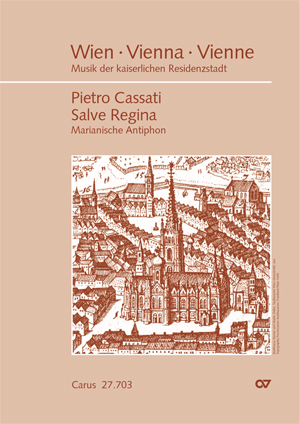
The figured bass has been realized so that the piece can also be performed without trombones, with only organ accompaniment. For a performance this piece could easily be combined with the Salve Regina by Pietro Cassati (Carus 27.703) from the Vienna series.
Découvrir


Acheter
Informations complémentaires sur l'œuvre
-
Compositeur
Leopold Hofmann
| 1738-1793
-
Éditeur
Guido Erdmann
Critiques
Dass herbe, von reichen Dissonanzen durchsetzte, düstere Klangbild des Stückes lässt sofort Assoziationen zu Mozarts Requiem aufkommen. Für einschlägige Zwecke sehr lohnend; Aufführungsdauer wohl etwa vier Minuten.
Gustav Danzinger, CHOR aktuell, März 2016
Über einem in pulsierenden Achtelrepetitionen durchlaufenden Bass errichtet Hofmann einen syllabisch deklamierenden homophonen Chorsatz in herber Klanglichkeit.
Kirchenmusik im Erzbistum Bamberg 12/2015
Les évaluations sur notre site web ne peuvent être effectuées que par des clients disposant d'un compte d'utilisateur enregistré. Il n'est pas vérifié si les produits évalués ont été effectivement achetés.
Aucune évaluation disponible pour ce produit.
Questions fréquentes sur l'œuvre
 Il n'y a pas encore de questions et réponses concernant cette œuvre ou vous n'avez pas trouvé la réponse à votre question sur l'œuvre ? Cliquez ici et envoyez votre question spécifique à notre service clients.