With his six symphonies for organ, written between 1895 and 1930, Louis Vierne carried on the splendid tradition of this genre and brought it to its peak. Vierne's compositional models are clearly discernible: chiefly Franck and Widor (the latter gave him composition lessons), but also Mendelssohn and Schumann. Vierne employs cyclical from in No. 4 as in Symphonies 2,5 and 6. The main thematic material of the whole work is presented in the Prélude.
Découvrir
 Consulter

Acheter
Informations complémentaires sur l'œuvre
-
Compositeur
Louis Vierne
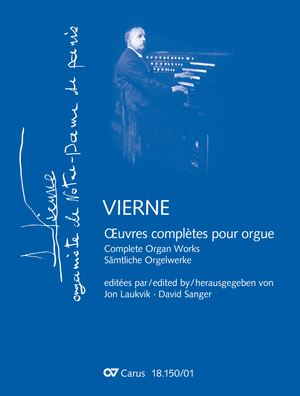
| 1870-1937Louis Vierne, who was from birth practically blind with cataracts, received his first piano instruction at the early age of six. His first moving encounter with the sound of a church organ also dates from this time. From October 1880 he studied with the blind piano teacher, Louis Specht, who taught at the Institution Nationale des Jeunes Aveugles (National Institute for Young Blind People) in Paris. When Vierne first heard César Franck (later his teacher at the Conservatoire for a short time) at the organ of Sainte-Clotilde, it was a profound experience for him: “I was left speechless and went into a kind of ecstasy.” Following the death of César Franck, it was Charles-Marie Widor who continued to further his development as an organist. In 1892 he appointed him as his assistant at the great Cavaillé-Coll organ in Saint-Sulpice. Although he was passed over several times when applying for positions as organist, in May 1900 he was unanimously elected by a prominent jury as organist of Notre Dame Cathedral, a position he held until the day he died. Travelling was a burden to him, but despite this in the 1920s he went on concert tours of Europe, Canada and the USA, where he was acclaimed as a composer and organist. He used these trips to collect contributions for the maintenance and rebuilding of his organ at Notre Dame. On 2 June 1937 Vierne presented an organ concert in Notre Dame together with Maurice Duruflé. As he was about to begin an improvisation he suffered a heart attack from which he died soon after. The funeral service was held in Notre Dame Cathedral on 5 June - his organ remained silent. // Complete Organ Works, see Carus 18.150 Plus d'information sur la personne
Critiques
Untitled Document
Gipfel der Orgelromantik
Unter den vielen Komponisten-Jubilaren des Jahres 2007 befindet sich auch Louis Vierne, der vor siebzig Jahren starb - auf eine Weise, wie sie sich ein leidenschaftlicher Organist nur wünschen kann: Als Vierne am 2. Juni in einem Konzert an der Orgel der Kathedrale NotreDame gerade mit einer Improvisation beginnen wollte - er hatte bereits einen Pedalton angeschlagen-, sackte er tot in sich zusammen, der Ton blieb liegen. Für Organisten sind seine sechs Orgelsinfonien neben den Werken Widors der Gipfel der französischen Orgelromantik. Viernes gesamtes Orgelschaffen wird nun vom Carus-Verlag unter der Herausgeberschaft Jon Laukviks und David Sangers neu ediert. Die Quellenlage ist bei Vierne alles andere als unproblematisch: Seit Jahren zirkulieren unter Organisten Tabellen mit den Fehlern der erhältlichen Ausgaben. Deshalb tut eine kritische Edition not.
Den Anfang der Gesamtausgabe macht die vierte Sinfonie, alle dreizehn Bände sollen bis Januar 2008 vorliegen. Im Falle der Vierten ist das Autograph verschollen, so dass sich die Herausgeber mit dem Erstdruck von 1917 als Vorlage behelfen mussten. Weitere Ausgaben wurden vergleichend hinzugezogen und die Korrekturlisten von David Sanger (1987) und Rollin Smith (1999) bemüht, um zu einem möglichst fehlerfreien Notenbild zu gelangen.
Die Neuausgabe ist gut lesbar und auf schönem, leicht getöntem Papier gedruckt, so dass sie schon deshalb eine Verbesserung gegenüber der noch erhältlichen französischen Edition darstellt.
Quelle: Fono Forum 6/2007, Michael Gassmann
Les évaluations sur notre site web ne peuvent être effectuées que par des clients disposant d'un compte d'utilisateur enregistré. Il n'est pas vérifié si les produits évalués ont été effectivement achetés.
Aucune évaluation disponible pour ce produit.
Questions fréquentes sur l'œuvre
 Il n'y a pas encore de questions et réponses concernant cette œuvre ou vous n'avez pas trouvé la réponse à votre question sur l'œuvre ? Cliquez ici et envoyez votre question spécifique à notre service clients.