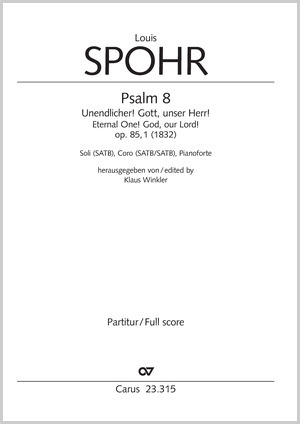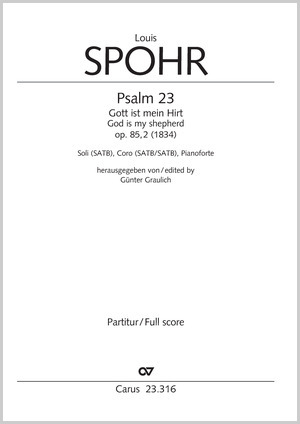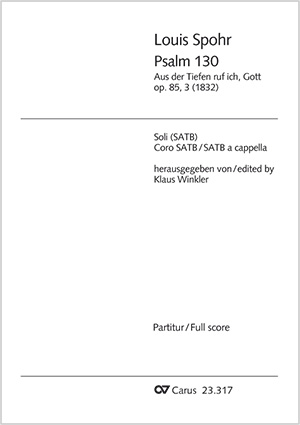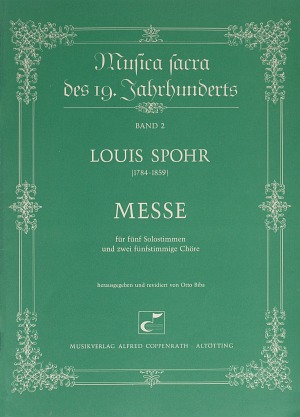
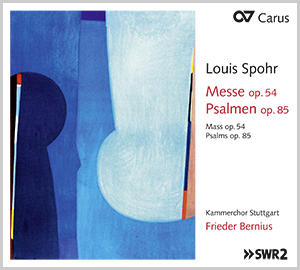
Mass op. 54 & Psalms op. 85
 Ecouter
(10)
Ecouter
(10)
- Psaume 8
- Kyrie
- Gloria
- Psaume 23
- Credo
- Psaume 130
- Sanctus
- Benedictus
- Agnus Dei
- Dona nobis pacem
 Compléments
-
 Texte numérique (sans notes), licence d'impression incluse, fichier html, paroles, traduction en anglaisfichier html, paroles, traduction en anglais (Extrait)
Kyrie Lord, have mercy on us.
Christ, have mercy on us.
Lord, have mercy on us.Gloria Glory be to God on high.
And on earth peace to men of good will.
We praise thee, we bless thee, we adore thee, we glorify thee.
We give thee thanks for thy great glory.
Lord God, heavenly King,
Lord God the almighty Father.
...
-
Texte numérique (sans notes), licence d'impression incluse, fichier html, paroles, originalfichier html, paroles, original (Extrait)
Kyrie Kyrie eleison.
Christe eleison.
Kyrie eleison.Gloria Gloria in excelsis Deo.
Et in terra pax hominibus bonae voluntatis.
Laudamus te, benedicimus te, adoramus te, glorificamus te.
Gratias agimus tibi propter magnam gloriam tuam.
Domine Deus, Rex coelestis,
Domine Deus Pater omnipotens.
...
-
Texte numérique (sans notes), licence d'impression incluse, fichier html, Texte introductif, en anglaisfichier html, Texte introductif, en anglais (Extrait)Text from the CD Carus 83.291
Hartmut Becker
Translation: David KosvinerLouis Spohr wrote his Mass op. 54 between the beginning of April and the end of June 1821, a few months before he began his appointment as court Kapellmeister of the Elector of Hesse and immediately after returning from a concert tour to Paris. In December 1820, Spohr had made the acquaintance of Anton Friedrich Justus Thibaut and his collection of old Italian church music in Heidelberg. This may have provided an external stimulus, but one should take care not to categorize Spohr’s work in a class with the soon to be burgeoning Cecilian Movement: it is quite impossible to reconcile the complicated chromaticism of Spohr’s style with the ideal of “purity” oriented towards Palestrina that Thibaut promulgated in 1825 in his publication “Über Reinheit der Tonkunst [Purity of Music]. The composer was not attempting to
...
-
Texte numérique (sans notes), licence d'impression incluse, fichier html, Texte introductif, en allemandfichier html, Texte introductif, en allemand (Extrait)Booklet-Text der CD Carus 83.291
Hartmut Becker
Louis Spohr schrieb seine Messe op. 54 zwischen Anfang April und Ende Juni 1821, wenige Monate vor Antritt seines Engagements als Hofkapellmeister des Kurfürsten von Hessen und unmittelbar nach Rückkehr von einer Konzertreise nach Paris. Im Dezember 1820 hatte er in Heidelberg Anton Friedrich Justus Thibaut und dessen Sammlung altitalienischer Kirchenmusik kennengelernt. Dies mag äußerer Anstoß zur Komposition gewesen sein, doch muss man sich hüten, Spohrs Werk in eine Reihe mit dem bald aufkommenden Cäcilianismus stellen zu wollen: Mit dem an Palestrina orientierten Ideal von „Reinheit“, in der 1825 erschienenen Schrift Thibauts Über Reinheit der Tonkunst, ist die komplizierte Chromatik des Spohr’schen Stils keinesfalls in Einklang zu bringen. Es ging dem Komponisten nicht um den Versuch einer historistischen Stilkopie, vielmehr verschmelzen in seiner Messe Eigenarten der
...
Sommaire

-
Compositeur
Louis Spohr
| 1784-1859Louis Spohr, né en 1784 à Braunschweig, mort en 1859 à Kassel. Considéré comme l'un des meilleurs violonistes, chefs d'orchestre et compositeurs de son époque. Il a suivi des cours de violon dès l'âge de cinq ans. Déjà violoniste à la chapelle de la cour de Brunswick en 1799, puis premier violon à Gotha ; 1812 - 1815 maître de chapelle à Vienne ; à partir de 1822 maître de chapelle de la cour de Kassel, recommandé par C. M. v. Weber. De longues tournées de concerts l'ont amené à rencontrer, entre autres, N. Paganini. Il a laissé plus de 200 œuvres, dont de nombreux chœurs a cappella. Son oratorio « Die letzten Dinge » (1826) a été très apprécié au 19e siècle. Plus d'information sur la personne
-
L'auteur de l'avant-propos
Hartmut Becker
-
Chœur
Kammerchor Stuttgart
The Kammerchor Stuttgart is regarded as one of the best ensembles of its kind. Over its fifty-year existence, Frieder Bernius has developed the choir into an exceptional ensemble acclaimed by audiences and press alike. This has led to invitations for the choir to perform at all the important European festivals. In Germany the chamber choir performs at festivals and in concert halls in repertoire ranging from the 17th to the 21st century. Frieder Bernius and his ensemble have received numerous accolades for their contribution to new music. The Kammerchor Stuttgart has made over 80 CDs and LPs, numerous of which have been awarded international recording prizes (including the Edison award, Diapason d’or, Gramophone Choice, Classical Internet Award, International Classical Music Award, and German Record Critics’ Award prizes). The International Federation for Choral Music has invited the ensemble to sing at the 1st, 4th and 10th World Symposia on Choral Music in Vienna, Sydney and Seoul. Regular tours of North America and Asia since 1988 and a South America tour reflect the Kammerchor Stuttgart’s international reputation. Since 1984 the top ensemble has also been invited to Israel biennially. Plus d'information sur la personne
-
Chef d'orchestre
Frieder Bernius
| 1947Frieder Bernius’s work has earned great worldwide recognition. He is in demand internationally as a conductor and as a teacher. His principal artistic collaborators are the ensembles he founded himself, the Kammerchor Stuttgart, the Barockorchester Stuttgart, the Hofkapelle Stuttgart and the Klassische Philharmonie Stuttgart. As a guest conductor, he has collaborated repeatedly with, for example, the SWR Vokalensemble Stuttgart, the Deutsche Kammerphilharmonie Bremen, the Stuttgarter Kammerorchester and the Streicherakademie Bozen. Great stylistic versatility is Frieder Bernius’s hallmark. Whether he conducts vocal works by Monteverdi, Bach, Händel, Mozart, Beethoven, Fauré and Ligeti, stage music by Mendelssohn or symphonies by Haydn, Burgmüller and Schubert, his work always aims for a sound that is at once unmistakably personal and at the same time oriented towards the original period sound ideal. He devotes himself equally to the rediscovery of 18th century operas and to first performances of contemporary compositions. He is particularly interested in the musical history of southwestern Germany. Carus-Verlag has awarded Frieder Bernius a Golden CD for his complete recording of the sacred music of Felix Mendelssohn Bartholdy. The award was presented to him during the German Choir Festival in Stuttgart 2016. The sale of over 250,000 recordings, which has been acclaimed with a number of awards, has made a not insignificant contribution to what today is the obvious presence of Mendelssohn's complete œuvre in the concert repertoire. Plus d'information sur la personne
-
Solist - soprano
Maria Bernius
-
Solist - alto
Carolina große Darrelmann
-
Solist - mezzo-soprano
Julia Diefenbach
-
Solist - ténor
Tobias Mäthger
Tenor Tobias Mäthger studied singing, conducting and school music in Dresden and works as a freelance singer, conductor, teacher and church musician. He has already achieved considerable success with a varied concert career both nationally and internationally. He is a member and soloist with the Dresdner Kammerchor, as well as a member of the soloists’ ensemble of the Musik Podium Stuttgart under Frieder Bernius. In addition, he regularly works with leading artists and ensembles including Marc Minkowski, Rafael Frubeck de Burgos, Dresden Staatskapelle, the Dresden Philharmonic Orchestra, Bremer Kammerphilharmonie, Dresdner Kreuzchor, Rheinische Kantorei and many others, as a soloist or as a conductor’s assistant. Plus d'information sur la personne
-
Solist - basse
Felix Rathgeber
-
Solist - basse
Simon Tischler
Critiques
Alles in allem enthält diese 2014 aufgenommene CD wirklich wundervolle Musik in exquisiter Darbietung.
Dietmar Hiller, Forum Kirchenmusik, April 2017
Hier erklingt Chormusik vom Besten in einer wohl nicht zu überbietenden Interpretation. ... ein besseres Plädoyer für diese Werke lässt sich nicht denken.
Johann van Veen, Toccata, März/April 2017
Christoph Heimbucher, Musik & Kirche, März/April 2017
He [Frieder Bernius] continues his superb work here. The sound is also excellent, allowing all of the choral parts to be clearly heard without ever sounding congested ...
David Reynolds, American Record Guide, 21.2.2017
Un disque ... recommandable qui bénéficie du geste alerte du chef allemand, toujours inspiré par cette période du début du romantisme.
Florent Coudeyrat, concertonet.com, 17.02.2017
Bei alledem liefern die Stuttgarter unter Frieder Bernius lupenreine Intonation und einen ausgewogenen Klang, der farblich nuancenreich ist.
Haino Rindler, Chorzeit, Dezember 2016
Dans un tel répertoire, le Chœr de chambre de Stuttgart est quasiment insurpassable.
Yves Kerbiriou, ClicMag, 12/2016
Bernius does wonders with his choir with regard to blending, phrasing, articulation ... dynamic differentiation, a remarkable transparency ... and perfect intonation.
Johann van Veen, MusicWeb International, 02.12.2016
Wieder beweist der Chor, daß er zu den besten Chören überhaupt gehört, weil [...] so klar und rein gesungen wird, [...] daß es einfach ein Hörgenuß ist.
Astrid Belschner, kulturradio.de, 21.09.2016
Les évaluations sur notre site web ne peuvent être effectuées que par des clients disposant d'un compte d'utilisateur enregistré. Il n'est pas vérifié si les produits évalués ont été effectivement achetés.
Questions fréquentes sur l'œuvre
 Il n'y a pas encore de questions et réponses concernant cette œuvre ou vous n'avez pas trouvé la réponse à votre question sur l'œuvre ? Cliquez ici et envoyez votre question spécifique à notre service clients.