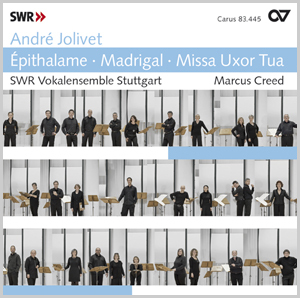
Épithalame · Madrigal · Missa Uxor Tua
Récompensé par le Preis der deutschen Schallplattenkritik
 Ecouter
(13)
Ecouter
(13)
- I. Moderato
- II. Allegretto semplice
- III. Allegro maestoso
- I. Amour, ô mer
- II. Mère de Dieu
- III. L'Aurore
- I. Kyrie
- II. Graduel et Alleluia
- III. Offertoire
- IV. Sanctus
- V. Benedictus
- VI. Agnus Dei
- VII. Dédicace
Sommaire
-
Compositeur
André Jolivet
| 1905-1974
-
L'auteur de l'avant-propos
Harald Hodeige
-
Ensemble
Radio-Sinfonieorchester Stuttgart
-
Ensemble
SWR Vokalensemble Stuttgart
-
Chef d'orchestre
Marcus Creed
The conductor Marcus Creed was born and grew up on the south coast of England. He began his studies at King’s College in Cambridge, where he had the opportunity to sing in the famous King’s College Choir. Further studies took him to Christ Church in Oxford and the Guildhall School in London. Marcus Creed moved to Berlin in 1977. Stations in his professional career have been the Deutsche Oper Berlin and the Hochschule der Künste, as well as the Gruppe Neue Musik and the Scharoun Ensemble. From 1987 to 2001, Marcus Creed was artistic director of the RIAS-Kammerchor. In 1998, he accepted a professorship for conducting at the Musikhochschule in Cologne. Marcus Creed has been artistic director of the SWR Vokalensemble Stuttgart since 2003. His particular objective with this ensemble has been to make renewed performances of outstanding compositions from the recent past, including, for example, works by Luigi Nono, György Kurtág, Wolfgang Rihm or Heinz Holliger. Marcus Creed is regularly invited to international festivals for both early music and new music and he regularly collaborates with the Akademie für Alte Musik Berlin, the Freiburger Barockorchester and Concerto Köln. His CD releases have won international awards for their stylistically sure and acoustically sensitive interpretations. Among others, he has been awarded the German Record Critics’ Award, the Edison Award, the Diapason D’Or, the Cannes Classical Award, and the Echo Classic Prize. Plus d'information sur la personne
Critiques
Jovilet: Madrigal, Missa Uxor Tua

Der Trend in der zeitgenössischen Chormusik geht im ausgehenden 20. Jahrhundert weg von schroffer Spröde zu mehr Klangsinnlichkeit. Davon zeugen die Chorwerke von André Jolivet … [Marcus Creed] setzt – bei aller Dissonanz im Vokalsatz – ganz auf einen verschmelzungsfähigen, weichen Gesamtklang. Das mildert Schärfen, macht diese Musik auch Hörern mit konventionelleren Hörgewohnheiten zugänglich. Dass nichts gesucht klingt, ist ein weiterer Vorzug dieser Aufnahme, die der zeitgenössischen Chormusik alte Freunde erhalten und neue gewinnen kann.
(Michael Klein, Glaube und Heimat - Mitteldeutsche Kirchenzeitung, 4. September 2011)
Described as a “vocal symphony for twelve voices”, Jolivet's Épithalame is an exploration of vocal tone colouring using densely-layered harmonic structures, intricate rhythms and almost death-defying changes of register. Under the expert hand of Marcus Creed, SWR Vokalensemble Stuttgart accomplish this with enviable control and dexterity.
(Shirley Ratcliffe, CHOIR & ORGAN, November/December 2010)
… diese CD [bietet] nicht bloss qualitativ hoch Stehendes, sondern erweitert den persönlichen Kenntnisstand über französische Musik aus der zweiten Hälfte des 20. Jahrhunderts um drei in ihrer Machart eigenwillige, um nicht zu sagen singuläre Werke.
(Christian Albrecht, musik&liturgie, 4/10)
[... Mit dieser CD] erinnert das SWR Vokalensemble Stuttgart unter Marcus Creed nun an einige Chorwerke [von André Jolivet] – und dies auf präzise, lebendige, tiefempfundene Weise.
(Karsten Blüthgen, Neue Chorzeit, November 2010)
Les évaluations sur notre site web ne peuvent être effectuées que par des clients disposant d'un compte d'utilisateur enregistré. Il n'est pas vérifié si les produits évalués ont été effectivement achetés.
Questions fréquentes sur l'œuvre
 Il n'y a pas encore de questions et réponses concernant cette œuvre ou vous n'avez pas trouvé la réponse à votre question sur l'œuvre ? Cliquez ici et envoyez votre question spécifique à notre service clients.